
The Court That Erased a People—Again
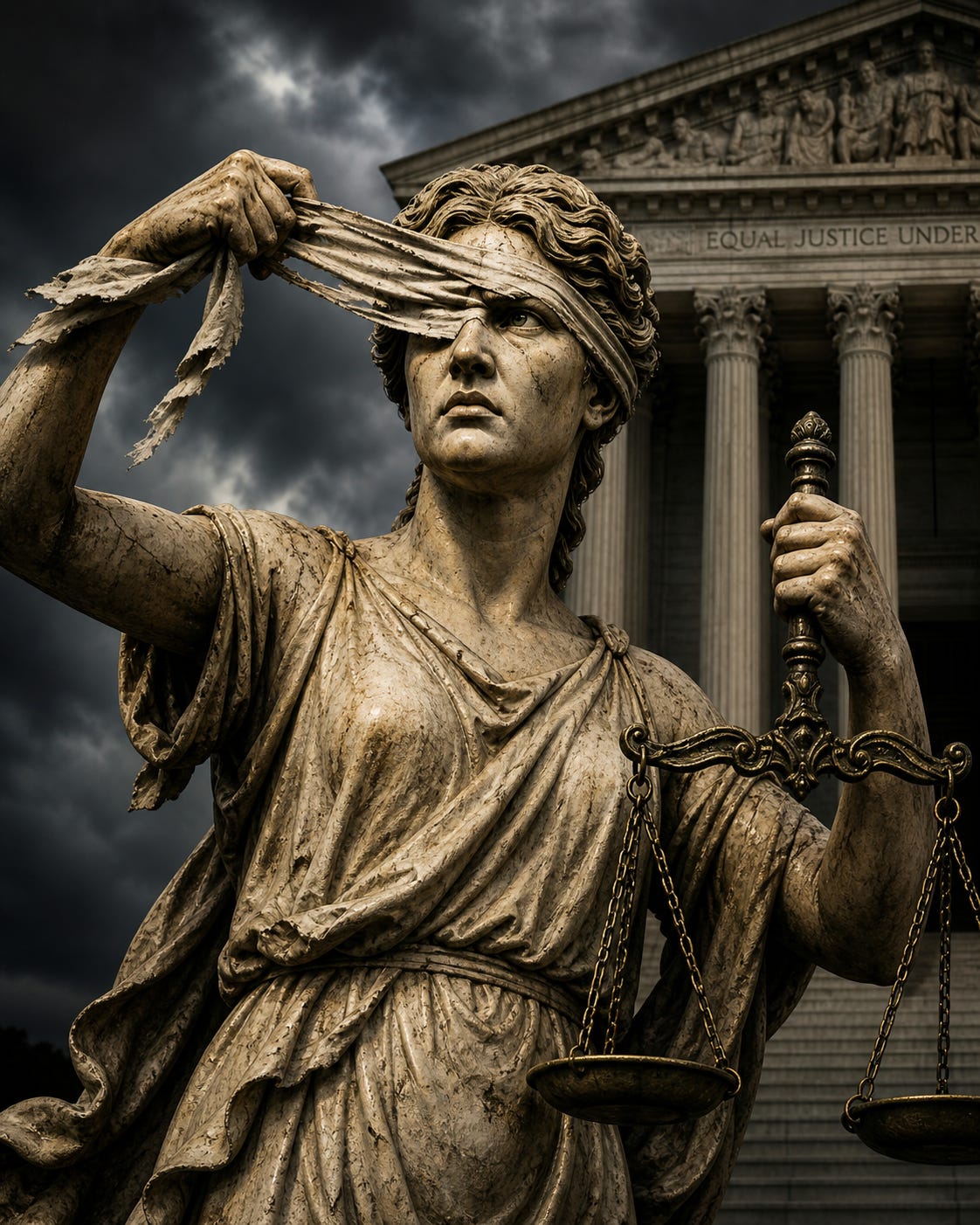
The Supreme Court’s latest voting rights decision echoes its most infamous precedents, effectively removing Black Americans from meaningful political participation in multiple states and raising profound questions about the Court’s democratic legitimacy.
In the aftermath of the Civil War and the disastrous presidency of Andrew Johnson, Congress in 1868 passed the 14th Amendment, which guaranteed birthright citizenship and equal protection under the law. In early 1870, the 15th Amendment, which guaranteed Black males the right to vote, entered into law. The Republican controlled Congress enacted the Civil Rights Act in 1875 as part of reconstruction and to implement the 15th Amendment with the aim of ensuring equal treatment for Black people in America in public accommodation, transportation, and jury service. In the contested election of 1876, Rutherford B. Hayes ultimately was proclaimed the winner over Samuel Tilden. In exchange for being declared the winner, Hayes brought a formal end to Reconstruction by withdrawing the last Federal troops from South Carolina in 1877 and signing the Posse Comitatus Act in 1878. In 1883, a mere eight years after the Civil Rights Act had been made the law of the land, the Supreme Court declared it to be unconstitutional, laying the groundwork for the even worse “separate but equal” Plessy v. Ferguson decision in 1896. In ignoring the promises of the 14th and 15th Amendments, these two decisions by the Supreme Court provided a firm legal basis for Jim Crow and its attendant horrors across the former Slave States. Black people “were disappeared” from political life for decades.
Frederick Douglass was appropriately outraged by the Supreme Court’s decision to exclude Black people from the civil rights guaranteed by the Constitution of the United States. As he observed, “the Supreme Court of the United States is the autocratic point in our National Government. No monarch in Europe has a power more absolute over the laws, lives, and liberties of his people, than the Court has over our laws, lives, and liberties.” In noting Roger Taney’s Dred Scott decision, he lamented “O for a Supreme Court of the United States which shall be as true to the claims of humanity, as the Supreme Court formerly was to the demands of slavery! When that day comes, as come it will, a Civil Rights Bill will not be declared unconstitutional and void, in utter and flagrant disregard of the objects and intentions of the National legislature by which it was enacted, and of the rights plainly secured by the Constitution.”
Douglass’ vision did come true with the passage of the Voting Rights Act in 1965 and its reaffirmation by Congress in 1982. Then on April 29, 2026, Douglass’ lament replaced his vision. After gunning for the Voting Rights Act for decades, John Roberts and his Majority did what his spiritual predecessors did in 1883: they have “disappeared” Black people from political life in at least Louisiana, Alabama, Florida, Tennessee, and Mississippi. They may succeed in other states with substantial Black populations such as North Carolina and South Carolina as well.
As the “autocratic point in our National Government”, the Court can use its unique position to be the defender of Constitutional rights against aggressive state action, or it can turn itself into a super-legislature, in which its policy views overwhelm the democratic institutions charged with making laws. The Justices can put their collective thumb on the political process, aiding the political and economic interests of the party that nominated them to the Supreme Court under the guise of merely “calling balls and strikes”. The Court, which is composed of nine unelected justices with life tenure, still maintains the power that Frederick Douglass described over a century and a half ago. It can support democratic principles and uphold the Constitution, to include the post-Civil War amendments, or it can contribute to democracy’s demise by enhancing, if not entrenching, one party rule.
Given its open hostility to minority rights and, in Louisiana v. Callais, turning the rationale that underscores the post-Civil War Amendments on its head, the Court has achieved a long term goal of the Chief Justice and its majority. The result will almost certainly be the disappearance of Black elected representatives from the Deep South, the same outcome that resulted from the 1883 decision. To the extent the Roberts Majority has any legitimacy after its romp through established precedent and unprecedented use of the Shadow Docket, the use of its power to overturn one of the most important pieces of civil rights legislation in the nation’s history drains its legitimacy reserves down to near zero.
America has struggled with slavery and race since slaves were first brought to the shores of Virginia in 1619. The Civil War, initially fought by the United States to save the Union, ultimately became a war to end slavery. The Civil War clearly did not resolve the question of equal rights for the formerly enslaved. The 14th and 15th Amendments were intended to provide a Constitutional basis for those rights. While America has made great strides as a multi-racial diverse democracy in its 250 years of independence, the Roberts Majority has shown that the struggle for equal rights is never fully won.
James Petrila spent over thirty years as a lawyer in the Intelligence Community, working at the National Security Agency and, for most of his career,at the Central Intelligence Agency. He has taught courses on counterterrorism law and legal issues at the CIA at the George Washington University School of Law. He is currently a senior advisor to the Institute for the Study of States of Exception and is a member of The Steady State.
Founded in 2016, The Steady State is a nonprofit 501(c)(4) organization of more than 400 former senior national security professionals. Our membership includes former officials from the CIA, FBI, Department of State, Department of Defense, and Department of Homeland Security. Drawing on deep expertise across national security disciplines, including intelligence, diplomacy, military affairs, and law, we advocate for constitutional democracy, the rule of law, and the preservation of America’s national security institutions.
Powered by WPeMatico