
From the Chunnel to the Counterterrorism Center
By Russ Travers
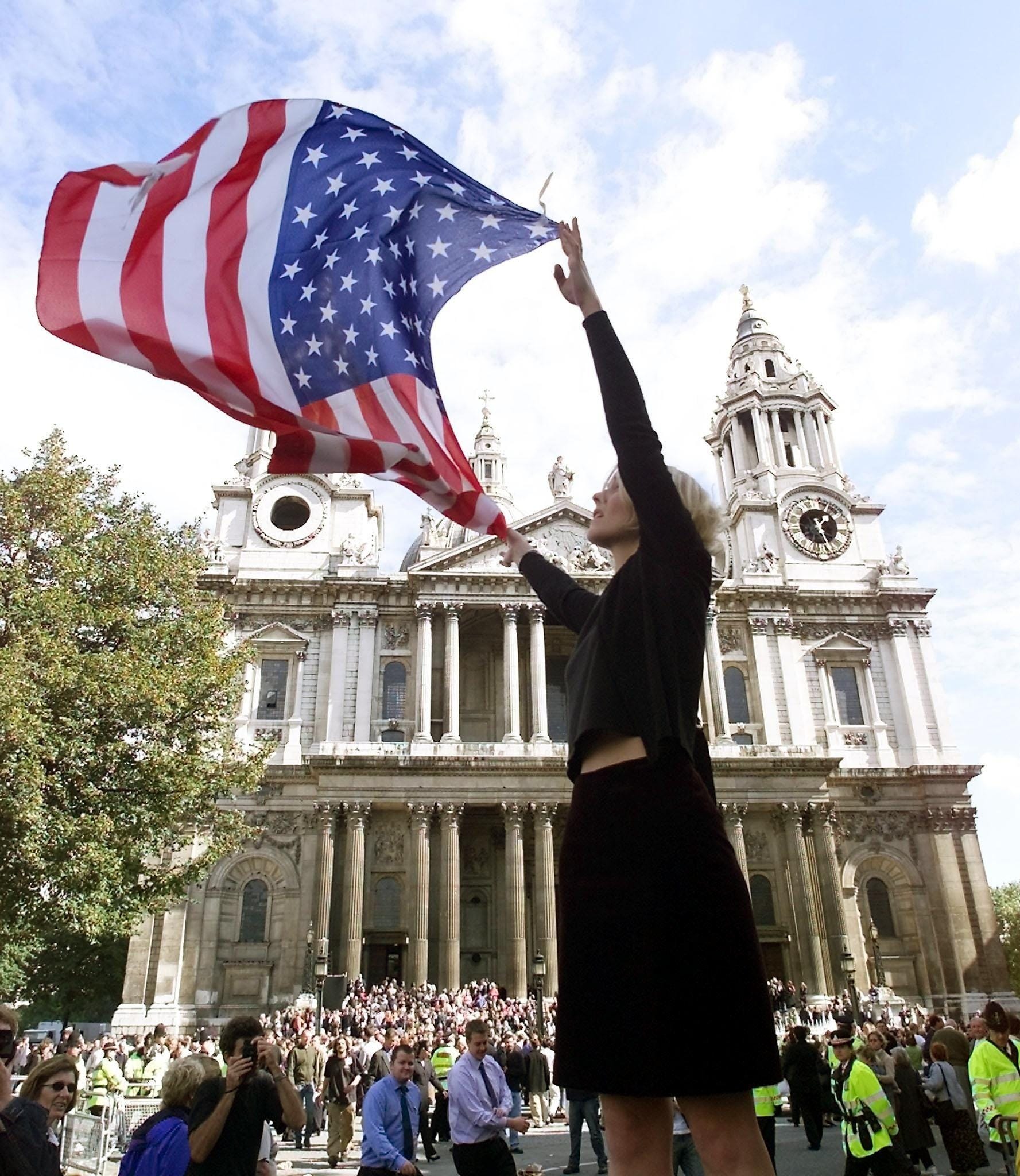
St. Paul’s Cathedral – 9/11 Memorial Service, 2001
On 9/11, I was beneath the English Channel, cut off from the crisis unfolding above. By the time I returned to London, the world had changed—and so had the course of my career.
On September 11th, 2001, I was serving as Chief of the Defense Intelligence (DIA) Liaison Staff in London, attached to British Intelligence. On that crystal-clear, fall-like morning, I caught the Eurostar train at Waterloo Station to Brussels for meetings at the European Union.
In the early afternoon, just before entering the Chunnel, I received a call from my Special Assistant telling me that a plane had struck one of the twin towers; details were sketchy. Shortly thereafter she called again, telling me that a car bomb had gone off outside the State Department – an erroneous report but suggesting we weren’t facing just a tragic accident. Once the train entered the Chunnel, I lost all cell phone coverage, and given the technology of the day, that continued after we resurfaced on the Continent. By the time we pulled into Brussels Midi Station, the Belgian MOD had deployed armored vehicles and armed forces around the station. I caught the first train back to London, arriving at our flat late that night; only then did I see the footage of the planes striking the towers for the first time.
3 days after the attack the UK held a Service of Remembrance with the American Community at St Paul’s Cathedral. The church was surrounded by tens of thousands of British citizens showing their respects and it was only because a very kind Constable escorted me through the mass of humanity that I reached the service. Attended by the Queen, the Royal Family and PM Blair, it was the most moving ceremony I have ever witnessed. Both the Star-Spangled Banner and the Battle Hymn of the Republic rang through the Cathedral. I cried then, and I still do, remembering both DIA colleagues who were lost in the Pentagon and the extraordinary compassion shown by all of Britain.
The Director, DIA called me the following week; he was curtailing my assignment, and I was to report back to the Pentagon as his Deputy Director for Policy Support. What followed was a blur. Packing out a young family and making multiple flights to CONUS to coordinate our return was stressful enough. But doing so in a time of widespread uncertainty and fear was quite another; not knowing what to expect about potential future airline plots, I wrote precautionary goodbye letters to my children.
9/11 would set the path for the next two decades of my career. After a year passed during which the Defense Intelligence Enterprise geared up for the “War on Terror,” I found myself lying in bed in late Jan 2003, drinking a beer, reading the paper and half listening to President Bush’s State of the Union address. My ears perked up when he included a 3-dozen word statement calling for the creation of a “Terrorist Threat Integration Center.” (TTIC) It was a directive to better integrate foreign and domestic information to rectify the shortcomings leading up to 9/11; in the coming days John Brennan would request a team of Seniors from across the IC to staff the Center’s leadership team. A strong believer in the necessity of interagency efforts to address transnational threats, I eagerly volunteered.
When TTIC stood up in May of 2003, the entire organization fit in a conference room at CIA HQ. We had no money, no staff, no independent infrastructure. But we had a leadership team that brought the vision of an “interagency joint venture”, a multi-agency Center that would bring together analysts and data from across the government and that would serve as the first tentative step toward changes for the Intelligence Community akin to that of the Defense Department through the Goldwater Nichols ACT . As as part of that vision, we knew one day the US government would no longer consider terrorism the highest priority threat and the government would need an organization in place for the long term that would focus on the problem around the clock. I believed in that vision then. I still do. We’ve still got work to do.
To be sure, everything did not go smoothly. There were turf battles, and fights over both mission and information access, but armed with a law directing the National Counter Terrorism Center (the TTIC’s successor) as the “primary organization” responsible for analyzing and integrating information about international terrorism, the Center pressed forward, attracting increasingly capable officers, gradually assuming greater capacity and focused on addressing 9/11-related shortfalls. Over the course of the next 17 years, my assignments would revolve between the Center and 3 National Security Council tours, in each case returning to the Center to help advance both the Center’s mission and that of the broader Counter Terrorism Community.
That national effort hasn’t been perfect, but it has done the American people proud. There is absolutely no question that Counterterrorism remains the single best exemplar of an integrated whole-of-government effort against a transnational threat. The fact that over the past 25 years there has been nothing approaching the scale of attack that occurred on 9/11 has not been just luck. Rather, it’s a tribute to the men and women across that entire US government enterprise. It was a privilege to play a small part.
Russ Travers retired after 5 decades in the Intelligence Community. He was twice Acting Director of the National Counterterrorism Center and served three senior-level tours on the National Security Council.
Founded in 2016, The Steady State is a nonprofit 501(c)(4) organization of more than 400 former senior national security professionals. Our membership includes former officials from the CIA, FBI, Department of State, Department of Defense, and Department of Homeland Security. Drawing on deep expertise across national security disciplines, including intelligence, diplomacy, military affairs, and law, we advocate for constitutional democracy, the rule of law, and the preservation of America’s national security institutions.
Powered by WPeMatico