
Hold Fast: Navigating the Ballot -What Voters Should Listen For

What Voters Should Listen For in Candidate Speeches
Campaign speeches are supposed to tell you two things: what a candidate wants to do, and why they are the right person to do it. The “what” is the policy. The important “why” goes beyond résumé, it is the candidate’s reasoning, values, and the story that explains why they’re running. This reveals how they might wield the authority voters hand them. Democracies depend on voters hearing both clearly enough to decide whether they agree.
Too much political speech is built to give you the feeling of an answer without the substance of one. Slogans replace plans. Grievance masquerades as a solution. Applause lines stand in for reasoning. Often, candidates skip past the hard question of how a democracy actually gets things done and reaches for a shortcut: “I can fix it,” or, “the rules don’t apply when the stakes are this high.” Understanding the difference is a skill every voter can build.
The most effective version of that shortcut doesn’t announce itself as a power grab; it disguises itself as common sense. In the 1980s, Margaret Thatcher became famous for saying “There is no alternative,” repeated so often she earned the nickname TINA. It did more than argue Thatcher’s policies were best. It defined disagreement as a refusal to face reality. Be wary of rhetoric declaring that only one solution or one candidate is possible.
On the campaign trail, I learned my résumé earned somewhere between a polite nod and amazement. I could talk about twenty-three years in uniform, rocket science, and public policy. But people leaned in when I explained why I was running: too many Americans had become afraid of what their own government was doing to them. My family had fled unrestrained power and demonization. I spent my career and beyond living an oath to a Constitution designed to restrain power and ensure it served the people. I could not accept fear as the relationship between citizens and their government.
Those answers told voters more than my qualifications did. It revealed what I believed public power was for, and what I would refuse to do with it.
Why it matters to voters
Candidates are often short on time. Thirty seconds in an ad, a few minutes at a forum, five to ten at a party meeting. Even under that pressure, specifics are not optional. A commitment can be tested by voters, reporters, and the next election. “I’ll make life more affordable” cannot be measured because it does not say what will change or how.
But specificity alone is not enough. A promise can be precise, memorable, and impossible.
Donald Trump promised to end birthright citizenship for certain children born in the United States. He signed an executive order, but a president cannot create constitutional authority with a signature. The Supreme Court struck the order down. Trump promised an action he could take while implying it would produce a result he lacked the power to guarantee.
The “why” matters because it tells voters what a candidate will do in the situations no campaign speech anticipated. You don’t elect a list of positions; you choose a candidate whose character defines their actions. A candidate who explains their reasoning is inviting you to hold them to it. A candidate who offers only feelings and enemies is asking you to trust them without accountability.
Red Flags
Platitudes with no mechanism. Big promises – safer streets, a stronger economy – with no word on how.
Enemies instead of solutions. Nearly every answer identifies someone to blame rather than something to build.
Evasion under pressure. When specifics are requested and candidates pivot away or drown the response in slogans.
The candidate as the plan. “Elect me” substitutes for explaining how they’ll work with Congress, courts, state governments, public servants, allies, and the public. No democratic leader governs alone.
A missing or shifting “why.” The candidate’s reason changes with the audience or never becomes clear.
Real answers often sound less impressive than slogans because they concede that governing requires other people, legal authority, and sustained work. Slogans and dodges promise the outcome without the path to reach it.
Ask Questions
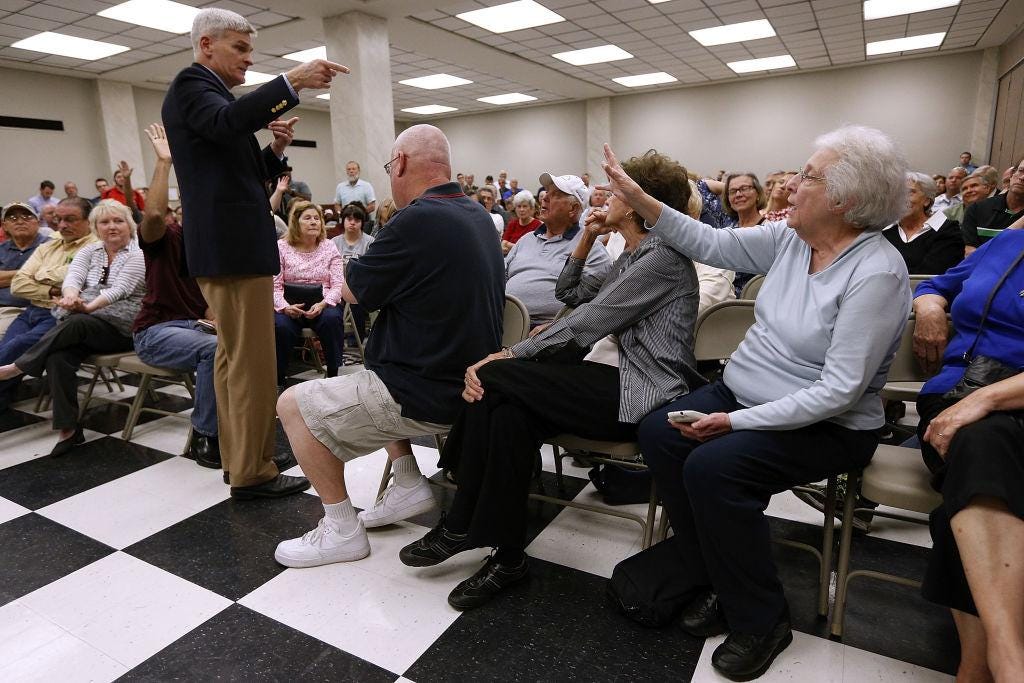
At a town hall or debate, a few questions cut through most obfuscation:
“Walk me through how you’d actually do that — what’s the first step, and who has to agree?” This tests whether a promise has a mechanism.
“Why this? What experience or belief brought you to it?” This asks for the “why” directly. A candidate with a real one will light up. A candidate without one will pivot to a canned talking point.
“What policy position have you changed your mind about, and what evidence or experience changed it?”

Bree Fram is an astronautical engineer and retired U.S. Space Force colonel who served 23 years before being forced out by the Trump administration, including Pentagon assignments in space policy and national security planning. She has published three books and is a former congressional candidate. She is a member of The Steady State.
Founded in 2016, The Steady State is a nonprofit 501(c)(4) organization of more than 400 former senior national security professionals. Our membership includes former officials from the CIA, FBI, Department of State, Department of Defense, and Department of Homeland Security. Drawing on deep expertise across national security disciplines, including intelligence, diplomacy, military affairs, and law, we advocate for constitutional democracy, the rule of law, and the preservation of America’s national security institutions.
Powered by WPeMatico