
ICYMI: Birds, Ducks, and the Surveillance State – A FISA Deep Dive with Former CIA Lawyer James Petrila
The Foreign Intelligence Surveillance Act (FISA) was supposed to balance national security and civil liberties. Then technology changed everything. Birds became ducks. Satellites gave way to fiber optics. And the government found itself collecting communications involving U.S. persons without individualized warrants or routine notice.
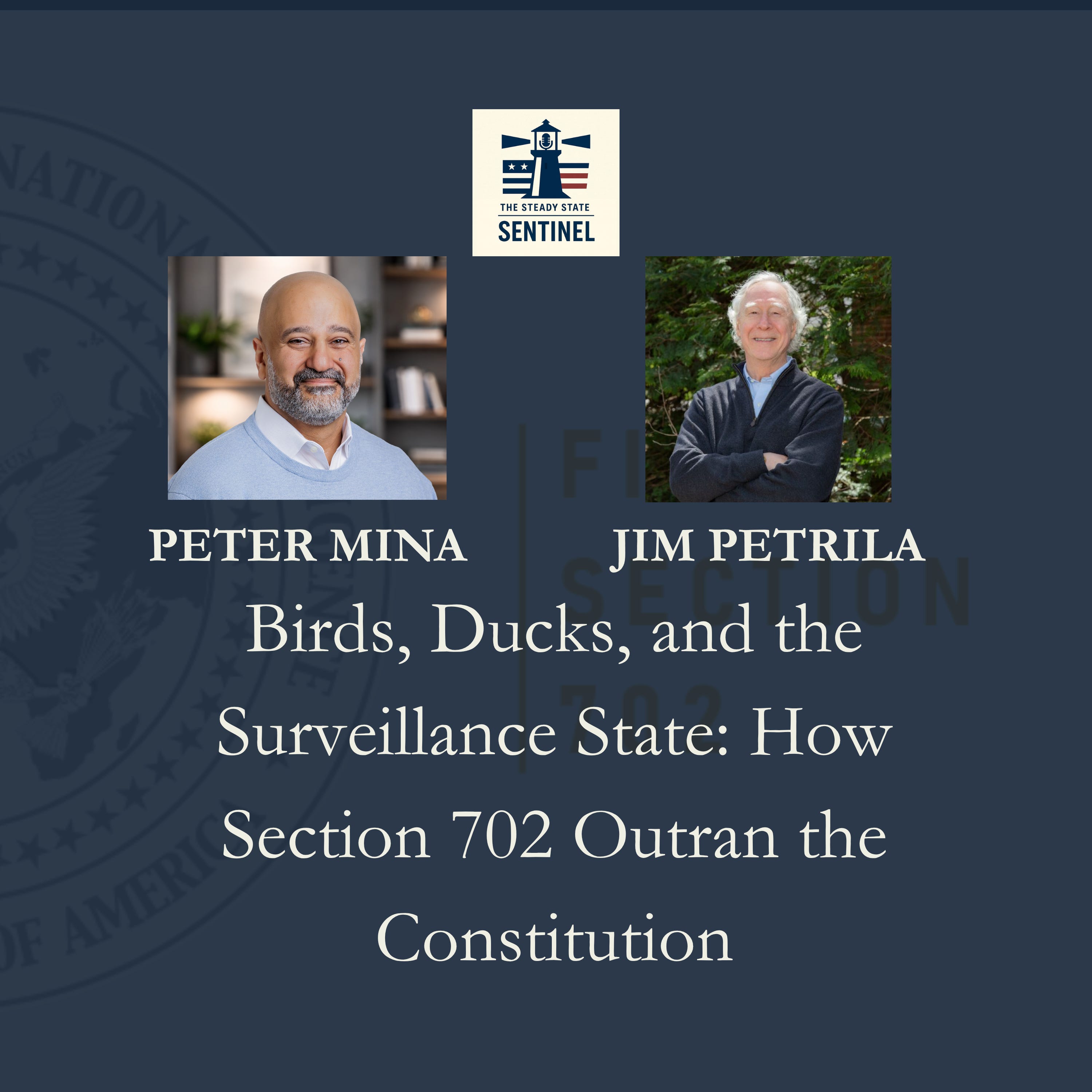
In this episode, former CIA Office of General Counsel attorney, James Petrila, walks host Peter Mina through the history, the controversy, and the quiet erosion of oversight that should worry every American with a smartphone.
The host of this episode, Peter Mina, is an attorney and founder of the Mina Firm and former DHS civil rights official. Guest Jim Petrila served in the CIA’s Office of General Counsel for 25 years and also served as Deputy Legal Advisor at the National Security Council from 2013 to 2015.
Petrila is also the author of The Steady States five-part series “The Ice Gulag-Power, Surveillance, and Fear Undermine Our Democracy,” focusing on the apprehension, detention, and removal of undocumented people, as well as“Tulsi’s Choice,” in which Petrila argues that Tulsi Gabbard must choose between acknowledging likely Russian responsibility for Havana Syndrome attacks or continuing what he describes as a broader pattern of protecting Putin politically. But today’s conversation focuses on Petrila’s true passion: the Foreign Intelligence Surveillance Act (FISA) and its most controversial provision, Section 702.
Here is what you need to know.
A Brief History: From the Keith Case to 9/11
Petrila begins with a story. In the late 1960s and early 1970s, a group of domestic terrorists bombed a CIA office in Ann Arbor, Michigan. After the defendants were arrested, they sought access to the government’s surveillance materials under Title III, the criminal wiretap statute. The government refused, arguing that the information was too sensitive to turn over because it involved national security.
The case became known as United States v. United States District Court for the Eastern District of Michigan, better known as the Keith case (1972). Judge Damon Keith ruled against the government, and the Supreme Court ultimately affirmed the principle that domestic security surveillance could not be conducted solely at the Executive Branch’s discretion without prior judicial approval. Petrila summarized the point this way: “Law enforcement is law enforcement.”
That ruling forced the government to drop the case. More importantly, it helped expose a much larger problem: the Church and Pike Committee investigations revealed that extensive domestic surveillance had been taking place without a clear legal framework. Congress responded by passing FISA in 1978, creating the Foreign Intelligence Surveillance Court, or FISC, and a statutory process for judicial approval of certain foreign intelligence surveillance.
Birds vs. Ducks: The Technology Problem
The original FISA distinguished between wire communications, which generally implicated domestic wire facilities, and radio communications, which in Petrila’s explanation, largely meant satellite communications. The metaphor, borrowed from an FBI official: birds (satellites) are treated differently than ducks (wires).
– If the target was a known person in the United States, or if you were doing a wiretap inside the United States, you needed a FISA warrant or court order regardless of whether the person was a U.S. citizen or a foreign diplomat.
– But for satellite communications, the rules were looser. As long as the target was a non‑U.S. person located overseas, the government could collect even if one end of the communication was in the United States. This allowed the NSA’s International Leased Circuits, or ILC, program to continue.
Then came fiber optics, including TAT‑8, the first transatlantic fiber-optic cable, which went into service in 1988. Over time, more international communications moved away from satellite transmission and onto undersea fiber-optic cables. The bird became a duck. And under the original statute, that meant a warrant requirement kicked in for a huge volume of communications.
“That was the big secret. That was the big sensitivity,” Petrila says. “In order to collect that information, you need the cooperation of the telecommunications company that controls the international gateway facility.”
The Bush Administration’s End Run – and Why It Failed
After 9/11, the intelligence community faced a choice: amend FISA to treat birds and ducks the same, or find another way. The Bush administration chose the latter.
Working through the Office of Legal Counsel (John Yoo and others), they produced a secret legal opinion arguing that the 2001 Authorization for Use of Military Force (AUMF) and Article II of the Constitution gave the president the authority to conduct warrantless surveillance – even though FISA already had a provision for wartime.
“It’s like a triple bank shot that makes as much sense as some of the crap coming out of OLC these days,” Petrila says flatly.
The administration convinced major telecom companies to cooperate based on periodic presidential authorizations. The program was called Stellar Wind.
It worked, until it didn’t. In 2004, before the program was publicly exposed, Jim Comey, then Acting Attorney General because John Ashcroft was hospitalized, rushed to Ashcroft’s hospital bedside amid a dispute over whether the program could be reauthorized. The program was later exposed, lawsuits followed, and the government had wrong-footed itself. Instead of an orderly statutory amendment, Congress had to play catch-up
The result was Section 702 of FISA, enacted in 2008 as part of the FISA Amendments Act..
How Section 702 Works – And Why It’s Controversial
Section 702 allows the government to target non‑U.S. persons reasonably believed to be outside the United States without individualized warrants or probable-cause orders for each target to acquire foreign intelligence information. The FISA Court approves annual certifications as well as targeting, minimization, and querying procedures, and there are internal and external oversight mechanisms.
But there’s a catch: the government inevitably collects incidental information about U.S. persons who communicate with those foreign targets. And under Section 702, there is no general requirement to notify those U.S. persons merely because their communications were incidentally collected or queried. In narrow circumstances, notice may be required if the government intends to use information obtained or derived from Section 702 against someone in a U.S. legal or administrative proceeding.
The real fight, Petrila explains, is over whether the government should need a warrant to query 702 databases using a U.S.-person query term. Should an FBI agent be able to run a U.S.-person identifier through a 702 database without first getting a warrant?
Petrila frames the controversy this way: some critics oppose Section 702 altogether, but the central fight is whether the government should need a warrant before querying a 702 database using a U.S.-person identifier.
Petrila offers a hypothetical: the FBI is tracking a Mexican drug cartel. It identifies a U.S. gun dealer on the border who may be supplying the cartel. Can the FBI query the 702 database using identifiers associated with that U.S.-based gun dealer? The efficiency argument says yes. The civil libertarian argument says no: if there’s probable cause, get a warrant.
The Bigger Elephant: Third‑Party Data Brokers
As important as 702 is, Petrila warns that it may not even be the biggest threat to privacy.
“A greater concern is the use of third‑party data. Anytime you use one of these, you’re sending all kinds of data that’s collected. And we are all the product, right? We’re not the customer. We’re the product. And a lot of that data is collected by third-party data brokers, and they sell it. They can sell it to anybody.”
His point is that 702, as controversial as it is, still operates under a statutory framework: the data is segregated, querying is governed by approved procedures, and the program is subject to auditing and FISA Court oversight By contrast, Petrila suggests that government purchases of commercial data may not be subject to anything comparable. As he puts it, he is “not sure that there are any restrictions on what the government can or can’t do with data that they buy from third-party data brokers.”
“Don’t forget the big elephant in the room,” Petrila says, referring to the vast amount of personal data generated through phones, apps, and online services.
The Trust Problem – and What You Can Do
Peter Mina asks the question that haunts the conversation: how can Americans trust that these systems are being used in good faith, especially when oversight structures have been systematically dismantled?
Petrila’s answer is cautious: the system depends heavily on internal controls, audits, statutory procedures, and the good faith of the agencies with access to 702 databases.. There is no general, proactive mechanism for an individual to find out merely because their information has been queried or used, which leaves U.S. persons facing what Petrila calls “a real dilemma”: whether to trust the targeting procedures, minimization procedures, audits, and agencies themselves.
“If you don’t know it’s there in the first place, what are you going to do about it? You don’t know that people have been following what you’re doing until you show up at the airport and your TSA PreCheck is no longer operable.”
His advice? Get educated. Follow the debates. Petrila recommends following experts like George Croner (who Petrila says knows more about FISA than almost anyone), the Brennan Center (a consistent critic of warrantless U.S.-person queries), and the ACLU to understand the competing arguments over Section 702. He also points people to The Steady State and the Institute for the Study of States of Exception, a new venture founded by former CIA operations officer Ed Bogan that examines how emergency authorizations can be misused and turned into illiberal structures.
One Quote That Stays With You
“You wind up with a real dilemma. Do you trust the targeting procedures? Do you trust the minimization procedures? Do you trust the audits? Do you trust that the FBI, NSA, CIA – whoever else has access – will use that access in good faith?”
— James Petrila
Listen and Watch the full Podcast Here:
Founded in 2016, The Steady State is a nonprofit 501(c)(4) organization of more than 400 former senior national security professionals. Our membership includes former officials from the CIA, FBI, Department of State, Department of Defense, and Department of Homeland Security. Drawing on deep expertise across national security disciplines, including intelligence, diplomacy, military affairs, and law, we advocate for constitutional democracy, the rule of law, and the preservation of America’s national security institutions.
Powered by WPeMatico