
Cui Bono? Trump, Bibi, and the Iran ‘War’
Who benefits? That is always a key question when it comes to war. The current non-war against Iran raises this in spades, given the lack of any consistent goals from the administration. The Atlantic has counted at least 10 different justifications, none of them accompanied by evidence of the imminent threat to American interests that would normally support the massive use of force.
Given this confusion, it is natural to look for something hidden, a ‘real’ reason for which the multiple stated reasons are a smokescreen. There are three that might be in play for President Trump: deflection, repression, and corruption.
Deflection. The first, deflection, is the most commonly cited by American pundits. The war is designed to divert attention from the Epstein files or his dropping poll numbers. Wars commonly pump up patriotic sentiments, unite the people against the enemy, and call forth sacrifice and deference to the country’s leaders.
The way Trump has sold his war, however, doesn’t show that this is a key goal. He didn’t make any effort to rally the public. Polls show his Republican base overwhelmingly supports his decision, not out of enthusiasm but because they reflexively support anything Trump does. Many are unhappy that they voted for fewer overseas interventions and are getting the opposite. The rest of the country is strongly opposed or skeptical.
Repression. A second argument is that wars can be used to justify domestic repression. War, or the threat of it, allows rulers with authoritarian inclinations to restrict speech and assembly, to use force against domestic opponents (“traitors”), to arrest political enemies, to postpone elections, and generally to create an atmosphere of fear that silences opposition. Given Trump’s eagerness to use government power to go after his enemies and his clear interest in manipulating the midterm elections, this is a plausible motive.
Putin’s Russia is a role model that Trump and others in his orbit have long watched for lessons in the use of state power. A study from the European Council on Foreign Relations describes how Putin has used war with Ukraine to mobilize Russians, especially the young, against the West and to inculcate a highly militarized version of Russian patriotism. The war has been cast as part of a civilizational struggle with NATO and the US. It has helped justify a sharp turn to conservative values and a comprehensive crackdown on domestic opposition.
Trump has spent a political lifetime stoking division and grievance. Among his allies, a powerful group identifies as National Conservatives, a movement that dispenses a distorted version of American history that makes white Europeans the only ‘real Americans’ and preaches suspicion of minorities. All this lays the groundwork for a wartime appeal to nativism. Though it is hard to see Trump continuing the current campaign much longer, this is the 2nd major attack on Iran in the past year, and he has laid the groundwork for resuming the ‘war’ whenever he chooses, perhaps to justify special security measures close to the midterms.
Corruption. A third possible interest is to make money and dispense favors. In wartime, government leaders have leeway to act quickly and secretly. They can easily direct contracts to favorites and disguise self-dealing actions as vital to the national interest. Putin’s Russia is an excellent example of how military expenditures help prop up a corrupt ruling class.
Trump’s track record of favoritism and corruption makes this a worrisome outcome. He has largely dismantled the internal government watchdogs who might prevent this, such as Inspectors General. Trump met on March 6 with major defense contractors to demand a “quadrupling” of production to replenish rapidly dwindling stocks, and Trump-aligned tech companies are in line to reap huge rewards. On March 9 it was announced that Trump’s sons are investing in Powerus, a new drone company.
During World War II, Congress played a central role in uncovering corruption. The Senate Special Committee to Investigate the National Defense Program, commonly known as the “Truman Committee” after its chairman, held frequent well-publicized hearings and made Truman a national figure, leading to his selection in 1944 as FDR’s running mate. Needless to say, we can expect no Truman Committees under the current Congress.
Deflection, repression, and corruption are all possible motives and legitimate concerns. Even if they were not Trump’s immediate aims, they could come to the fore if the war goes on longer, with greater costs than Trump initially expected.
The Likely Beneficiary. For another actor in this war, however, deflection, repression, and corruption are much closer to the surface. That is Israeli Prime Minister Benjamin Netanyahu.
How much Israel drove the scope and timing of American actions is, as yet, unclear. We all saw Marco Rubio blurt out, on March 2nd, that the US struck because Israel was about to attack, and we thought we would face Iranian retaliation. This was such a crazy thing to admit that it has the ring of truth. Rubio, who often has the look of a hostage saying things because he has a gun to his head, occasionally says the quiet part out loud, which he then ritually foreswears. For instance, when the initial US 28-point peace plan for Ukraine was trotted out in November, Rubio told Senators (in private) that it really wasn’t our plan at all; we were just cutting and pasting a Russian plan. Which was obviously the case.
Since the Hamas attack in October 2023, Netanyahu has tried to avoid paying the political price for disaster by keeping Israel constantly at war. Before the attack, he was on the ropes and facing corruption charges in Israeli court. Hundreds of thousands were demonstrating for his removal. By fighting virtually nonstop in Gaza, in Lebanon, now in Iran, Netanyahu has been able to postpone elections, avoid investigations, and try to build back his support as a wartime leader. Getting the US to join Israel in overthrowing the Iranian regime, or at least destroying Iran’s military, is a tremendous success that Netanyahu probably judges will guarantee him victory at the polls—and keep him out of jail.
He is also using the war to justify repression. Under Netanyahu, hard-line right-wing forces in Israel have been brought into government and put in charge of Israel’s police. They have been given carte blanche to go after dissidents, expand settlements in the West Bank, and clamp down on the press.
Did Netanyahu force Trump’s hand, as Rubio implies? Maybe. But flattery and cajoling are the more likely avenues. Trump’s former National Security Advisor H.R. McMaster warns that Trump’s narcissism and greed make him a fish-in-the-barrel target for manipulation by foreign actors. There are no people close to him willing to tell him ‘no’. Netanyahu talked frequently with Trump, in person in December and February, to push him to end negotiations and take part in joint action.
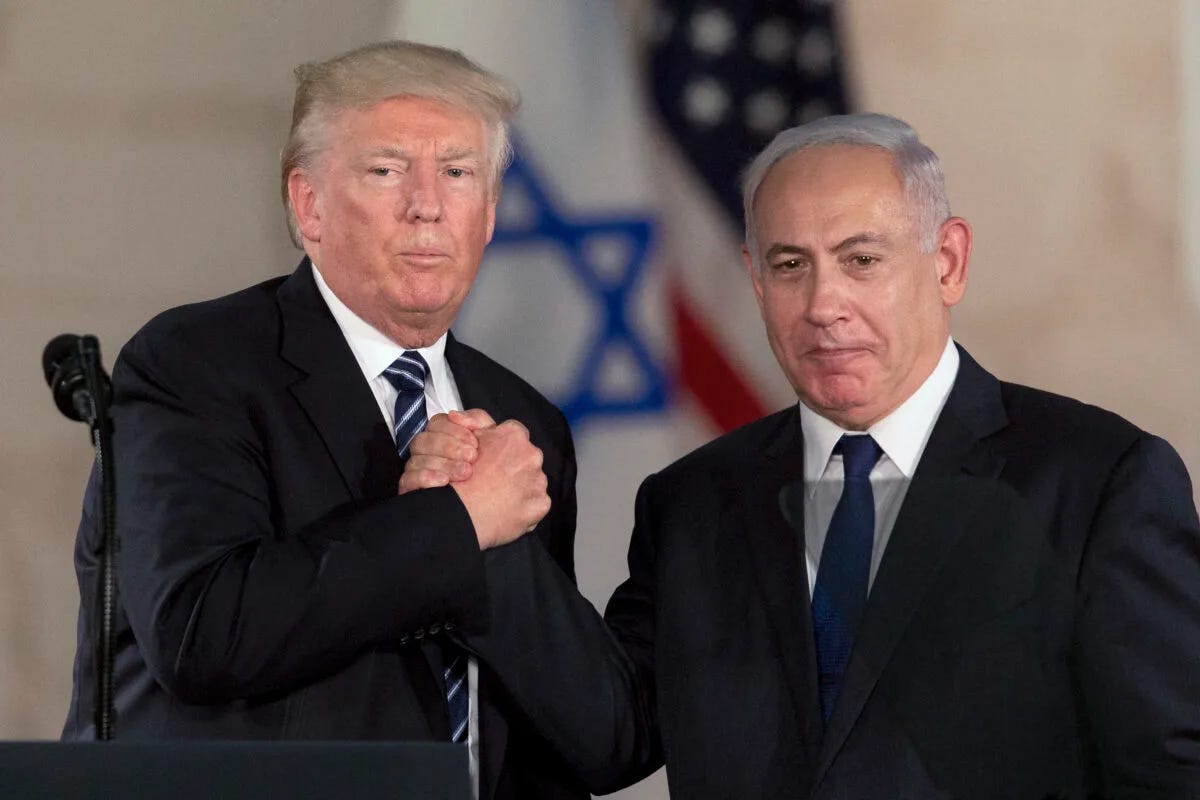
Trump identifies with Netanyahu’s claims of legal persecution and has several times asked Israeli President Herzog to pardon Netanyahu (in advance of a trial!) for his alleged corruption. On March 5, Trump again called for a pardon and said, “Every day I talk to Bibi about the war. I want him to focus on the war and not on the f*CKing court case. I want the only pressure on Bibi to be the fighting against Iran.” Free Bibi!
Explaining how exactly war with Iran benefits the US is hard to do. Explaining how it benefits Benjamin Netanyahu is easy. Cui bono.
Adam Wasserman is a retired CIA analyst with experience on failing democracies in the former Soviet Union, the Middle East, and Southeast Asia. He served on the State Department Policy Planning Staff, the CIA Red Cell, and the National Security Council staff. He is a member of The Steady State.
Founded in 2016, The Steady State is a nonprofit 501(c)(4) organization of more than 390 former senior national security professionals. Our membership includes former officials from the CIA, FBI, Department of State, Department of Defense, and Department of Homeland Security. Drawing on deep expertise across national security disciplines, including intelligence, diplomacy, military affairs, and law, we advocate for constitutional democracy, the rule of law, and the preservation of America’s national security institutions.
Powered by WPeMatico