
It wasn’t meant to be like this
By Steven Cash and Steve W. DeVine
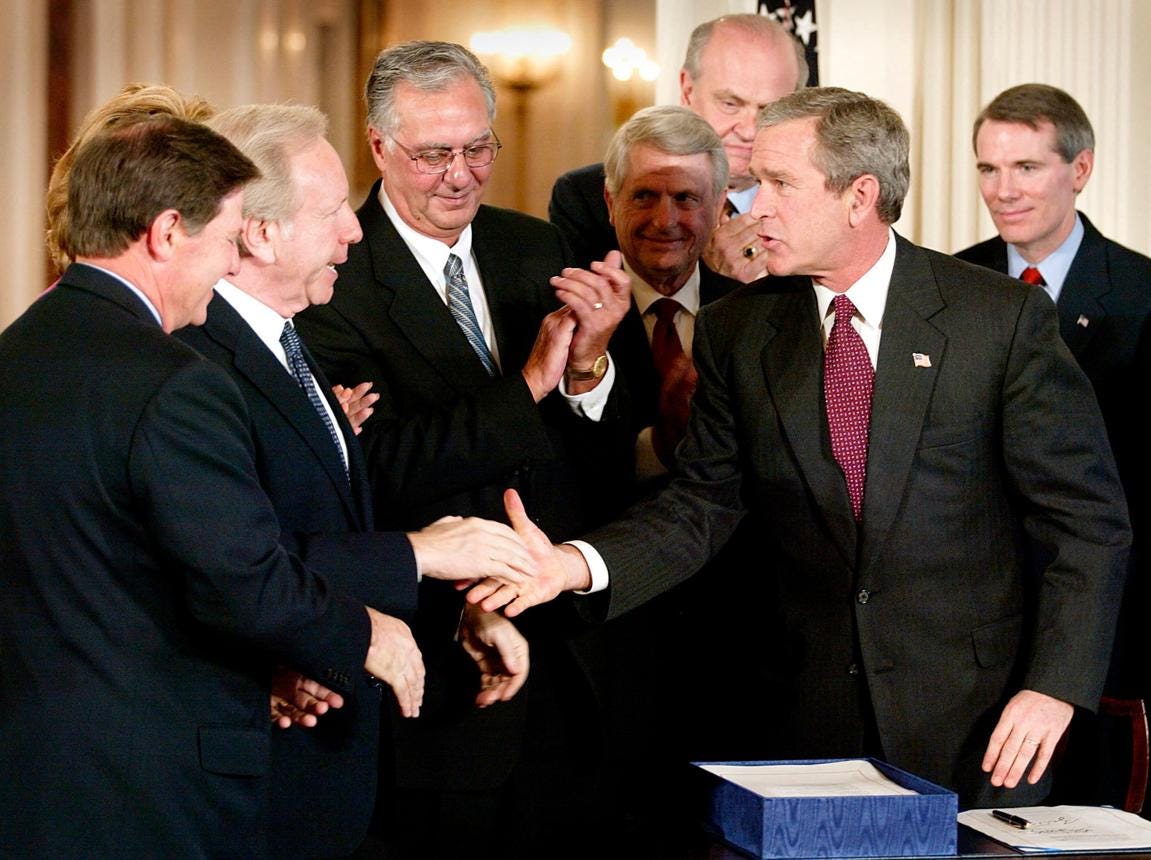
President Bush Signs Homeland Security Act
We responded to 9/11 by building institutions meant to make America safer without surrendering the freedoms we were defending. Twenty-five years later, we’re dismantling pieces of that architecture—and forgetting why we built it.
This month marks the 25th anniversary of the September 11 attacks. In the aftermath, Democrats and Republicans came together to build a coordinated front-line defense against international terrorism — creative, hard-won, good-faith reforms that strengthened the country’s security without sacrificing the freedoms that have long been America’s calling card to an anxious world. Two reforms anchored that effort: the Department of Homeland Security, standing up a unified front line, and the Director of National Intelligence, forcing fractured intelligence and domestic security communities finally to talk. Twenty-five years on, that bipartisan legacy is being dismantled.
Corralling 22 different federal entities into a single Department of Homeland Security was one of the era’s signature bipartisan achievements. It did not emerge full-blown from a flourish of trauma-spawned goodwill. Many doubted the need; many more feared the consequences to Americans’ civil rights and personal freedoms. Still, the pervasively felt need to do something, coupled with the political reality that something significant needed to be seen to be done, carried the day.
That didn’t just happen. President Bush accepted the need for legislation, and Congress recognized the need for sustained and, at points, enhanced independent oversight of the new departmental behemoth. Both branches were involved in equal measure. There was, of course, plenty of infighting, not least among committee chairs who recognized that a new, coordinated congressional oversight committee would inevitably mean a diminution of their own jurisdiction.
The status quo, though, was a picture of institutional chaos, underscoring the dystopian images of the attacks themselves. In the House Select Committee on Homeland Security, what we called a “spaghetti chart” — imagine a complex circuit board on meth — aptly described existing congressional oversight. With members’ wish lists flying from dusty files and patched quickly into massive national security reform legislation, notably the PATRIOT Act — and with a chorus of witnesses, including widowed spouses and grieving parents, urging prompt action — the status quo didn’t stand a chance.
We were fortunate to serve on that Select Committee. Our leadership understood that the 9/11 problem wasn’t a shortage of “guns, guards, and gates.” It was that the key players didn’t have in hand all the information there might have been, and that what they did have hadn’t gotten where it was needed in time to be useful. The 9/11 problem was, in other words, a novel and multi-dimensional intelligence problem. Its solution required, as Director of Central Intelligence George Tenet put it in his initial public testimony to the bicameral congressional investigation into the 9/11 attacks, that “we … move information in ways and to places it has never before had to move” and “make sure our customers get from us exactly what they need – which generally means exactly what they want – fast and free of unnecessary restrictions.” Even so, unprecedented sharing across missions and layers of government entailed real risks to the information itself, its sources, and privacy interests.
Congressional oversight of this new pool of functions, and of public monies, also needed enhancement, coordination, and a considerable infusion of expertise. On the Select Committee, both Chairman Chris Cox and Ranking Member Jim Turner — and later Ranking Member Bennie Thompson — began by engaging experienced intelligence officers in key roles. Two years later, the result — though far from perfect — was a permanent Committee on Homeland Security in the House, paired with enhanced homeland security jurisdiction for the Senate’s Committee on Governmental Affairs. Both were a significant step in the right direction.
The intelligence community got its own overhaul two years later. While there had been a Director of Central Intelligence since 1947, no single official had ever had the authority to force the CIA, the FBI, Defense Department entities, and the rest of the alphabet soup to share what each was sitting on. The Intelligence Reform and Terrorism Prevention Act of 2004 provided an answer by creating the Director of National Intelligence — a position deliberately designed to sit above any one agency and speak for the community as a whole. It passed with a bipartisan margin that’s hard even to imagine today.
That is the system we built: real interbranch coordination, real independent oversight, real expertise brought to bear on a genuinely hard problem. It is also the system now being subjected to reckless disassembly. One flagrantly unqualified Director of National Intelligence has been succeeded by others well short of the statutorily required “extensive national security expertise.” An office built to be above politics has become a reward for political loyalty instead of a preventative and check on potentially catastrophic failure.
Meanwhile, DHS agents – “ICE” – operate as the president’s inland army in masked deployments into American cities where they have shot and killed Americans and non-Americans alike in the name of immigration enforcement. That’s not homeland security. Nor is congressional oversight anything like that of the bipartisan coalition that fought to build coordinated and expert congressional oversight. The majority’s anemic oversight now curates its anemic oversight with care never to challenge a president who flaunts his contempt for fundamental civil rights and basic decency.
We, and the Members who led the Select Committee in its early years, wanted and worked hard for more and better. The American people deserve, and should demand, far better: unmasking ICE and requiring its agents to respect basic constitutional rights, for starters, and a Director of National Intelligence chosen for relevant expertise, as the law requires, rather than blind loyalty, for another. There is no better moment to remember why than the 25th anniversary of the September 11 attacks.
Steven A. Cash served as a prosecutor in the Manhattan District Attorney’s office before joining the CIA in 1994 as Assistant General Counsel and subsequently serving as an intelligence officer in the Directorate of Operations. In 2001 he joined the Senate Select Committee on Intelligence as Counsel and designee-staffer to Senator Diane Feinstein. He later served as Democratic Staff Director of the House Select Committee on Homeland Security in the 108th Congress, and as a senior staffer at the Department of Energy, the Senate Judiciary Subcommittee on Terrorism, Technology and Homeland Security, and the Department of Homeland Security. In the private sector he has advised on national security, counterintelligence, and technology policy and served on the Biological Sciences Experts Group under the Director of National Intelligence. Mr. Cash is currently the Executive Director of The Steady State.
Stephen W. DeVine served as the Deputy Staff Director and General Counsel of the House Select Committee on Homeland Security in the 108th Congress. He also served as Deputy Legal Adviser at the National Security Council in two administrations, as a Senior Advisor to the Chairman of the Securities and Exchange Commission, and as a Counselor at the U.S. Privacy and Civil Liberties Oversight Board, as well as in various roles at the CIA (Senior Intelligence Service), and as a Senior Counsel on the Select Committee to Investigate the January 6 Attack on the U.S. Capitol. He has taught and practiced law. He is a member of The Steady State.
Powered by WPeMatico