
Not So Fast
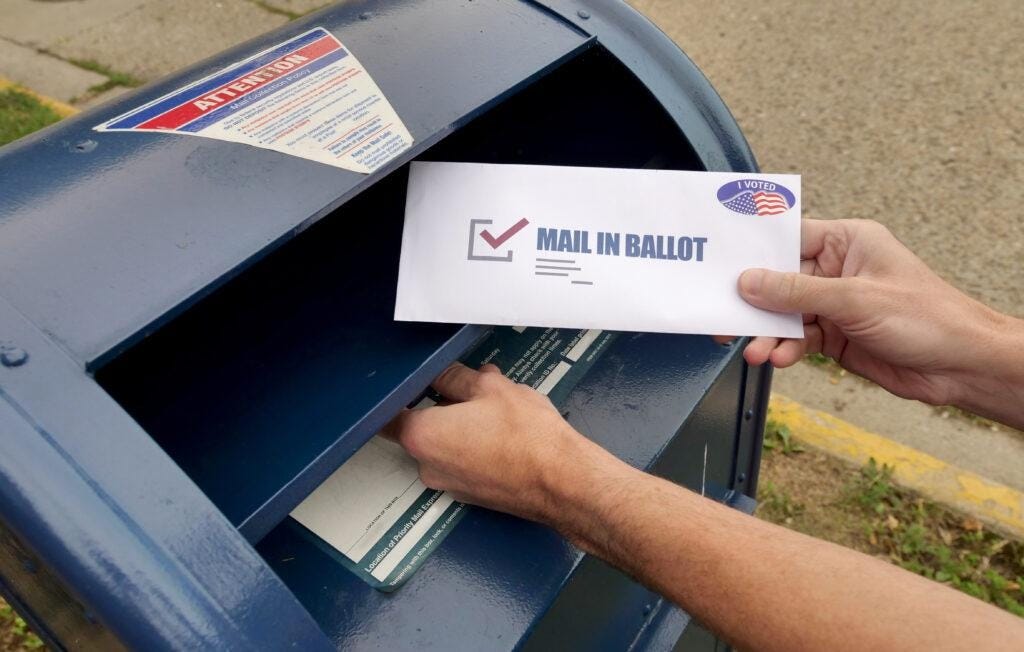
The Supreme Court has put the brakes on a last-minute effort to change the rules governing mail-in voting before the 2026 midterms. The underlying legal fight continues, but for this election, the existing rules remain in place—and voters can cast their ballots under them.
In a one paragraph, unsigned Order, seven Justices on the Supreme Court shot down the Trump Administration’s efforts to kill mail-in voting as a means of interfering with the 2026 midterms. Trump had appealed a District Court injunction that found the entire scheme to be unlawful. As detailed in How to Interfere With an Election: Let’s Count the Ways, the issue before the Court was whether the US Postal Service (USPS) could restrict the delivery of mail-in ballots only to those voters on a list approved by the US Government, and impose those requirements even as mail-in ballots are being mailed to voters in a number of states.
There were two problems the Court identified with the Trump appeal: the Government is unlikely to succeed on the merits of its challenge to the District Court, and the equitable factors do not support relief.
While there were six solid votes against the plan hatched by Trump to restrict mail-in voting by having the USPS determine who could vote by mail, Kavanaugh concurred in the decision, not because the USPS did not have the authority to issue its rule, but because it was unreasonable to think anything along the proposed lines could be implemented before the midterms.
That leaves Samuel Alito and Clarence Thomas, who predictably were fine with Trump’s plan for restricting mail-in voting.
This is the second time this week that the Supreme Court has intervened in election issues in a way that runs counter to Republican interests. Earlier, the Court upheld, first, the Missouri State Supreme Court in its ruling on the illegality under Missouri law of an attempted gerrymander. When a federal District Court judge in Missouri then attempted to reinstate the map that had just been declared illegal, the Supreme Court again stepped in and unanimously upheld the Missouri Supreme Court’s decision. Both of these cases are major wins for free and fair elections, as they traditionally have been conducted in the United States.
The Steady State has been critical of the many decisions in which the Court has sided with Republican interests on the Voting Rights Act, on granting presidents immunity from criminal acts, and the general deference to Executive Branch excesses, for example, in giving DHS and ICE near-free rein in the apprehension, detention, and rendition of both permanent residents and undocumented individuals.
In this case, however, seven members of the Court have sent an important message to the country and to the President. They have protected mail-in voting as it has occurred for years against a highly partisan assault.
It is now up to those of us who are eligible to vote to ensure that we exercise that right by mail, by drop box, at early voting stations, or in person on election day. Only once, however, since more than once is almost certainly going to land you in jail.
James Petrila spent over thirty years as a lawyer in the Intelligence Community, working at the National Security Agency and, for most of his career,at the Central Intelligence Agency. He has taught courses on counterterrorism law and legal issues at the CIA at the George Washington University School of Law. He is currently a senior advisor to the Institute for the Study of States of Exception and is a member of The Steady State.
Founded in 2016, The Steady State is a nonprofit 501(c)(4) organization of more than 400 former senior national security professionals. Our membership includes former officials from the CIA, FBI, Department of State, Department of Defense, and Department of Homeland Security. Drawing on deep expertise across national security disciplines, including intelligence, diplomacy, military affairs, and law, we advocate for constitutional democracy, the rule of law, and the preservation of America’s national security institutions.
Powered by WPeMatico