The Day Fear Came Home
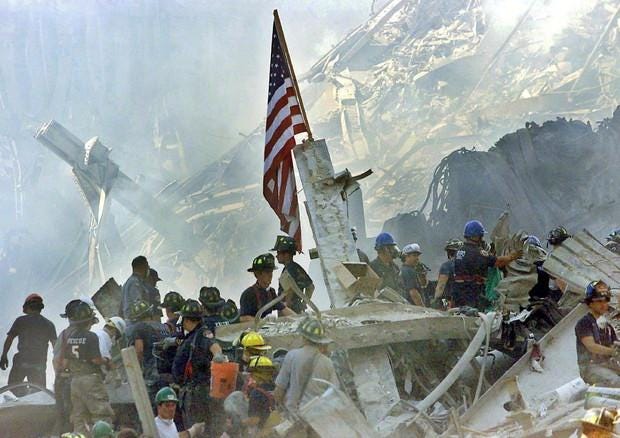
“The Pile” Speciali – ANSA.it
The policies created after 9/11 were intended to keep Americans safe. But when fear becomes the organizing principle of national security, the tools created to protect democracy can eventually threaten it.
On September 11, 2001, it was a stunningly beautiful day in the Washington, DC area, perfect because it felt like early fall. Cool-ish, bright blue sky, no clouds, no hazy air. I had all the car windows open as I drove to CIA Headquarters and the walk inside from the parking lot was more pleasant than it had been since mid-April.
A short time later, I was sitting at my desk and a woman who worked with me ran into my office with the news “a plane had crashed into the World Trade Center.” I turned on the television, just in time to see the second jet crash into the Trade Center. My phone rang, and a friend, whose office was located in the Trade Center, was calling to let me know she was all right. Another call from my sister soon followed, to ask if I was ok and if I’d heard from our brothers; I had not. Pretty soon, we learned that one them was in New Jersey, and had been under the Trade Center on the subway at 8:20 that morning. He was headed back to Manhattan, to join up with his reserve unit, which had been called up to work the site of the crash; looking for survivors.
At about that time, the Federal Government closed all US government offices and sent employees home. The CIA followed suit, although they asked about 200 officers, myself included, to head to off-site buildings and work there until notified otherwise. Unfortunately, because the entire Federal government was released all at the same time, the four lane road in front of CIA was bumper to bumper, so all 200 of us were all stuck in CIA parking lot. We all knew that four planes had crashed, but no one knew if any more planes were in the skies. I was standing next to my car, next to a very senior officer. After about 25 minutes, with still no sign that we would be out of that parking lot anytime soon, he looked at me and, after a pause, wryly commented, “I served in Viet Nam. I was in Guatemala, I was in Honduras, I was in The Congo, and now I’m going to die in the CIA parking lot.” He summed up the fear, the confusion, the lack of knowledge and the complete absurdity of the situation perfectly.
When my team members finally got to the off-site building, we got to work. Many of us assisted other government offices in the trade center which were now trying to locate staff who had left the collapsing buildings who had not yet checked in. Others poured over information in an effort to begin investigating who, why, how, and what had happened.
That night, I met my mom and dad who, after weathering the 9/11- associated flight cancellations, returned home from a trip to Europe. Their arrival at Dulles Airport might have been the first plane to land in the US after the attacks; the landing was escorted by fighter jets. As passengers disembarked, the airline crews based at the airport gave the ladies red roses. There were lots and lots of tears.
My New York friend asked me to come up for a couple of days following the attack. Once there, she insisted that I accompany her to ground zero. We walked there from the Upper East Side, and it was like nothing I had ever seen or could imagine. There was a big Red Cross presence, under a tent at one side of The Pile and a Federal presence under a different tent. There were fire fighters and police officers everywhere going through the wreckage on search and rescue or recovery missions. The stench was overwhelming and inescapable.
We walked onto The Pile. We were briefed on where to run if we heard different blasts of a whistle. Adjacent buildings or half-destroyed structures were still upright and there was a chance that there would be another collapse. In the few hours at the site, we did have to sprint away a couple of times. After our visit, I took a long shower and went with my friend to a local Tex Mex place. Our bottled up anxiety, fear and total uncertainty were palpable; the distraction was helpful, if only for a short time.
Post 9/11
To be sure, the initial post-9/11 weeks, brought communities and the country together. Very sadly, this was short-lived. For much of the history of our country we have experienced fear-driven nativism, racism and xenophobia. After 9/11, those feelings were exacerbated and returned to front and center. Because the men who commandeered the planes on 9/11 were Middle Eastern and Muslim, members of both of those groups were suddenly considered suspect and were subjected to government scrutiny. Everyone who wore a turban or hijab had to prove over and over again that he or she was not a terrorist.
In the months and years to follow, Terrorism, and the people and nations that sponsored it and participated in it became central to the CIA’s mission, as it did for much of the US government. New departments and agencies sprang up. I remember wondering about the need for those agencies and how it might change or possibly backfire over the years. Terrorism was designated as THE existential threat, and the emphasis on homeland security drove resources, capabilities, careers away from other very real existential threats like climate change, food insecurity, and militant armed forces. It chewed up millions and millions of dollars that might have been more effectively used in other ways.
Twenty-five years later, I find myself thinking about that question again. As I watch this administration designate domestic terrorism as THE existential threat, attempt to broadly expand its definition of “terrorist organizations,” (most recently suggesting that it includes opposition political parties), and as I watch the Markwayne Mullin, Department of Homeland Security and ICE abuse people to the point of death, be it murder or suicide, I am sad to see that my earlier concerns have proved to be all too prescient.
The policies put in place to keep all of us safe after 9/11 are putting all of us at risk.
Margaret Henoch served in the Clandestine Service of the CIA for 25 years, at Headquarters and in the field, focusing on operations and counterintelligence and retiring as a Senior Intelligence Officer. She is a member of The Steady State.
Founded in 2016, The Steady State is a nonprofit 501(c)(4) organization of more than 400 former senior national security professionals. Our membership includes former officials from the CIA, FBI, Department of State, Department of Defense, and Department of Homeland Security. Drawing on deep expertise across national security disciplines, including intelligence, diplomacy, military affairs, and law, we advocate for constitutional democracy, the rule of law, and the preservation of America’s national security institutions.
Powered by WPeMatico