
The Department of Homeland Security becomes our own Ministry of Interior.
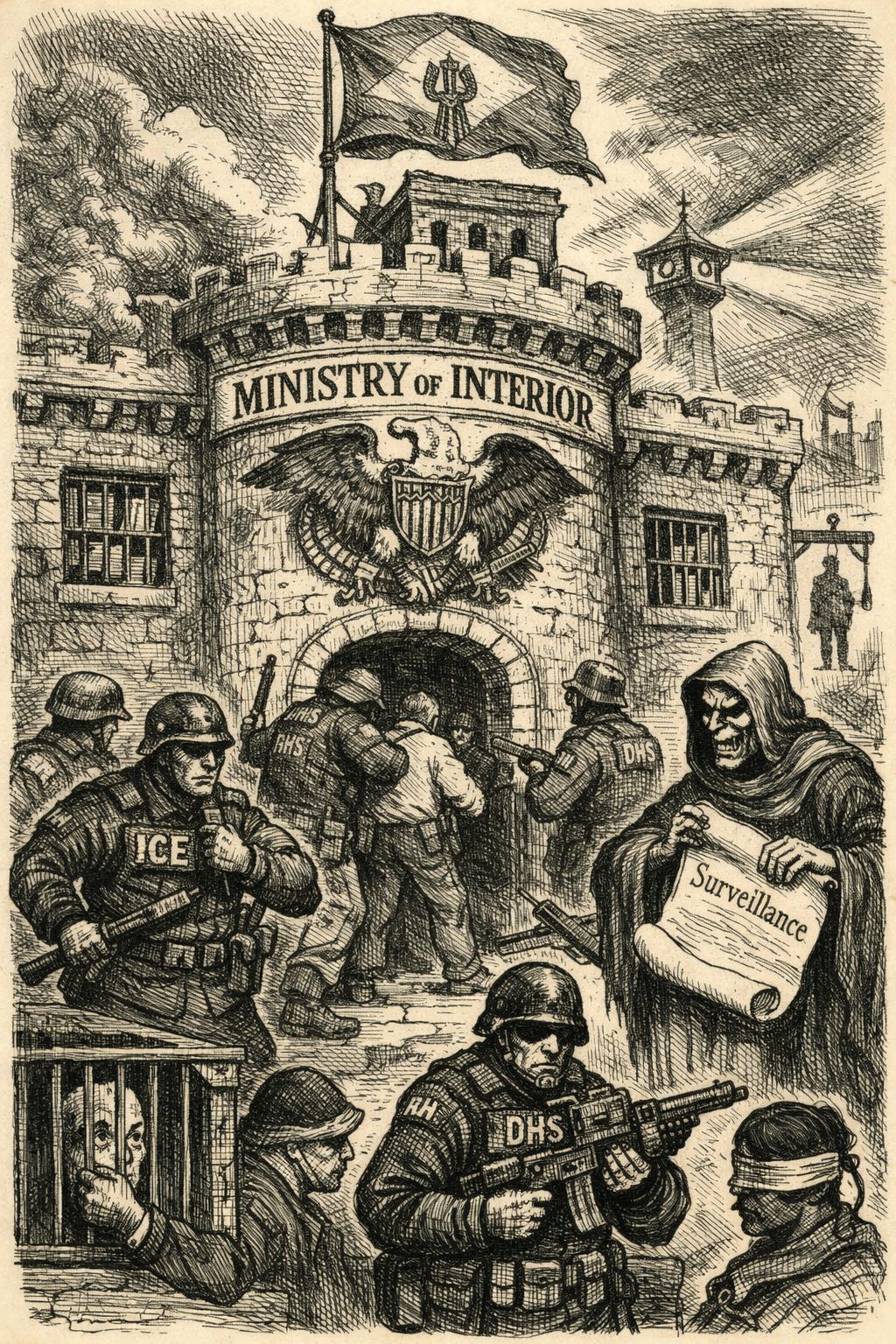
I served as a Senate staffer in the aftermath of September 11, 2001, and was part of the effort that ultimately resulted in the creation of the Department of Homeland Security. In the days and months after the attacks, Washington was shaken in a way that is difficult to convey to those who did not experience it firsthand. Nearly three thousand people had been murdered in a coordinated assault on the United States, and it was widely believed that more attacks were likely. There was an overwhelming sense—shared across party lines—that the U.S. government was not effectively organized to meet what seemed, at the time, a terrifying and novel threat: transnational Islamist terrorism, embodied by al-Qa’ida.
The response was a massive reorganization of the federal government, the largest since the creation of the Department of Defense. Disparate functions, immigration enforcement, border control, emergency management, presidential protection, port security, and others, were brought together under a single new cabinet-level department. The theory was straightforward: unity of effort would bring speed, coordination, and effectiveness. The costs of fragmentation, we believed, were simply too high.
But even at the moment of its creation, there was a bipartisan recognition that what we were doing was fraught with danger. Concentrating coercive and protective power inside a single institution is efficient, but efficiency cuts both ways. The same machinery that can prevent attacks can also be turned inward, to our own society.. Protective efficiency can become equally efficient tyranny.
Many of us were acutely aware of that risk which was a regular topic of conversation and debate. More than once, sometimes seriously, sometimes darkly, and sometimes a bit tongue-in-cheek, we referred to the worst-case outcome as creating a “Ministry of Interior.” It was not a hypothetical phrase. Ministries of Interior are often a feature of authoritarian systems, particularly in the former Soviet Union and its client states. In authoritarian states, similar institutions become the institutions responsible not merely for law enforcement, but for political control: surveillance, internal security, intimidation, and the suppression of dissent. We recognized that many non-authoritarian states have Ministries of Interior, including many of our allies. But the Ministry of Interior as a shorthand reference to the former Soviet Union and other dictatorships, rang, and still rings, true.
We tried, consciously, to mitigate that risk.
Guardrails were built in, some internal, some external. We allowed, even designed for, a degree of inefficiency. The Department was divided into semi-autonomous “components.” Customs and Border Protection, Immigration and Customs Enforcement, the Coast Guard, the Secret Service, each with distinct authorities, cultures, and chains of command. This internal friction was often frustrating. It slowed decision-making. It annoyed operators. But it was intentional. Fragmentation was a feature, not a bug.
We also limited intelligence authorities. Rather than granting DHS broad, free-standing intelligence powers, Congress created a narrowly scoped Office of Intelligence & Analysis, led by a Senate-confirmed Under Secretary. The idea was to ensure that intelligence activity inside DHS would be subject to meaningful oversight, integrated into the broader Intelligence Community, and constrained by law. DHS was not meant to become a domestic intelligence leviathan. It was meant to be a coordinating department, not a political police.
In retrospect, it is clear that we failed due to a tragic lack of imagination. We did not anticipate the election of a president who in fact admired the Soviet model, who would seek to suppress our citizens, to scare and intimidate rather than to protect. We assumed that any American president would instinctively recoil from the idea of centralized internal security power being used for political ends. That assumption was wrong.
A would-be autocrat does what autocrats always do, and must do. He gathers the tools of repression and coercion, consolidates them, and deploys them to enhance and protect power. This is not a matter of ideology or temperament; it is structural. Authoritarianism requires enforcement. It requires fear. It requires institutions capable of acting quickly, forcefully, and with minimal accountability.
That is what we are confronting now.
The Department of Homeland Security has, in effect, become a tool of a dictator, our Ministry of Interior. Its sprawling law-enforcement elements have been remade into a paramilitary force: heavily armed, lightly restrained, and increasingly insulated from meaningful oversight. Immigration enforcement, in particular, has been transformed from a regulatory and investigative function into a domestic security apparatus operating in American communities with a posture that looks far less like civilian law enforcement and far more like internal security services abroad.
We now have our own version of the Soviet KGB, Russian FSB without the name, an East German Stasi, a Serbian MUP without the uniform. The labels differ, but the logic is the same. Centralize authority. Blur legal boundaries. Normalize force. Declare opponents dangerous. Treat dissent as disorder.
The warning signs were always there. Many of us saw them. Some of us said so, quietly at first, then more openly. We built guardrails for a system that assumed an executive who would respect the rule of law. That assumption no longer holds. And when it collapses, the machinery in place is his to use, in whatever way he deems is in his interest .
None of this is accidental. None of it is unprecedented. And none of it is unfamiliar to those who have spent careers studying how democracies erode from within.
A Ministry of Interior was always a risk. We are living with the consequences of refusing to believe that it could ever happen here.
Steven A. Cash served as a prosecutor in the Manhattan District Attorney’s office before joining the CIA in 1994 as Assistant General counsel and subsequently serving as an intelligence officer in the Directorate of Operations. Until January 20, 2025, he served as Senior Advisor to the Under Secretary for Intelligence & Analysis at DHS. In 2001 he joined the Senate Select committee on Intelligence as Counsel and designee-staffer to Senator Diane Feinstein. He later served as a senior staffer in the House Select Committee on Homeland Security, at the Department of Energy, and on the Senate Judiciary Subcommittee on Terrorism, Technology and Homeland Security . In the private sector he has advised on national security, counterintelligence, and technology policy and served on the Biological Sciences Experts Group under the Director of National Intelligence. Mr. Cash is currently the Executive Director of The Steady State.
Founded in 2016, The Steady State is a nonprofit 501(c)(4) organization of more than 360 former senior national security professionals. Our membership includes former officials from the CIA, FBI, Department of State, Department of Defense, and Department of Homeland Security. Drawing on deep expertise across national security disciplines, including intelligence, diplomacy, military affairs, and law, we advocate for constitutional democracy, the rule of law, and the preservation of America’s national security institutions.
Powered by WPeMatico