
The Terrorism Court That Sat Empty for 30 Years
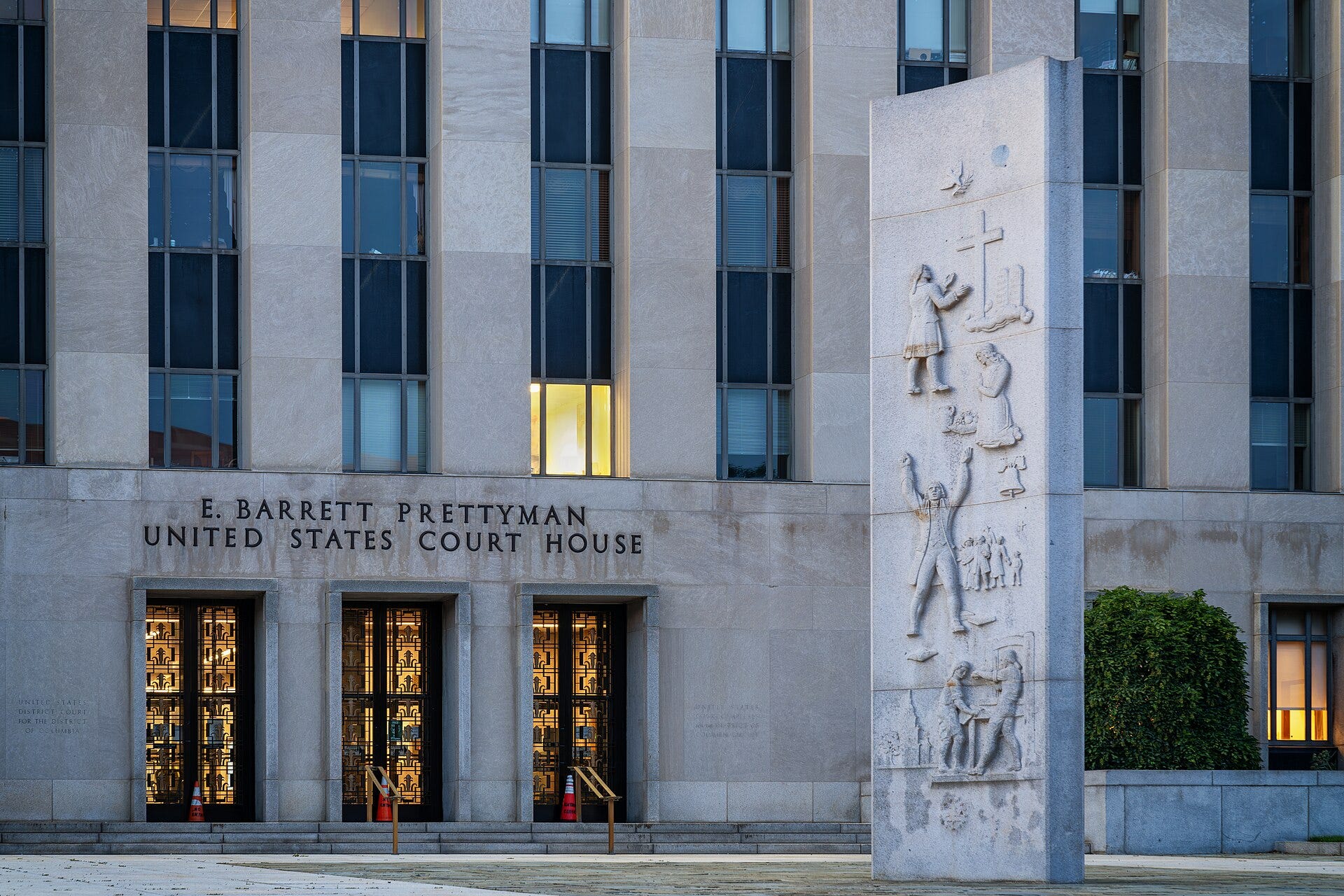
A court created three decades ago to handle the most sensitive terrorism-related immigration cases has never heard a case—until now. Its sudden revival, amid an expanding campaign that increasingly blurs the line between terrorism, political dissent, and national security, raises questions that go far beyond immigration enforcement.
Last week, the government filed an application before the Alien Terrorist Removal Court (ATRC) seeking to deport a foreign national, whose identity remains undisclosed, for being an “alien terrorist.” The ATRC was created in 1996 as an alternative to the immigration courts for cases involving terrorism-related offenses, but where the government intends to introduce evidence that is classified.
The last three decades have been marked by 9/11 and the Global War on Terror, the creation of the U.S. Department of Homeland Security (DHS), the wars in Iraq and Afghanistan, and many other regional conflicts and domestic initiatives concerning terrorism and national security concerns. Yet in its 30 years of existence, the ATRC has not heard a single case—until last week. So why now?
This departure from the tens of millions of removal cases brought by the government at the immigration courts—the administrative hearings that adjudicate cases where a foreign national is charged with a civil immigration violation, including terrorism-related offenses—is significant. The government already has a successful track record of deporting foreign nationals from the United States on terrorism-related grounds and separately, of prosecuting defendants in terrorism-related criminal cases within the federal court system.
Last year, the Administration invoked the long-dormant Alien Enemies Act as the legal basis for detaining and summarily deporting a group of Venezuelan nationals alleged to be members of the Tren de Aragua gang—a transnational criminal organization now designated as a Foreign Terrorist Organization. The U.S. Supreme Court held that the Administration’s actions raised due process concerns, as the detainees were not given an opportunity to challenge the government’s claims in court.
While that case was before Chief Judge Boasberg at the U.S. District Court for the District of Columbia, he noted that the ATRC provides a venue for classified evidence in removal proceedings. It remains unclear whether the Tren de Aragua case is the Administration’s primary motivation for using it now. DHS, which plays a role similar to a prosecutor in immigration court, has had a policy in place since 2004 on the use of classified information in removal proceedings—and expanded its permissible use in 2024—though use of classified information in immigration courts remains rare.1
Who is an Alien Terrorist?
Relevant Immigration Law, Explained
The part of the Immigration and Nationality Act that defines an “alien terrorist” incorporates by reference the terrorism-related inadmissibility grounds (TRIG) that have been used for decades to deny immigration applications and remove noncitizens from the United States. 2These grounds cover not only actions that people commonly understand as terrorism but are so broadly defined that even victims of terrorism have faced bars to immigration based on these grounds, particularly the “material support” provision. Over the years, we’ve seen TRIG applied to people who were forced to give food and supplies to armed groups under threat of violence, Syrian refugees who had to pay to pass through checkpoints when fleeing civil war, doctors who treated patients on both sides of a conflict in accordance with their Hippocratic Oaths, and to other persons whom most Americans would not consider “terrorists.”3
The other section of the statute incorporated into the “alien terrorist” definition provides for the Secretary of State or Attorney General to determine that a noncitizen is associated with a terrorist organization and “intends . . . to engage . . . in activities that could endanger the welfare, safety, or security of the United States” and find them inadmissible. It’s not known whether the Administration has or will apply this portion of the statute to the ATRC. Last year, Secretary of State Marco Rubio controversially applied another ground of inadmissibility allowing the Secretary of State to base such a determination on “potentially serious adverse foreign policy consequences” of a noncitizen’s activities to college students exercising their First Amendment right to protest. If that’s any indication, we may see similarly “creative” and potentially spurious applications of 8 U.S.C. § 1182(a)(3)(F) at the ATRC.
Why is the ATRC Attractive to this Administration?
We are seeing an increase in the use of existing legal frameworks to carry out this Administration’s crackdown of perceived ideological threats—including the constructive outlawing of dissent and deportation of more noncitizens than at any other point in U.S. history.4
The ATRC’s Procedural Advantages for the Government
The government’s case before the ATRC has some significant procedural advantages. For example, the government only needs to establish by a preponderance of evidence that a noncitizen is removable, compared to the higher clear and convincing standard required in immigration court. The government also benefits from a forum designed to streamline the removal process—defendants are not permitted to apply for “relief” from removal in the form of asylum, adjustment of status, or cancellation of removal, among other applications or requests.
Most importantly, the ATRC allows for the government to introduce evidence to the judge only, without sharing it with the defense. Consequently, and unlike a federal trial court or an immigration court, the accused can’t move to suppress or otherwise challenge the legality or veracity of that evidence. The Constitutional protections against illegally obtained or fabricated evidence won’t apply.
The ATRC Coincides with a Politically Charged “Domestic Terrorism” Policy Agenda
NSPM-7
Declaring its intention to target those engaging in or supporting activities “perpetuating extremism” on matters including “migration, race, and gender; and hostility towards those who hold traditional American views on family, religion, and morality[,]” on September 25, 2025, President Trump issued National Security Presidential Memorandum 7, Countering Domestic Terrorism and Organized Political Violence (NSPM-7). Despite this directive, an Administration has no statutory authority to designate entities as domestic terrorist organizations with any binding legal effect. Nevertheless, NSPM-7 directs federal agencies to prioritize investigating, prosecuting, and disrupting individuals and organizations involved in activities described vaguely as “politically motivated terrorist acts” including “civil disorder” and activity “designed to suppress lawful political activity or obstruct the rule of law.”
Dissent as Domestic Terrorism?
Even beyond that, what we’ve seen in the past year is an administration that has played fast and loose with accusations of terrorism, asserting that noncitizens and U.S. citizens alike are terrorists based merely on their First Amendment protected activity. The Administration accused Veteran’s Affairs Nurse Alex Pretti of being a domestic terrorist after he was killed by a CBP agent and has pursued deportation of international students who exercised their First Amendment right to protest. The President himself has promoted statements on his social media labeling the Democratic Party a “domestic terrorist party,” among other frequent and baseless accusations of communism and terrorism levied against political opponents.5 If the Administration is willing to label First Amendment protected activity terrorism in other contexts, will it do so in the ATRC?
At the same time, the recent prosecution of U.S. citizens for last year’s shooting incident at the Prairieland ICE Detention Center in Alvarado, Texas, reinforces the Administration’s narrative that their political opponents are a threat to national security. The case is notable because defendants were charged under the seldomly-used 18 U.S.C. § 2339A, for providing material support to terrorists without relying on a connection to a designated Foreign Terrorist Organization. Instead, the government argued that defendants were members of “Antifa,” a decentralized and unorganized political movement opposing racism and fascism. The indictment framed defendants as being formal members of a local Antifa “cell” as part of a larger “militant enterprise . . . call[ing] for overthrow of the U.S. government, law enforcement authorities and the system of law.” Pursuing terrorism charges allowed the prosecution to advance claims that the defendants were part of an organized, ideologically motivated group.
Conclusion
While the ATRC is authorized by law, this first-ever application shows this Administration’s intent to leave no stone unturned in its pursuit of immigration enforcement under the guise of protecting national security—and is another example of our current government’s willingness to exercise extraordinary power. This first ATRC application appears in a context of the administration engaging in a pattern and practice of labeling political speech protected by the First Amendment “terrorism,” and as such deserves to be monitored closely and with suspicious scrutiny.

Lauren Skompinski is a civil rights and civil liberties attorney, focused on humanitarian immigration, detention, and removal defense. She is a former Biden administration appointee at the U.S. Department of Homeland Security’s Office for Civil Rights and Civil Liberties (CRCL). Ms. Skompinski most recently worked with Kids in Need of Defense (KIND), representing unaccompanied children before the U.S. Immigration Court, USCIS, and state family court. She is a member of The Steady State
José Pitti is an attorney who previously served in policy and operational roles at U.S. Citizenship and Immigration Services, where he worked on asylum and refugee matters and spent time conducting research and adjudicating case-by-case exemptions for the Terrorism-Related Inadmissibility Grounds (TRIG) Working Group, and at the DHS Office for Civil Rights and Civil Liberties, where he conducted oversight investigations. Mr. Pitti served at DHS CRCL until that office was effectively dismantled in May 2025. He is a member of The Steady State.
Compare U.S. Dep’t of Homeland Sec., Guidelines for the Use of Classified Information in Immigration Proceedings (Oct. 4, 2004), available at https://www.uscis.gov/sites/default/files/document/memos/Guidelines_for_the_Use_of_Classified_Information_in_Immigration_Proceedings_Ridge_Memo.pdf, with U.S. Dep’t of Homeland Sec., DHS Policy and Guidelines for the Use of Classified Information in Immigration Proceedings (May 9, 2024),
https://www.dhs.gov/sites/default/files/2024-05/24_0509_sec_24-02395-s1-signed-policy-and-guidellines-classified-info-in-immigration-proceedings-508.pdf. 8 U.S.C. § 1531, referring to 8 U.S.C. § 1227(a)(4)(B), which incorporates 8 U.S.C. § 1182(a)(3)(B) and (F) by reference.
See also: Singh-Kaur v. Ashcroft, 385 F.3d 293 (3d Cir. 2004) (finding that offering food and helping to arrange shelter constituted material support); Hosseini v. Nielsen, 911 F.3d 366 (6th Cir. 2018) (finding that copying and distributing flyer’s criticizing the Iranian government’s human rights abuses constituted material support when done on behalf of undesignated terrorist organizations); Jabateh v. Lynch, 845 F.3d 332 (7th Cir. 2017) (finding that providing interpreter services to a member of a terrorist organization for medical appointments and social errands constituted material support even though it occurred outside the context of the group’s terrorist activities
While ICE has still not published its Fiscal Year 2025 report to Congress, an official statement by Administration officials at DHS claims over 400,000 deportations occurred in FY2025. https://www.dhs.gov/news/2025/09/23/new-milestone-over-2-million-illegal-aliens-out-united-states-less-250-days
Powered by WPeMatico