
Trump Has Created a Strategy to Make U.S. Less Secure
As published below in the Pensacola News Journal Pensacola News Journal (Part of the USA Today Network) March 29 2026
Making sense of the shambolic actions of the Trump administration is a daunting, full-time task for American voters, whether MAGA, Democrat, Republican or Independent.
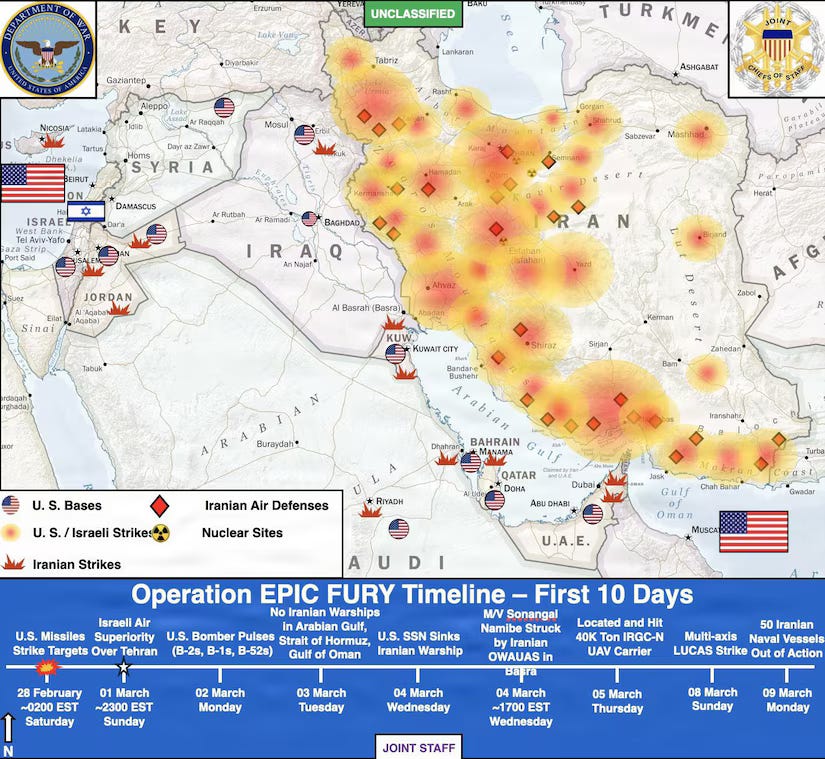
Deliberate disruption at home metastasized internationally on Feb. 28 with the launch of war against Iran, an undertaking seemingly inadequate in its military and diplomatic planning, political preparation of the nation, and analysis of the second- and third-level consequences of starting a war in the volatile region.
Two questions continue to demand coherent answers: “Why?” and “To whose benefit?”
Instability in world energy supplies, surging gasoline prices and possible terrorist attacks in the U.S., mounting civilian casualties in Iran and the region, deep dismay among allies and partners, and no change in Iran’s nuclear posture are the initial results of the war. The conflict could widen regionally and even globally, as China sees its Iranian oil deliveries threatened, Russia continues to undercut the U.S., and other countries are affected economically or by war-related violence.
How to understand what is happening and why?
One starting point: the Administration’s own National Security Strategy document, released just last November. One would hope that the document answers those questions and confirms how America is being made great again. Rather, it showcases the administration’s muddled thinking, jingoistic public bluster, and lack of serious people with a credible grasp of our dynamic yet unchanging 21st- century world.
The strategy simply defies rationality regarding its purpose and implementation. Its presidential cover letter claims that “America is strong and respected again – and because of that, we are making peace all over the world”, with Iran-Israel included in the list of conflicts resolved. The document’s 29 pages disingenuously assert the need for a radical reorientation of U.S. foreign policy to achieve a more secure America: ”…motivated above all by what works for America—or, in two words—“America First.” President Trump has cemented his legacy as The President of Peace.”
The document’s regional priority is the “Trump Corollary to the Monroe Doctrine, and “a readjustment of our global military presence to address urgent threats in our Hemisphere…”. The administration’s Jan. 3 action to seize Venezuelan leader Maduro and its ongoing pressure on Canada, Mexico and increasingly Cuba demonstrably flow from that.
On Asia, the strategy addresses rebalancing the U.S. economic relationship with China. states the need for a “robust and ongoing focus on deterrence to prevent war in the Indo-Pacific” and recognizes Taiwan’s critical economic and geographic roles.
Europe comes next. The strategy does not mention Russia as a threat to the U.S., but asserts the need to “reestablish strategic stability with Russia” and that NATO allies increase defense spending to meet their security responsibilities in their region. The strategy does recognize that “many Europeans regard Russia as an existential threat” but argues that Europe’s problems also include the twin specters of migration overwhelming countries and political liberty being sapped by (alleged) “censorship and repression”.
Finally, the Middle East (followed by cursory attention to Africa).
The strategy’s text could not be more at odds with the administration’s war on Iran:
“Stopping regional conflicts before they spiral into global wars that drag down whole continents is worthy of the Commander-in-Chief’s attention, and a priority for this administration. A world on fire, where wars come to our shores, is bad for American interests.”
“Conflict remains the Middle East’s most troublesome dynamic, but there is today less to this problem than headlines might lead one to believe. Iran—the region’s chief destabilizing force—has been greatly weakened by Israeli actions since October 7, 2023, and President Trump’s June 2025 Operation Midnight Hammer, which significantly degraded Iran’s nuclear program.”
“The days in which the Middle East dominated American foreign policy in both long-term planning and day-to-day execution are thankfully over—not because the Middle East no longer matters, but because it is no longer the constant irritant and potential source of imminent catastrophe, that it once was. It is rather emerging as a place of partnership, friendship, and investment.”
“We should encourage and applaud reform when and where it emerges organically, without trying to impose it from without.”
National discussion is understandably perplexed by the administration’s preemptive attack on Iran in tandem with Israel. Given the NSS document’s assertion of Operation Midnight Hammer’s significant success, it is difficult to understand what changed since November, other than an urge to exploit the opportunity on Feb. 28 to take out an Iranian leadership foolishly gathering together to consider the results of the Feb. 26 indirect negotiations in Geneva with U.S. representatives.
When you hear leaders on both sides of the aisle question the administration’s Iran war strategy and endgame, know that they are merely reacting to events as they unfold as well as the documented confusion of the National Security Strategy.
It should come as no surprise that Trump 47 is ensuring that America First really means America Alone. This hollowing out of the U.S. role as the leader of the free world has been signaled openly for a decade now; we are simply experiencing the inevitable, despite MAGA’s unrelenting and misleading propaganda otherwise.
Let’s hope that this war ends soon and makes for a safer world and America. Meanwhile, please read the strategy document and continue to ask, “Why?” and “To whose benefit?”
Mike Mozur is a retired Senior Foreign Service Officer with over 33 years of experience in the Soviet Union, former Soviet Union, Eastern Europe, the Balkans and Latin America. Mike also led a global professional association of environmental scientists and writes periodically on current political, economic, and social issues. He is a member of The Steady State.
Founded in 2016, The Steady State is a nonprofit 501(c)(4) organization of more than 400 former senior national security professionals. Our membership includes former officials from the CIA, FBI, Department of State, Department of Defense, and Department of Homeland Security. Drawing on deep expertise across national security disciplines, including intelligence, diplomacy, military affairs, and law, we advocate for constitutional democracy, the rule of law, and the preservation of America’s national security institutions.
Powered by WPeMatico