
“Just for Fun”- A Presidential Remark and the Law of War
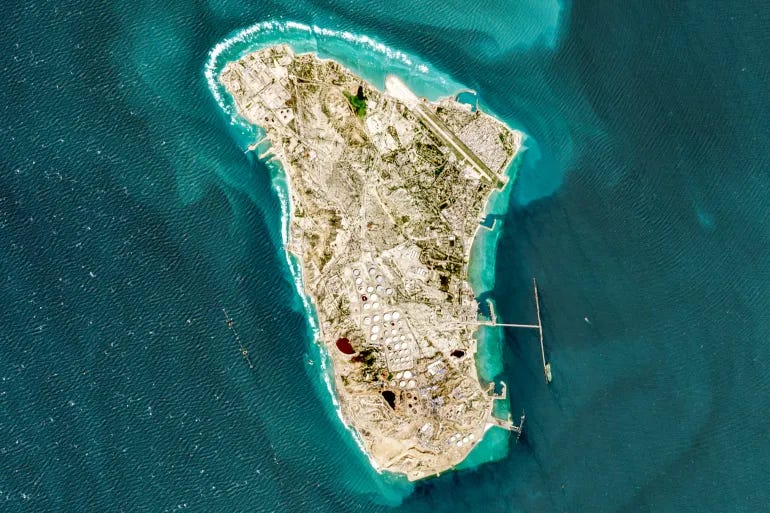
Pre-war Kharg Island, compliments of the European Space Agency and AFP
In discussing U.S. strikes on Iran’s principal oil export terminal at Kharg Island, President Donald Trump recently made a revealing statement. After asserting that U.S. forces had already destroyed the island’s military capabilities, Trump told NBC News that the United States might “hit it a few more times just for fun.”
The remark is not merely rhetorical indiscipline. Taken at face value, it collides directly with the legal principles that govern both the justification for war and the conduct of military operations once war begins.
From the outset, the administration defended the opening strikes against Iran as an act of self-defense. President Trump’s initial public statement described the operation as necessary to eliminate “imminent threats” posed by the Iranian regime. Defense Secretary Pete Hegseth similarly framed the campaign as a focused effort to neutralize Iran’s nuclear program and protect U.S. forces and Israel.
Those arguments rely on a familiar framework. Under the United Nations Charter, a state may use force without Security Council authorization only in self-defense against an armed attack or an imminent one. Even then, the use of force must satisfy two additional requirements: necessity and proportionality.
Necessity means that force is required to address the threat at hand. Proportionality means that the scale and effects of military action must not exceed what is reasonably required to remove that threat.
The president’s Kharg Island comment sits uneasily with both principles.
If, as the president said, the island’s military capabilities have already been destroyed, the legal justification for further strikes becomes difficult to sustain. Once the military objective has been achieved, additional attacks require a new and clearly defined military purpose. Striking again “just for fun” plainly does not meet that standard.
The legal implications become sharper when one considers the nature of the target.
Kharg Island is not primarily a battlefield installation. It is Iran’s principal oil export hub, responsible for the overwhelming majority of the country’s crude shipments. Its core function is economic. While certain facilities on the island may support military operations, the island itself is fundamentally a commercial infrastructure.
International humanitarian law places strict limits on attacks directed at such objects. The law of armed conflict requires that attacks be directed only against military objectives, specifically, against objects whose destruction offers a definite military advantage.
Even when an object qualifies as a military objective, commanders must still conduct a proportionality analysis. They must determine whether the expected civilian harm would be excessive relative to the concrete and direct military advantage anticipated.
Large oil terminals are among the most legally sensitive targets in modern warfare. Their destruction can produce environmental damage, disrupt civilian livelihoods, and cause cascading economic effects that extend far beyond the battlefield.
A strike aimed at destroying a specific military capability can sometimes be defended under these rules. A strike aimed at crippling a country’s economic lifeline is far more difficult to justify.
That distinction matters here. If Kharg Island is being targeted primarily to damage Iran’s economy or coerce its leadership politically, the campaign begins to resemble economic warfare against civilian infrastructure rather than the neutralization of military objectives.
The president’s own words reinforce that concern.
The remark about hitting the island again “just for fun” undermines the case that additional strikes are tied to military necessity. In legal terms, it weakens the argument that continued force is required to remove a threat. If the military objective has already been achieved, continued attacks risk appearing punitive or coercive rather than defensive.
Statements of this kind can also carry evidentiary consequences. That is why senior officials traditionally speak with care about military operations. Precision in language signals discipline in the application of force.
The Kharg Island comment signals the opposite.
More broadly, it highlights the widening gap between the administration’s initial legal justification for the war and the objectives now being pursued. What began as a strike to eliminate imminent threats increasingly appears to involve the destruction of economic infrastructure central to Iran’s civilian economy.
Wars often evolve in this way. Strategic goals expand as the conflict unfolds. But when the operational objectives drift away from the legal rationale that justified the war in the first place, the legal foundation of the campaign becomes progressively weaker.
Again, the phrasing of the president’s remark is, in this instance, more than rhetorical indiscipline. A single sentence crystallizes a central tension in the conflict: the distance between the disciplined legal language required to justify war and the far less disciplined reality of how this war is being conducted.
Jonathan M. Winer is the former Special Envoy for Libya and Deputy Assistant Secretary of State for International Law Enforcement and a Distinguished Diplomatic Fellow at MEI. He is a member of The Steady State.
Founded in 2016, The Steady State is a nonprofit 501(c)(4) organization of more than 400 former senior national security professionals. Our membership includes former officials from the CIA, FBI, Department of State, Department of Defense, and Department of Homeland Security. Drawing on deep expertise across national security disciplines, including intelligence, diplomacy, military affairs, and law, we advocate for constitutional democracy, the rule of law, and the preservation of America’s national security institutions.
Powered by WPeMatico