
If the ODNI Won’t Assess Threats, Who Will?
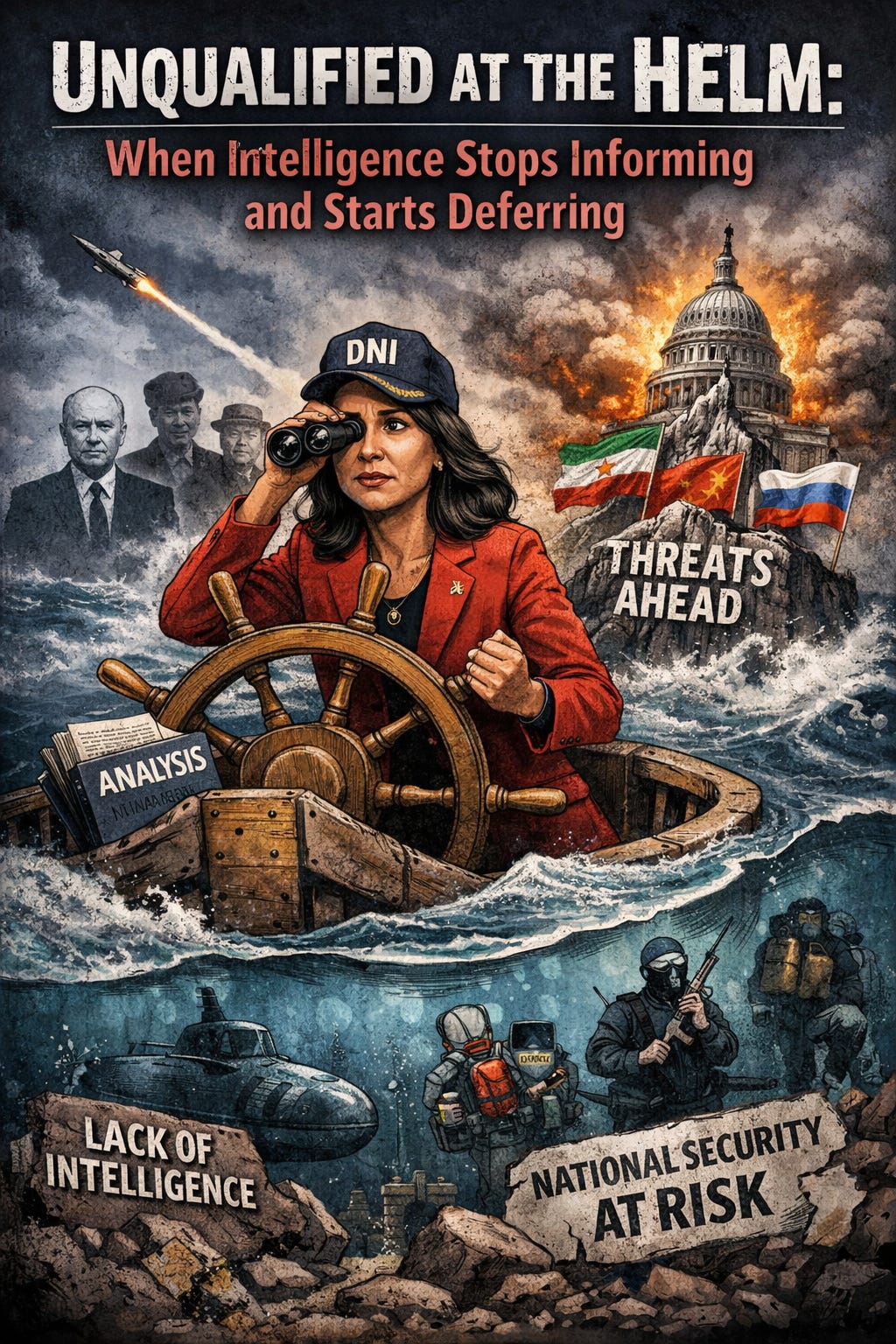
When intelligence stops informing power and starts deferring to it, it ceases to be intelligence at all—and becomes a liability that risks strategic blindness, policy failure, and war.
In a functioning democracy, intelligence exists to illuminate reality, not to mirror power. That principle is not aspirational; it is structural. The Office of the Director of National Intelligence (DNI) was created to ensure that objective, apolitical analysis reaches policymakers with clarity, independence, and integrity. When that function falters, the consequences are not theoretical; they are operational, tactical, and strategic—often immediate, and sometimes tragic.
Recent testimony by Tulsi Gabbard raises a fundamental concern: whether the DNI is fulfilling that mission at all. By declining to assess whether Iran poses an “imminent threat” and asserting that only Donald Trump can make that determination, the DNI did more than sidestep a question—she relinquished the core analytic responsibility of her office. This is not how the system is designed to work.
The DNI is not an extension of presidential judgment. The role exists precisely to inform that judgment—grounding it in evidence, context, and independent analysis. “Imminence” is not a political label. It is an analytic conclusion derived from intelligence collection, pattern recognition, and expert assessment. When that responsibility is deferred upward, intelligence ceases to function as a check on power and becomes an instrument of it. That shift is especially dangerous given the complexity of today’s global threat environment.
Professor Jiang Xueqin, a Chinese-Canadian educator, and others have noted that the strategic alignment among Iran, China, and Russia is not incidental—it is structural. Eurasian integration, energy control, and geographic chokepoints like the Strait of Hormuz form the backbone of a long-term competition that cannot be understood through isolated or reactive analysis. Iran is not just a regional actor; it is a connective node in a broader geopolitical architecture that links energy flows, financial systems, and military positioning.
We have already seen Iranian forces bolstered by Russian and Chinese technology.
Professor Xueqin posited that the war with Iran is also impacted by economic flow that comes from UAE, Saudi Arabia, and Qatar. If the supply chain from this Middle East sector is impacted, then the American economy is impacted. Understanding those inter-connecting systems requires exactly what the DNI appears to be abandoning: deep, integrative analysis.
The Steady State former intelligence professionals have raised alarms about the recent Annual Threat Assessment—pointing to its reliance on commercially available information, its lack of analytic depth, and its omission of critical threat domains ranging from domestic extremism to climate instability and global migration. These are not minor gaps. They are indicators of a diminished analytic enterprise.
The Steady State has gone further, warning that the document reads less like an intelligence product and more like a political one—shaped as much by omission as by inclusion. When key threats are excluded, and convenient narratives are emphasized, the result is not just incomplete, it is misleading.
This erosion of analytic rigor is compounded by a broader cultural shift. Discussions in recent forums by some of our retired members of the National Security Community have highlighted the growing influence of ideological framing. When strategic analysis is replaced by worldview-driven narratives, the risk is not just bias; it is blindness.
Blindness, in intelligence, is how wars begin. History offers a clear warning. From Vietnam to Iraq to Afghanistan, the United States has repeatedly entered conflicts where initial assumptions hardened into political commitments—commitments that then demanded validation, escalation, and, ultimately, prolonged entanglement.
In such an environment, the role of intelligence is not to justify decisions; it is to challenge them. That requires independence. It requires the willingness to assess threats, even when those assessments complicate political narratives. It requires the ability to connect disparate signals into a coherent picture of long-term risk. And above all, it requires leadership capable of exercising that responsibility.
Right now, that capability is in question.
When the DNI defers analytic judgment to the President, relies on shallow or incomplete data, and presides over a threat assessment that omits critical realities, the issue is not just performance—it is qualification. The position demands more than alignment with executive authority. It demands expertise, rigor, and the courage to speak with analytic clarity.
The stakes could not be higher. The partnership among Iran, China, and Russia, the fragility of global energy systems, the persistence of domestic and transnational threats are not problems that yield to simplified narratives or politically convenient omissions. They require a fully functioning Intelligence Community led by someone prepared to do the job as it was intended.
Intelligence must inform power—not defer to it. If that principle is lost, so too is one of the most critical safeguards of American national security.
Martha Duncan is a retired U.S. Department of Defense senior executive with 37 years of service, including 23 years as an officer in the U.S. Army Reserves, where she also served as Reserve Attache. She had three operational deployments to Panama, Bosnia, and Afghanistan. At DIA, she worked as a Latin American analyst for 11 years. A specialist in human intelligence (HUMINT), she is recognized for her leadership in intelligence operations, coalition-building, and enterprise-level policy development across the Defense Intelligence Agency (DIA), the U.S. Army, and the broader Intelligence Community. She grew up in Panama during the rise of Manuel Noriega and was instrumental in his capture.
Founded in 2016, The Steady State is a nonprofit 501(c)(4) organization of more than 400 former senior national security professionals. Our membership includes former officials from the CIA, FBI, Department of State, Department of Defense, and Department of Homeland Security. Drawing on deep expertise across national security disciplines, including intelligence, diplomacy, military affairs, and law, we advocate for constitutional democracy, the rule of law, and the preservation of America’s national security institutions.
Powered by WPeMatico