
The Death of Restraint
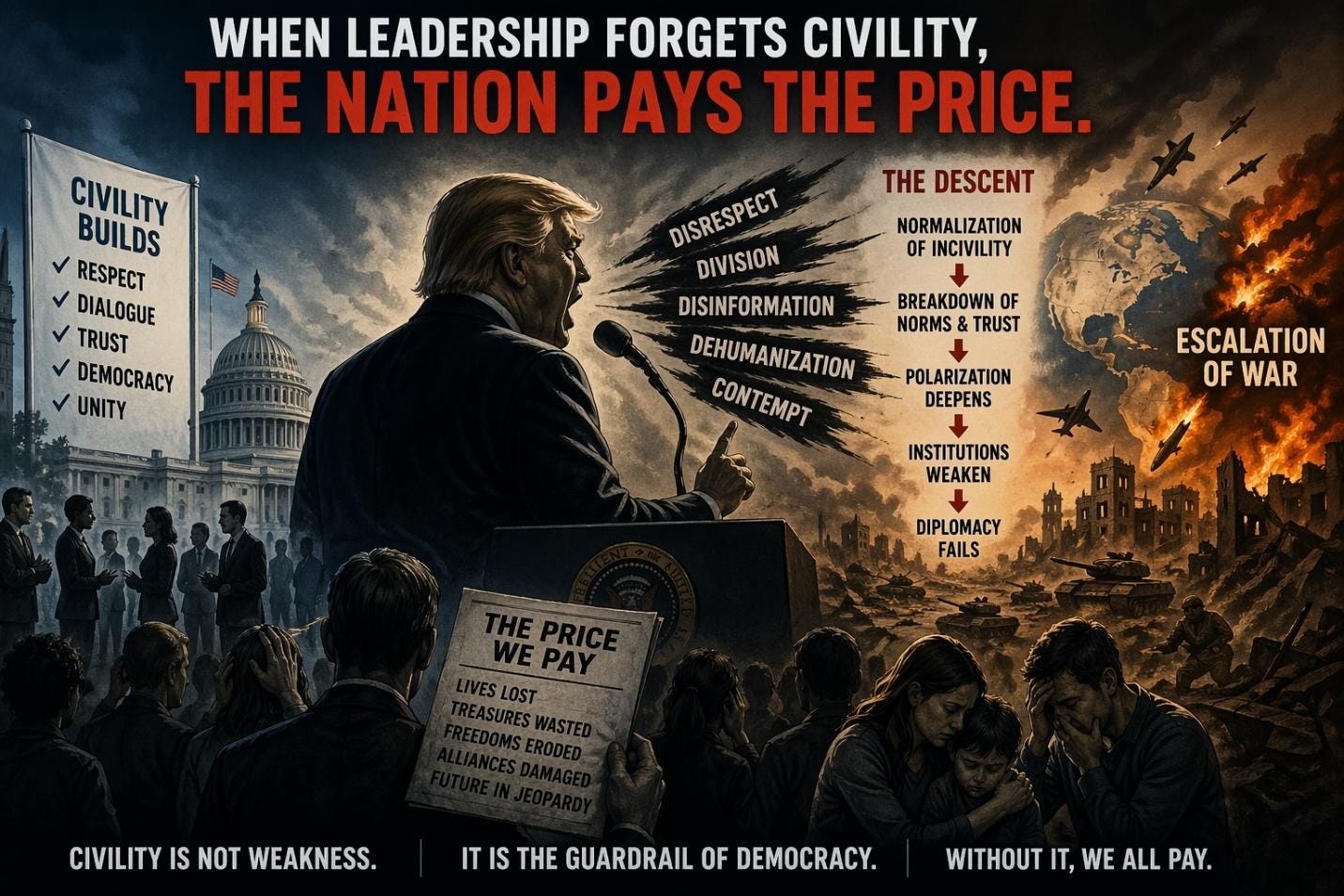
Civility is the discipline that keeps conflict from becoming chaos; without it, polarization deepens, institutions erode, and leadership drifts toward instability.
A quiet erosion is underway in American public life. It does not appear in GDP reports or polling averages, but it is unmistakable in tone, in trust, and in the fraying fabric of civic interaction. It begins at the top, in the language and posture of national leadership, and cascades downward into Congress, institutions, and ultimately into the way citizens speak to one another.
Civility is often dismissed as mere politeness. That is a mistake. Civility is discipline. It is the ability to engage in serious disagreement without stripping others of dignity. It is the guardrail that allows a diverse republic to argue fiercely without coming apart. And now that guardrail is failing.
As Mary Geddry argues in her essay, “Lost the Plot, Holding the Matches,” what we are witnessing is not just a coarsening of tone, but a shift from governance to performance. The language of leadership has become louder, sharper, more theatrical—and less tethered to responsibility. Provocation replaces persuasion. Spectacle displaces substance.
Why is this happening?
First, we are operating in an attention economy that rewards outrage over reason. Political power now flows through visibility, and visibility is driven by conflict. The sharpest insult travels farther than the most careful argument. Leaders who might once have chosen restraint are pulled toward escalation because escalation is what gets seen—and increasingly, what gets rewarded.
Second, polarization has hardened into identity. Political disagreement is no longer confined to policy; it has become personal, cultural, even existential. Opponents are not merely wrong; they are framed as illegitimate or dangerous. In that environment, civility is recast as weakness, and hostility becomes a form of loyalty. We see it in the normalization, even celebration, of destruction abroad, treated not with gravity but with applause.
Third, and most consequential, there has been a collapse of norms at the highest levels of leadership. Tone is not incidental; it is set. When presidents, cabinet officials, and members of Congress model contempt, sarcasm, and impulsiveness, they legitimize it. What was once disqualifying becomes routine. What was once unthinkable becomes standard operating procedure.. This dynamic is not new. It has been observed in regimes around the world, I saw it under Manuel Noriega in Panama, where authority was maintained not through institutional trust, but through the continual projection of force and unpredictability. In such systems, restraint is seen as weakness, and civility as a liability. The result is a cycle in which authoritarian leaders feel compelled to keep raising the stakes, because standing still risks appearing diminished.
Geddry’s analysis makes clear that this erosion does not stop at our borders. It is mirrored in how the United States now projects power abroad. When foreign policy is conducted through threats, contradictions, and public displays of dominance, it ceases to be strategy and becomes performance. Diplomacy depends on credibility, consistency, and restraint—qualities that cannot survive in an environment of erratic signaling.
In Iran, demands for immediate compliance are paired with sweeping threats, as if complex nuclear negotiations could be forced into submission through volume and repetition. This is not strength. It is volatility. Civility in this context is not about courtesy; it is about control. Without it, words become destabilizing signals, and the margin for miscalculation narrows dangerously.
In Gaza, the same indiscipline manifests in another form. Humanitarian catastrophe is at risk of being reframed as logistical opportunity, reconstruction discussed in terms of systems, platforms, and managed outcomes while the human cost and aspirations? remains unresolved. When suffering is abstracted into a planning exercise, something essential has been lost. Civility demands recognition of human dignity. Without it, policy becomes transactional, and moral authority erodes.
Even among allies, the consequences are visible. Reports of opaque U.S. security involvement in Mexico—operations conducted without clear acknowledgment or coordination, underscore how quickly trust can fray when transparency and respect for sovereignty and one’s trusted interlocutors are ignored? . These are not isolated missteps; they are symptoms of a broader shift in how power is exercised.
At home, the effects are cumulative and corrosive. When incivility is modeled at the top, it spreads. Public discourse hardens. Institutions are treated with contempt. The space for good-faith disagreement shrinks. Citizens begin to mirror the tone of their leaders. The result is a political culture defined less by debate than by division.
Perhaps most damaging is the exhaustion this environment creates. A constant stream of provocation, contradiction, and escalation overwhelms the public’s capacity to process events clearly. When everything is urgent, nothing is. When outrage is constant, judgment dulls. This is not accidental; it is the byproduct of a system that thrives on overload and confusion.
Civility is not a luxury. It is not nostalgia for a gentler era. It is a prerequisite for effective leadership. It is what allows power to be exercised with legitimacy, conflict to be managed without escalation, and disagreement to occur without dehumanization.
When leadership abandons civility, the nation does not merely lose its manners.
It loses its balance.
Martha Duncan is a retired U.S. Department of Defense senior executive with 37 years of service, including 23 years as an officer in the U.S. Army Reserves, where she also had three operational deployments to Panama, Bosnia and Afghanistan. At the Defense Intelligence Agency (DIA), she worked as a Latin American analyst for 11 years. A specialist in human intelligence (HUMINT), she is recognized for her leadership in intelligence operations, coalition-building, and enterprise-level policy development across DIA, the U.S. Army, and the broader Intelligence Community.
Founded in 2016, The Steady State is a nonprofit 501(c)(4) organization of more than 360 former senior national security professionals. Our membership includes former officials from the CIA, FBI, Department of State, Department of Defense and Department of Homeland Security. Drawing on deep expertise across national security disciplines including intelligence, diplomacy, military affairs and law, we advocate for constitutional democracy, the rule of law and the preservation of America’s national security institutions.
Powered by WPeMatico