
Regime Change Abroad to Avoid Regime Change at Home
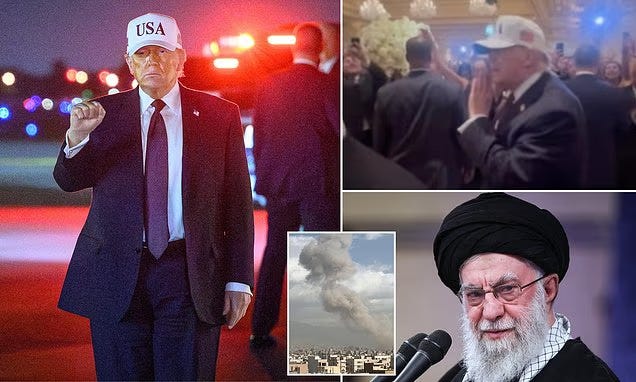
It is difficult to understand why Donald Trump and his inner circle decided to go to war with Iran. Ordinarily, when the United States contemplates war, there is a process. The Constitution assigns the power to declare war to Congress. Over time, that process has been, in practice, largely replaced by other means to make Congress a part of the initiation of hostilities. But the underlying principle has endured: prolonged or large-scale war requires the voice and counsel of the people’s representatives. War is not meant to be the continuing decision of one person. If a president believes hostilities must be sustained, he is expected to seek authorization and funding from Congress, and it should reflect deliberation, debate, and, ultimately, the informed consent of the governed.
That process does more than allocate power. It provides an explanation. Congressional hearings, unclassified briefings, public statements, and debate all help citizens understand why American blood and treasure should be expended abroad. Even in controversial conflicts, there has usually been a discernible rationale. We may disagree with it. We may later conclude it was flawed. But it has been articulated and defended within a recognizable constitutional framework, which Congress formally or functionally engaged in the decision to initiate or continue hostilities.
Even if the process has been imperfect, Americans have historically been able to rely on something more basic: a presumption that the President acts out of patriotism, guided by experienced professionals, and exercising reasoned judgment. That presumption has extended across party lines. Citizens have trusted that before ordering missiles launched or troops deployed, the President has weighed the evidence, consulted intelligence professionals, listened to military leadership, and reflected on the national interest.
None of that clarity exists here. We are told we are now at war with Iran only after learning that our own government has carried out what appears to have been an unprovoked attack on that sovereign country. There was no meaningful congressional debate. There was, and has been, no intelligible public explanation. There was no visible interagency process that Americans could point to and say: this is how such a grave decision was made.
In place of deliberation, we have received fragments—largely delivered through social media. The explanations offered have been thin and inconsistent and include: an (unidentified) imminent Iranian threat to the US and to U.S. forces and interests abroad; the need to protect American troops and citizens in Iran; even, astonishingly, allegations that Iran “stole” the election for Joe Biden. These rationales do not make sense; they are ketchup thrown at the wall to see if it sticks. They are asserted, not demonstrated. There are, of course, genuine threats to American forces and interests in the region. But the leap from those ongoing dangers to a sudden, large-scale assault on Iran, and especially to the allegation that Iran “stole” the election for Joe Biden, lacks the evidentiary foundation and strategic clarity that one would expect before initiating hostilities against a regional power with significant asymmetric capabilities. And they have the sharp odor of lies.
If the conventional explanations do not fully explain or fail to explain the decision to go to war, then we must ask whether there is another, more obvious answer—one drawn not from constitutional democracies, but from the playbooks of authoritarian leaders: When a ruler needs to tighten his grip on power, he starts a war.
History is replete with examples. External conflict consolidates internal authority. It shifts attention away from domestic divisions. It enables emergency powers. It justifies secrecy, surveillance, and suppression in the name of national security. It reframes dissent as disloyalty. And it creates a climate in which elections, oversight, and civil liberties are portrayed as inconvenient luxuries rather than constitutional necessities.
For Donald Trump, it is increasingly clear that the central adversary is not Iran, or China, and certainly not Russia. It is the American voter—particularly voters who oppose him. He has called for “regime change” in Iran, but his real interest may be in avoiding regime change here in America.
In recent weeks, he has openly mused about the possibility that there may not be a midterm election, about the need for him to control those elections, about the desirability of a third term, and even about the idea that we “don’t need elections anymore.” These are not slips of the tongue. They are themes.
Until now, he has attempted to justify extraordinary measures by invoking domestic unrest: “leftist terrorists,” a vast Antifa network, a country supposedly teetering on the brink of insurrection. But those claims have grown increasingly untenable as Americans learn more about what actually occurred in places like Minneapolis and Los Angeles. The narrative of nationwide chaos has not held.
A foreign war against a country with a history of and capability for committing significant terrorist attacks, by contrast, is a far more sustainable justification. Iran is not a phantom menace. It is a longstanding adversary with real capabilities and a documented history of supporting proxy groups such as Hezbollah. The threat of terrorism—whether directly conducted by Iran or carried out by its global network of proxies—is real. That reality gives fear credibility.. It provides a plausible basis for emergency declarations. It allows the executive branch to invoke extraordinary authorities that would otherwise meet resistance.
This is precisely what an aspiring autocrat requires: an external enemy that is not fabricated out of whole cloth, but is real, and the danger of that enemy can be internalized, amplified, and instrumentalized. The existence of a genuine threat makes it easier to normalize expanded surveillance, militarized policing, restrictions on protest, and the marginalization of political opposition. Under the banner of wartime necessity, measures that would once have been shocking can become routine. Dictators need enemies. Sometimes they invent them. But when invention ceases to persuade, autocrats create circumstances in which the enemy seems undeniable. A long, bloody conflict with Iran would achieve what exaggerated claims of domestic unrest could not: a sustained atmosphere of emergency.
To be clear, this is not to deny that Iran poses a threat to U.S. interests or that legitimate disputes exist. Nor is it to minimize the real dangers that could flow from escalation. It is precisely because those dangers are real that the decision to go to war must be subjected to the highest level of scrutiny and constitutional discipline. But this, Trump’s decision, was not explained, coordinated, or authorized; Trump decided and then told the country that we were invading. We are at war.
If this war proceeds without additional scrutiny—if it serves to entrench executive power, sideline Congress, and condition the public to accept indefinite emergency rule—then it will not be merely a war against Iran. It will be something far more troubling.
Donald Trump may frame this as a necessary confrontation with a foreign adversary. He will undoubtedly claim it as “his” war. But if the true effect is to weaken elections, concentrate power, and suppress dissent, then the ultimate target is not Tehran. It is the American people.
Steven A. Cash served as a prosecutor in the Manhattan District Attorney’s office before joining the CIA in 1994 as Assistant General counsel and subsequently serving as an intelligence officer in the Directorate of Operations. In 2001 he joined the Senate Select committee on Intelligence as Counsel and designee-staffer to Senator Diane Feinstein). He later served as a senior staffer in the House Select Committee on Homeland Security, the Department of Energy, the Senate Judiciary Subcommittee on Terrorism, Technology and Homeland Security and the Department of Energy. In the private sector he has advised on national security, counterintelligence, and technology policy and served on the Biological Sciences Experts Group under the Director of National Intelligence. Mr. Cash is currently the Executive Director of The Steady State.
Founded in 2016, The Steady State is a nonprofit 501(c)(4) organization of more than 390 former senior national security professionals. Our membership includes former officials from the CIA, FBI, Department of State, Department of Defense, and Department of Homeland Security. Drawing on deep expertise across national security disciplines, including intelligence, diplomacy, military affairs, and law, we advocate for constitutional democracy, the rule of law, and the preservation of America’s national security institutions.
Powered by WPeMatico