
Common Sense, Take 2: Democracy as a Patient, Part II
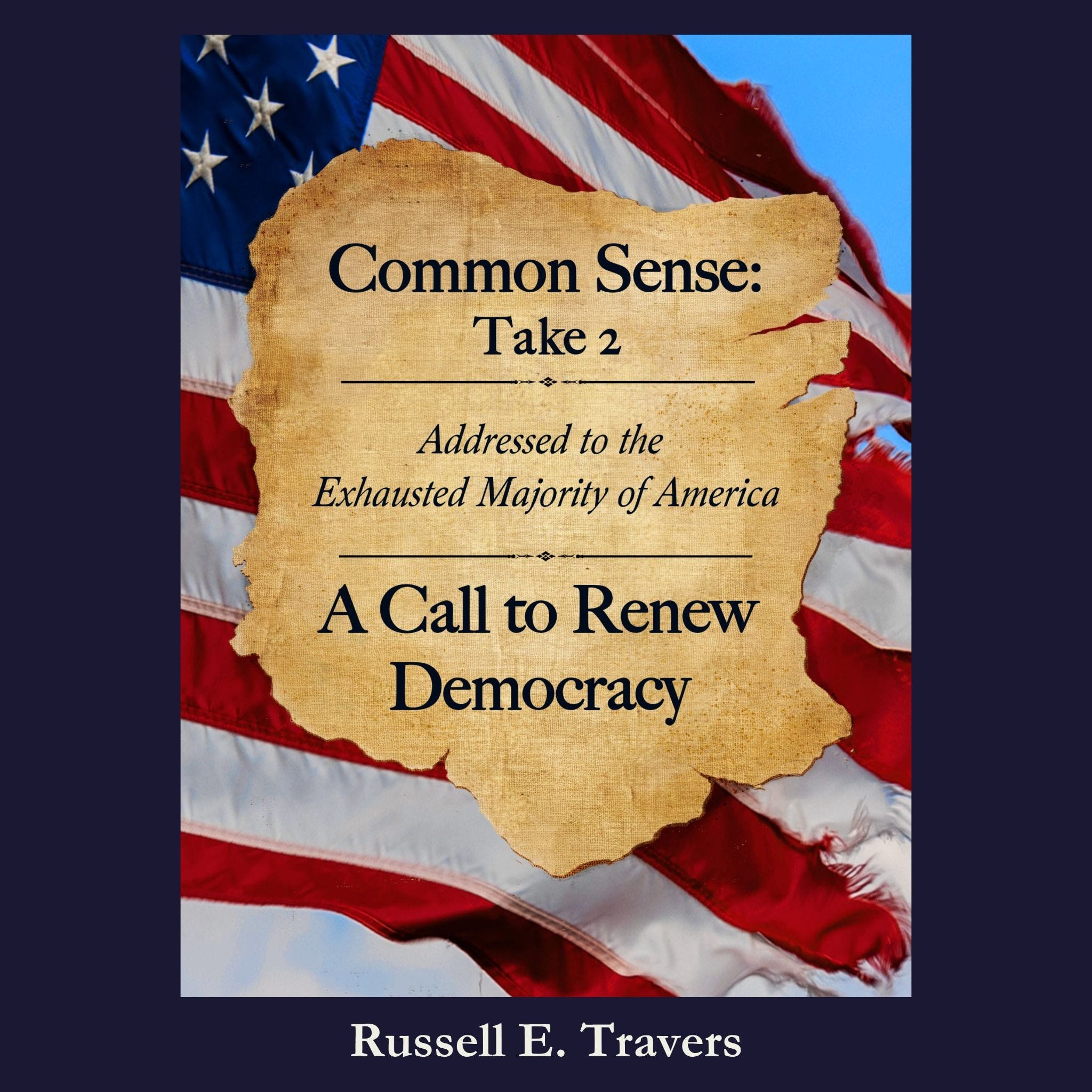
A new book, Common Sense: Take 2, A Call to Renew Democracy, contends that the United States is confronting not simply a political crisis but a deeper crisis of democratic capacity. Written by Russ Travers, a career public servant across multiple administrations who retired as Acting Director of the National Counterterrorism Center, the book focuses on the institutional, civic and cultural work needed to address this crisis.
Over a period of five weeks, members of The Steady State provide commentary on each of the book’s five themes. This essay, written by Jim Petrila, addresses Theme Two: Democracy as a Patient and is the second essay the Steady State is offering on this particular theme.
Abraham Lincoln’s opening words to his iconic Gettysburg Address crystallized the existential threat that faced America in what, from our vantage point in 2026, was the first third of our nation’s history: whether the America envisioned by the Declaration of Independence, committed to the proposition that all men are created equal, long endure. The slave power was so entrenched in American institutions that it took a Civil War to resolve the slavery question. The issue of racial equality, of course, was an entirely different issue that remains unresolved to this day.
The run-up to the Civil War was characterized by multi-system failure, inevitable for a young country that could not remain half slave and half free. The great abolitionist William Lloyd Garrison viewed the Constitution as inherently a pro-slavery document, a view that ironically was shared by many pro-slavery forces. Frederick Douglass initially held that view, but in May 1851 announced his belief that the Constitution in fact could be used to end slavery. This debate continues into the present.
A deeply divided Congress ultimately favored the slave interests. The Missouri Compromise of 1820 drew a line at the thirty-sixth parallel to divide the country into free and slave states, but was undone by the Kansas-Nebraska Act of 1854, which allowed the new territories to determine whether they would be slave or free. The Fugitive Slave Act of 1850 showed that Congress was willing to support the slave interest throughout the country, which in turn mobilized abolitionist forces in the North. Chief Justice Roger Taney’s Dred Scott decision in 1857, recognized as the worst decision in Supreme Court history, held that Black people could never become citizens and that Congress could not prohibit slavery in any U.S. territories. The Civil War followed.
While Congress and the Supreme Court were aligned on the slavery issue, Franklin Pierce and James Buchanan were weak leaders who failed at addressing the existential threat to the nation. Buchanan in particular claimed he had no power to prevent states from seceding, nor to prevent the secessionist states from raiding federal arsenals throughout the South.
If the Civil War ended the first third of America’s history, the next period centered on whether Black Americans would enjoy equal rights (a resounding “no” from all three branches of government), whether the United States would become an imperial power (a resounding “yes” cemented by the Spanish-American War), and whether the U.S. government would regulate business in any meaningful way (a resounding “no” until the Great Depression brought a different answer).
Though the Union had been saved, U.S. institutions helped ensure the legality of racial segregation. The Supreme Court paved the way for Jim Crow throughout the South in the infamous Plessy v. Ferguson decision. Woodrow Wilson segregated the federal work force and the military. Racial equality remained a distant dream. The US entered World War I in 1917, but isolationism, limits on immigration, and a Red Scare soon followed. The failure of the government to address the social crisis of the Great Depression led to the New Deal and the development of a series of independent federal agencies to provide necessary regulation to what had been unregulated financial markets.
The post-World War II period was one of American leadership, resilience, and ingenuity, making possible the Allied victory and post-war rebuilding of Europe and Japan. National purpose in opposition to the Soviet Union, commitment to a rules-based international order, and a firm belief in our democratic values resulted in what has been called the American century. The Supreme Court overturned the Plessy case; Congress at the urging of President Lyndon Johnson passed civil rights legislation; America created NATO, the world’s most successful defense organization. While progress could be slow and uneven, the government recognized the need to protect the environment. The aperture of human rights opened up to racial minorities and other marginalized groups and communities. Equality for women moved forward at tremendous speed.
It was good while it lasted, but we must recognize that this third period has now come to an end. Democratic norms are eroding in all three branches of government. The Roberts Majority has made the Supreme Court a super-legislature, overturning environmental and civil rights legislation. It has enabled Executive overreach but appears to be retaining the right to intervene based on partisan outcomes. Congress has willingly ceded its power to. an executive who regularly tests legal and constitutional limits while seeking to reward allies and punish perceived enemies. Congress has also weakened its own credibility by failing to meet long-term fiscal responsibilities while allowing the wealthiest Americans to benefit from a tax system many citizens experience as unequal. The system is flashing red as institutional capture, corruption, and democratic backsliding are illiberal governance.
As before the Civil War, the slide of our institutional erosion has been steep; we are seeing once again that democracy can fail when multiple institutions weaken at once and citizens lose hope that a constitutional government can still correct itself. The first step is for citizens to awaken to the dangers to our fragile democracy to stop the slide. Solutions will be there but democratic renewal will require seeing the whole patient, not merely addressing one symptom at a time.
Powered by WPeMatico