Common Sense Take 2: Democracy as a Patient
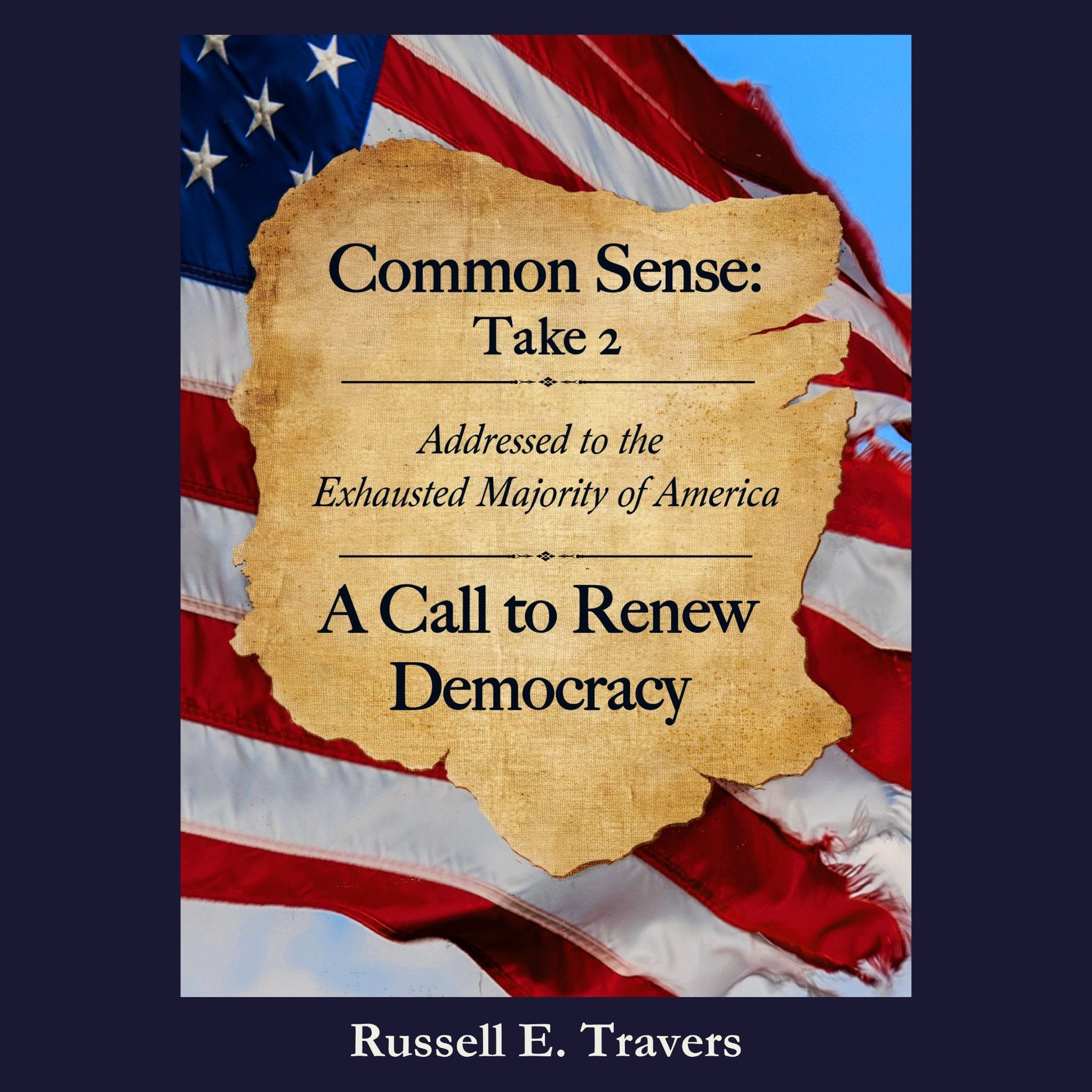
A new book, Common Sense: Take 2, A Call to Renew Democracy, contends that the United States is confronting not simply a political crisis but a deeper crisis of democratic capacity. Written by Russ Travers, a career public servant across multiple administrations who retired as Acting Director of the National Counterterrorism Center, the book focuses on the institutional, civic and cultural work needed to address this crisis.
Over a period of five weeks members of The Steady State will provide commentary from The Steady State on each of the book’s five themes. This essay, written by Martha Duncan, addresses Theme Two: Democracy as a Patient.
Enjoy a second essay on this same theme on Friday.
America’s democratic challenge is often described through the lens of elections, candidates, or administrations. We speak of democratic crisis as if it arrives every four years and departs when ballots are counted. History suggests otherwise.
Democracies rarely weaken because of a single election. They do not usually fail because one leader arrives, one court rules, one party wins, or one movement gains strength. More often, democratic erosion emerges gradually through accumulated institutional stress: declining trust, weakening oversight, civic disengagement, information fragmentation, legislative paralysis, and the growing belief that government no longer works in ways citizens experience as fair, competent, or responsive. Democracy behaves less like a machine than a living system: when several organs weaken simultaneously, the whole body begins to lose resilience, including the capacity to correct, adapt, and govern..
This is where conversations about authoritarianism matter.
Authoritarian governance rarely arrives announcing itself from one day to the next. More often, it appears first as concentration: more power flowing upward alleging to “fix” an eroding democracy. and becomes increasingly powerful as a result of fewer institutions acting independently, increasing personalization of authority, weakening constraints, loyalty replacing expertise, and public frustration that makes simplified answers appear attractive.
My family and I lived through it under General Manuel Noriega, Panama’s de facto military dictator from 1983 until Operation Just Cause in December 1989 removed him from power. Strongman politics has always drawn energy from institutional fatigue. When people lose confidence that legislatures can legislate, agencies can function, courts can be trusted, information can be verified, or civic participation can matter, the appeal of certainty from a strongman grows. Complexity becomes exhausting. Pluralism begins to feel inefficient. Democratic friction, the very thing designed to prevent abuse, starts to look like failure.
The challenge before us is larger than resisting any single personality, election cycle, or political movement, although that, we must do. But even if immediate threats pass, unresolved institutional weakness remains. Democracies that restore surface stability without repairing underlying capacity often discover the crisis was delayed rather than solved. We may win the moment and still lose the future. If democratic resilience is the goal, then the task ahead is not nostalgic restoration but a rebuilding of democratic capacity.
If democracy is a patient suffering from multiple interconnected stresses, then the observations offered by Russ Travers serve as both diagnosis and framework for renewal. They remind us that democratic renewal cannot be achieved through elections alone; it requires rebuilding the legitimacy, capability, and public trust of the institutions upon which self-government depends.
Renewal means rebuilding civic trust. Renewal means strengthening institutional capacity. Renewal means restoring confidence that constitutional systems still function as intended—not perfectly, but credibly. Renewal means ensuring that rule of law remains stronger than personalities and institutions and that that those institutions remain larger than factions. It also means accepting an uncomfortable truth: democratic resilience is measured not by how societies behave during calm periods, but by how they respond under stress. That raises hard questions: Do institutions adapt? Do citizens remain engaged? Does oversight continue? Do independent voices survive? Can disagreement exist without democratic rupture?
Answers to these questions increasingly define the future of our self-government. There are reasons for optimism. History shows that democratic systems possess an extraordinary ability to correct when citizens remain committed to them. Institutions can recover. Trust can be rebuilt. Civic culture can renew itself. Democratic legitimacy can be strengthened.
But none of these occur automatically. Democracy is not self-sustaining. It requires maintenance. It requires participation. It requires institutions capable of doing difficult things over long periods of time. And perhaps most importantly, it requires citizens willing to think beyond the immediate and ask harder questions about what kind of democratic system future generations will inherit.
America’s democratic challenge is therefore not only to reverse authoritarian tendencies in the present. We also need to build enough resilience to ensure that future generations are not forced to confront the same vulnerabilities again. The work ahead will be long. Institutional repair rarely fits election cycles. Trust rebuilds slowly. Capacity develops over years. Civic culture evolves across generations.
Democracies have survived difficult periods before because citizens chose engagement over resignation and stewardship over complacency. The American experiment has always depended on that choice. Our challenge is not merely to preserve democracy as it was. It is to strengthen democracy, so it remains capable of governing, adapting, and renewing itself in the century ahead. Because self-government is not an inheritance that renews automatically. It is a responsibility. And resilience is how republics endure.
Enjoy a second essay on this same theme on Friday.
Martha Duncan is a retired U.S. Department of Defense senior executive with 37 years of service, including 23 years as an officer in the U.S. Army Reserves, where she also served as Reserve Attache. She had three operational deployments to Panama, Bosnia, and Afghanistan. At DIA, she worked as a Latin American analyst for 11 years. A specialist in human intelligence (HUMINT), she is recognized for her leadership in intelligence operations, coalition-building, and enterprise-level policy development across the Defense Intelligence Agency (DIA), the U.S. Army, and the broader Intelligence Community. She grew up in Panama during the rise of Manuel Noriega and was instrumental in his capture.
Founded in 2016, The Steady State is a nonprofit 501(c)(4) organization of more than 400 former senior national security professionals. Our membership includes former officials from the CIA, FBI, Department of State, Department of Defense, and Department of Homeland Security. Drawing on deep expertise across national security disciplines, including intelligence, diplomacy, military affairs, and law, we advocate for constitutional democracy, the rule of law, and the preservation of America’s national security institutions.
Powered by WPeMatico