Common Sense, Take 2: States, Schools, and the Generational Roadmap
By Adam Wasserman
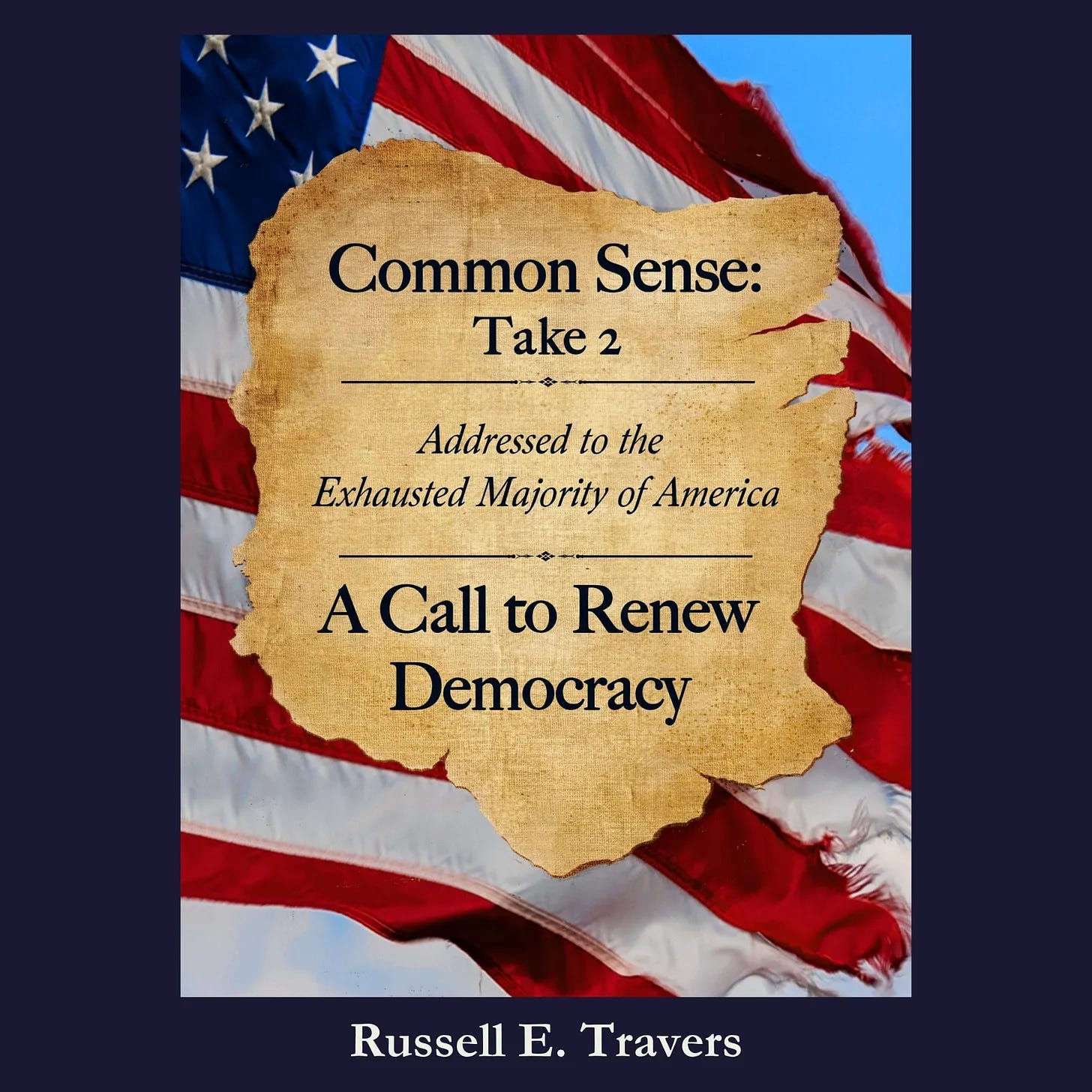
A new book, Common Sense: Take 2, A Call to Renew Democracy, contends that the United States is confronting not simply a political crisis but a deeper crisis of democratic capacity. Written by Russ Travers, a career public servant across multiple administrations who retired as Acting Director of the National Counterterrorism Center, the book focuses on the institutional, civic and cultural work needed to address this crisis.
Over a period of five weeks, members of The Steady State provide commentary on each of the book’s five themes. This essay, written by Adam Wasserman, addresses the 5th theme: States, Schools, and the Generational Roadmap – Political Experimentation; Building Democratic Capacity Through Civic Participation.
“When a problem cannot be solved, enlarge it.” Dwight Eisenhower
Democratic renewal will require a combination of civic education, local engagement, and institutional experimentation, to create a culture of participation. That premise offers a useful starting point for thinking about what ails our country and what renewal may require. We are in the midst of a multi-faceted crisis, what some call a ‘polycrisis’, that has many causes and will not be remedied overnight. Replacing one party or one President in the next round of elections is a necessary but far from sufficient solution. Every election now is ‘throw the bums out’ and that cycle will continue until we acknowledge that we are doing the same thing over and over and expecting different results. And we all know that points to a deeper institutional failure which has opened the door to a wannabe-autocrat.
Any serious conversation about democratic renewal has to start with the decline in governing capacity. Most citizens do not think our elected officials and the institutions they occupy are doing their jobs. And they’re right. Instead of passing budgets and negotiating seriously to tackle the complex challenges voters expect the government to address, they are preening on social media and dialing for dollars from rich donors. The elected members of an entire political party have abandoned their independence in favor of a single man.
The same dynamic is at work in major democracies around the world. Great Britain’s historic liberal and conservative parties are being sidelined by anti-immigrant, populist movements. In France and Germany, similar forces have become entrenched and threaten to take power. In India, Narendra Modi has dominated politics for over a decade and shifted India sharply towards his vision of a Hindu nationalist state.
In short, the political center is under assault, mostly from nationalist right-wing parties and movements who often exacerbate political paralysis to benefit from the resulting voter dissatisfaction. In their frustration, citizens are vulnerable to demagogues and would-be tyrants.
Upstream Democratic Work
That is why upstream democratic work matters. Some of the most important repairs to democratic capacity can begin at the state level or through civil society: electoral reforms, limits to gerrymandering, civic education (where we are making progress, according to Harvard professor Danielle Allen, head of Educating for American Democracy), and institutional experimentation. These kinds of upstream efforts can help rebuild trust and participation, creating the civic conditions that make larger institutional repair possible over time.
I want to highlight the last of these, institutional experimentation. This year we celebrate 250 years of independence. We are proud that for almost all this time we have flourished under our original Constitution and under the same basic electoral system: a two-party first-past-the-post election process that is used at almost every level in American politics. But 250 years is a long time for any political system to go unexamined. As constitutional scholar Erwin Chemerinsky points out in his recent book No Democracy Lasts Forever: How the Constitution Threatens the United States, our constitution is very difficult to change and under present political conditions is virtually unamendable. Most state constitutions—and constitutions in other democracies— are much more flexible.
I believe most of the Founders would be appalled that we have become such sticks-in-the-mud. They knew what they were crafting was an experiment. They knew they could not foresee the future. They would expect future generations to re-examine and re-think the American project in light of experience—ours and other countries—a changing world, and changing values. Think of the issues that need examination: the electoral college, the 2nd Amendment, lifetime appointments to the Supreme Court, an un-democratic Senate, unchecked Presidential pardon power, gerrymandering, the two-party system, money in politics. For many of these, a majority of Americans clearly wants change. All these and more could, in principle, be addressed with amendments. But few think this is possible in our present political environment.
Democratic Deliberation and Participation
We must widen the Overton window for serious democratic discussion. This should include space to examine fundamental constitutional questions and the civic processes by which Americans might deliberate about them. Conservatives have in recent years been enthusiastic about this to impose term limits and a balanced-budget amendment; others should be willing to consider how democratic participation itself might be made more representative, deliberative, and accountable. Debating and arguing about these fundamentals would help re-invigorate our democracy and start the kind of national conversation we desperately need. Chemerinsky and other constitutional scholars argue that in many ways it would be easier to write a new constitution than to try to make piecemeal changes to our existing document.
Critics have rightly worried that any major surgery on the Constitution, much less trying to write a new one, would fall prey to polarization. How could our divided country possibly debate these issues without exacerbating our differences? We would be looking at the loudest, nastiest, most expensive campaign in history. We would be lucky to survive it without civil war.
Maybe. But we have been digging a long time and are now deep in the hole. We will not get out with “business as usual.” Perhaps we are already in a hole so deep that such action is no longer possible, or at least not possible now. But, if or when the opportunity arises, we will not get out of that hole with business as usual. There are ways we could consider to make possible direct citizen engagement, ways that have shown promise here and in other countries.
Examples From Around the World
There are ways we could consider to make possible direct citizen engagement, ways that have shown promise here and in other countries. Take, for example Citizen’s Assemblies, in which groups are assembled by lot, , randomly, using well-understood statistical methods to ensure participants reflect the broader public.
Citizens’ Assemblies have been used hundreds of times in the last several decades in Europe, the US, Canada, Australia and other countries to tackle issues at the municipal, regional, and national level. In Ireland a series of Assemblies led to the liberalization of laws on abortion and same-sex marriage; they are now a routine part of governance.
Or the Taiwan/Polis online platform that helps to create deliberation and consensus among disparate users. In Taiwan it has become an accepted part of governance, and has also been used in Austria, Paraguay, and Bowling Green Kentucky.
Or in Denmark, where the constitution guarantees the right to form associations free from state control, and municipalities provide small, flexible grants to citizens for a wide variety of cultural and environmental groups.
Democracy is a not a Spectator Sport
Modern democracy depends on elections, but it should not end with them. Elections are essential acts of self-government, yet many citizens experience them as distant, performative, and disconnected from problem-solving. Competition between political parties inevitably produces polarization and animosity, which is easily supercharged in today’s media environment. The people who win elections often do so by displaying qualities like looks, money, glibness, and unwarranted self-confidence. They appeal more to anger and fear than to our better angels. Too often, people who would make good legislators and decisionmakers but lack these characteristics remain on the sidelines. In fact, they avoid electoral politics like the plague.
I realize a constitutional convention might seem too radical, too risky. But we need to start talking together about this and other ideas for institutional experimentation. Dwight Eisenhower said, “When a problem cannot be solved, enlarge it.” Our democratic polycrisis calls on us to think big about how civic participation, local experimentation, and long-term renewal can rebuild democratic health. Instead of treating symptoms, this approach promises to bring about true health.
Adam Wasserman is a retired CIA analyst with experience on failing democracies in the former Soviet Union, the Middle East, and Southeast Asia. He served on the State Department Policy Planning Staff, the CIA Red Cell, and the National Security Council staff. He is a member of The Steady State.
Founded in 2016, The Steady State is a nonprofit 501(c)(4) organization of more than 400 former senior national security professionals. Our membership includes former officials from the CIA, FBI, Department of State, Department of Defense, and Department of Homeland Security. Drawing on deep expertise across national security disciplines, including intelligence, diplomacy, military affairs, and law, we advocate for constitutional democracy, the rule of law, and the preservation of America’s national security institutions.
Powered by WPeMatico