Common Sense Take II: States, Schools, and Communities – Part 3
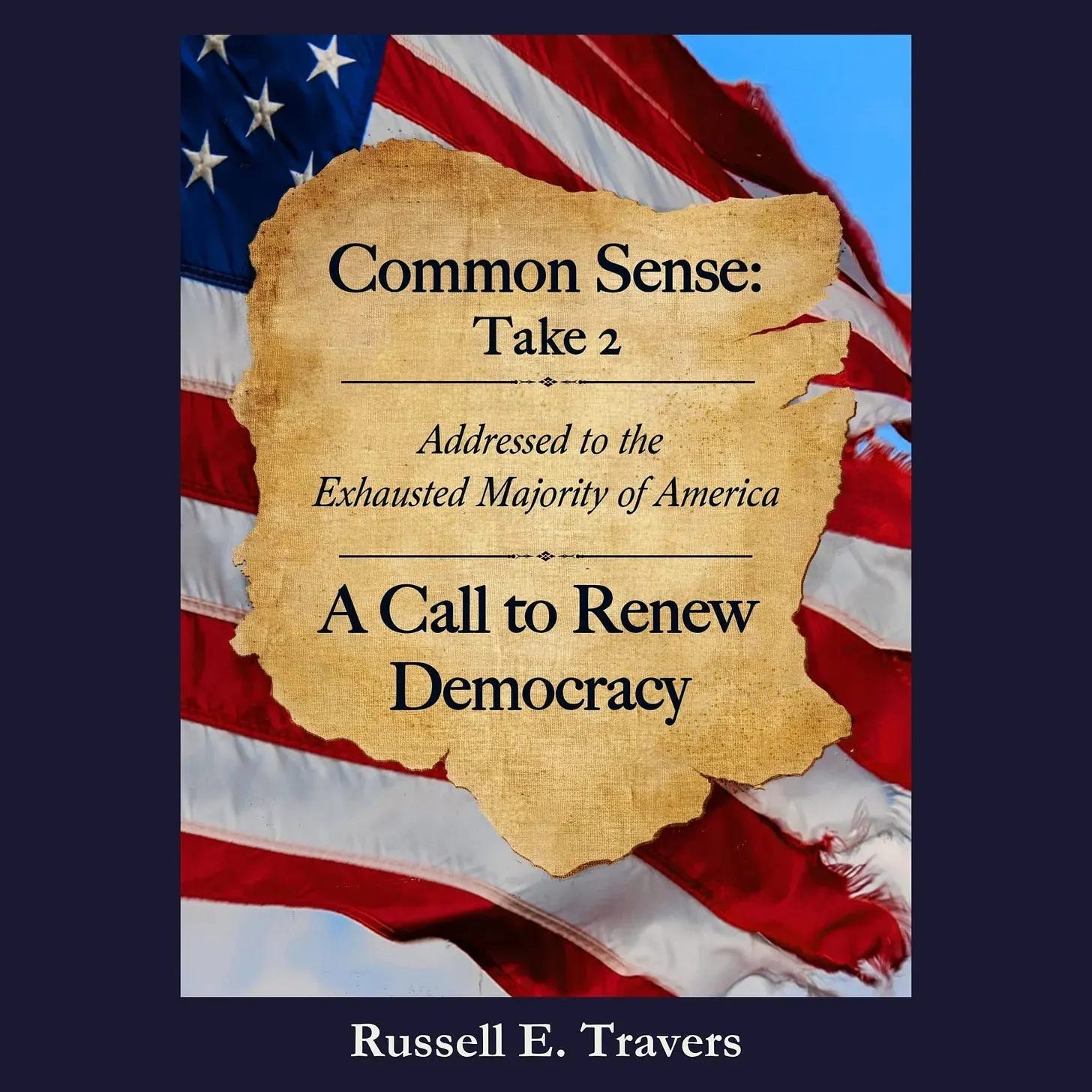
A new book, Common Sense: Take 2, A Call to Renew Democracy, contends that the United States is confronting not simply a political crisis but a deeper crisis of democratic capacity. Written by Russ Travers, a career public servant across multiple administrations who retired as Acting Director of the National Counterterrorism Center, the book focuses on the institutional, civic and cultural work needed to address this crisis.
Over a period of five weeks, members of The Steady State provide commentary on each of the book’s five themes. This essay, written Ken Syring, is the third essay to address the 5th theme: Civic Renewal Through States, Schools and Communities.
Democracy depends on perishable skills. We rarely name them as such, but a free society runs on a set of learned human capacities — the habit of cooperating with people unlike ourselves, the reflex of extending dignity across lines of difference, the patience to settle disputes through argument rather than force — and like any perishable skill, they can atrophy when they go unpracticed.
In California, where I trained and spent a decade as a police officer in San Francisco, the state requires officers to periodically return to the range and the mat on a to requalify in what are known as “perishable skills” that can keep a tense encounter from turning violent. The premise is unsentimental, and every officer learns it early: the abilities most essential to the job are precisely the ones that degrade without deliberate, repeated practice. A capability you stop exercising is a capability you are quietly losing.
I did not learn this in a police academy. I learned it in Mongolia.
When I arrived in the city of Choibalsan as a Peace Corps Volunteer in 2006, it was for the primary task of being an English teacher. Two years later, I came home changed in a way the recruitment brochures had not quite advertised. Through winters that reached forty below, my survival and my work depended on the hospitality of neighbors whose language I spoke poorly and on partnerships with local leaders I could meet only as an equal. Something in the us-versus-them circuitry that I, like everyone, carry was rewired in the process. I returned more empathetic, less frightened of the unfamiliar, and more willing to trust that cooperation across difference actually works.
Measurable Dispositions Predict Inclination to Authoritarian Support
The evidence that such capacities can be deliberately built is stronger than most people realize. Social psychologists have identified two measurable dispositions that reliably predict support for authoritarian politics: right-wing authoritarianism (RWA), a craving for order, conformity, traditionalism, and strong leaders who punish deviance; and social dominance orientation (SDO), a preference for rigid hierarchy in which some groups rightly sit above others. Both correlate with believing and spreading disinformation, with endorsing antidemocratic policies, and even with condoning political violence.
These dispositions may not be necessarily fixed: in one study of 140 undergraduates, students who completed a service-learning experience showed roughly a ten percent reduction in their SDO scores, while a control group showed no change at all. In psychological terms that shift is considerable — the distance between a person inclined to share a conspiracy theory and one inclined to question it. This is the mechanism that programs like the Peace Corps and AmeriCorps quietly run at scale. They are not interesting here as line items in a federal budget; they are interesting as places where ordinary people practice the perishable skills of a free society until those skills take hold.
When a society stops providing those places to practice, the skill does not just fade away. Rather, it becomes something that can be easily replaced by something else.
The Combustibility of Social Isolation
We are living through a loneliness epidemic that has left the young uniquely exposed. Roughly a quarter of young men report feeling lonely frequently — about ten points above the average across wealthy democracies — and more than four in ten college students say they feel more isolated than earlier generations did. Isolation of that kind is not merely painful; it is politically combustible. In my years studying extremist recruitment, I watched a consistent pattern: social isolation drives people into online communities — from white-supremacist forums to anti-government militias — where belonging is purchased with shared grievance, where a worldview reorganizes itself around blame, and where some eventually become willing to endorse violence against the system they fault.
I saw this from inside law enforcement, not only as a researcher. Officers who drifted toward groups like the Oath Keepers were often chasing the belonging their increasingly polarized profession had cost them. January 6, 2021, was not an aberration; it was the predictable yield of a great many isolated people who had found community in conspiracy rather than in common purpose. A generation formed in grievance is the mirror image of one formed in service.
Civic Participation – An Antedote
This is why civic participation cannot just be improvised. Like muscle memory, the disposition to govern ourselves – together – is built slowly, through repetition, long before the moment it is seriously tested. And it cannot be conjured up on the afternoon an aspiring strongman finally knocks at the door. It is the patient work of decades: a civic education that is practiced rather than merely recited, and a habit of participation carried from one generation to the next. In an age of algorithmic isolation, the most effective antidotes remain stubbornly analog — real people, in real communities, doing real work across real differences, until they serve, belong, and ultimately flourish into citizens an authoritarian cannot easily move.
We are, at present, moving in the opposite direction. The institutions that exist to give Americans those shared experiences are being hollowed out rather than expanded, at the precise moment the country can least afford to let the skill lapse. The cost will not appear on a balance sheet. It will surface a decade from now, in a cohort that never practiced the habits a republic requires and never learned that its political opponents are also its neighbors.
Every police officer knows that the skills you neglect are the skills that fail you when your life depends on them. The same is true of a free people. The question before us is not whether we can afford the practice — the ranges and the partnerships and the years of cooperative work that turn residents into citizens. The question is whether we can afford to let the skill perish, and to discover, too late, that self-government was a capacity we once had and quietly let lapse.
We still have the time to practice democracy. Shouldn’t we use it?
Ken Syring served as Deputy Chief of Staff at U.S. Customs and Border Protection, is a former San Francisco police officer and forensic investigator, and is a Returned Peace Corps Volunteer (Mongolia, 2006–2008). His research focuses on mitigating authoritarian traits through national service and countering extremist insider threats within law enforcement. He is a member of The Steady State.
Founded in 2016, The Steady State is a nonprofit 501(c)(4) organization of more than 400 former senior national security professionals. Our membership includes former officials from the CIA, FBI, Department of State, Department of Defense, and Department of Homeland Security. Drawing on deep expertise across national security disciplines, including intelligence, diplomacy, military affairs, and law, we advocate for constitutional democracy, the rule of law, and the preservation of America’s national security institutions.
Powered by WPeMatico