
“He Can’t Do That” Is a Hope, Not a Strategy
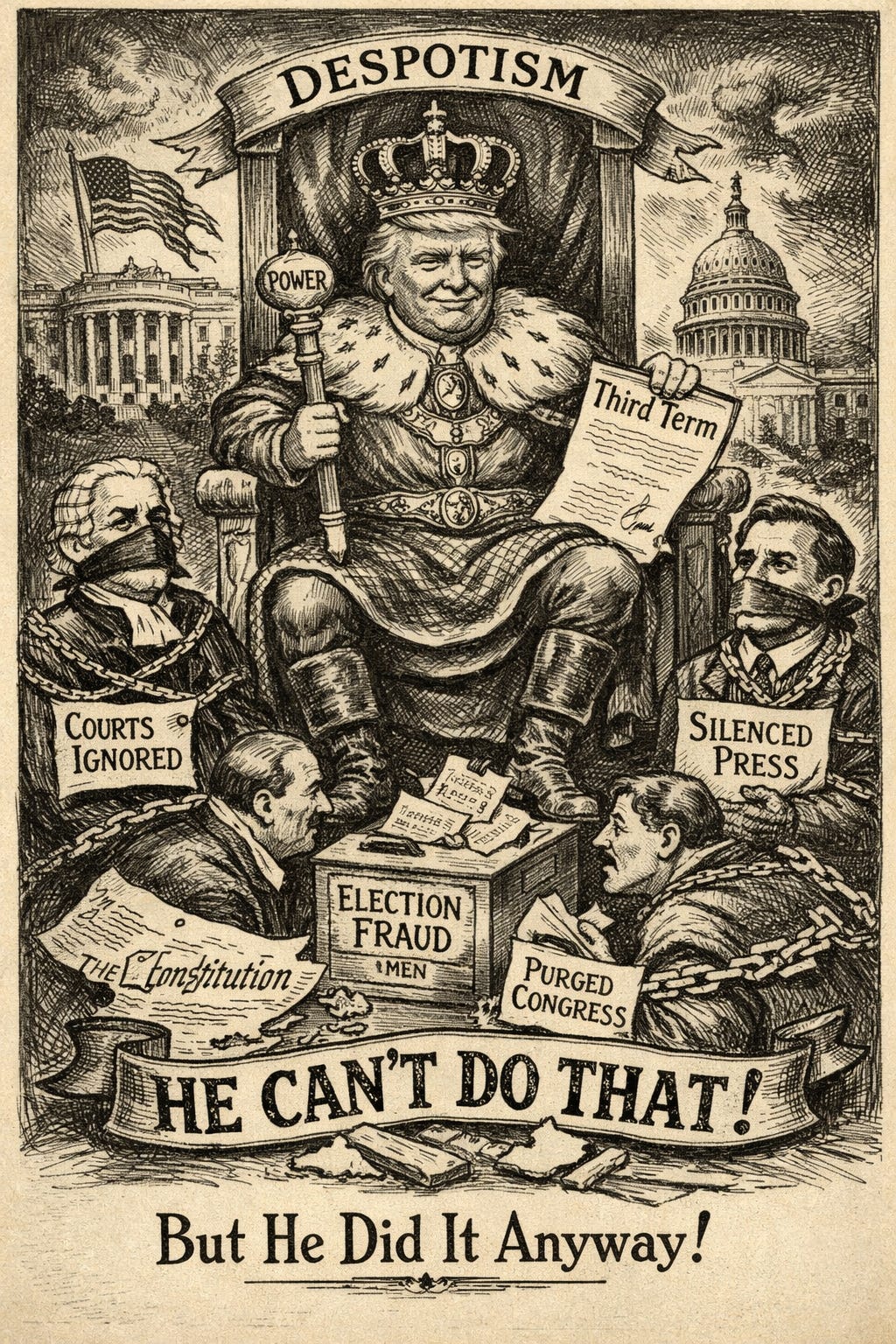
When President Trump muses aloud about canceling elections, serving a third term, ignoring statutes he dislikes, or deciding who governs cities and states, many Americans respond with a reflexive reassurance: He can’t do that.
If by can’t we mean cannot do so in a way that is constitutional or lawful, that response is correct. The Constitution is clear. Federal statutes are clear. The norms and traditions of American governance leave little ambiguity about the limits of residential power.
But if “can’t” means to imply cannot happen, cannot be attempted, or cannot be imposed in practice, then the response is dangerously wrong. In systems governed by power rather than restraint, the only truly impossible act is the one no one attempts.
That instinct—to equate illegality with impossibility—is not a sign of civic ignorance. It is, in fact, a byproduct of living in a country where, for most of its history, the law has largely been followed. Americans are accustomed to a system in which violations of constitutional limits are exceptional, contested, corrected, and punished. Over time, we internalized a comforting assumption: that actions outside the law simply do not occur, or if they do, they collapse under their own illegitimacy.
That assumption is understandable. It is also, regrettably, a fiction.
Members of The Steady State have spent decades working in, studying, and observing countries where constitutions exist on paper but do not meaningfully constrain power. Where courts issue rulings that are ignored. Where elections are formally held but substantively hollow. Where leaders remain in office not because they are authorized to do so, but because they can. In those systems, the phrase “he can’t do that” is often spoken shortly before he does. We have seen this pattern repeatedly overseas. Leaders extend their terms by reinterpreting constitutional provisions, manipulating courts, or simply ignoring legal limits. Judges who resist are sidelined, discredited, or arrested. Legislatures are bypassed or reduced to symbolic bodies. The law remains on the books, but it no longer governs.
Authoritarianism does not announce itself with a formal repeal of constitutional order. It advances through normalization: small transgressions that go unpunished, larger ones that are rationalized, and eventually actions that would once have been unthinkable but are now met with resignation or fatigue. Each step is defended not by legality, but by power, loyalty, or the absence of effective resistance.
The critical lesson from those systems is simple: illegality does not prevent action; it merely tests the cost calculus.
President Trump has already demonstrated this reality in the American context. He has taken actions that were plainly unlawful or unconstitutional and suffered few immediate consequences. He attempted to overturn a lawful election. He pressured state officials to falsify results. He obstructed investigations. He ignored congressional subpoenas. He used federal power to reward allies and punish perceived enemies.
In none of these cases did the fact that he “couldn’t” do those things prevent him from trying—or from doing significant damage before institutions reacted.
The American system is resilient, but it is not self-executing. Laws do not enforce themselves. Courts rely on compliance. Norms depend on shared commitment. When a president is willing to violate legal boundaries and test whether anyone will stop him, the question is no longer Is this allowed? but Who will act, and at what cost? That is the question authoritarians ask every day.
Too often, American commentary treats Trump’s statements as jokes, bluster, or rhetorical excess precisely because they are unlawful. But experience abroad teaches a harsher truth: authoritarian leaders often signal their intentions openly. They normalize extreme ideas by floating them casually, watching public reaction, and adjusting tactics accordingly. Each unchallenged statement lowers the bar for the next.
Dismissing these signals as impossible is not prudence—it is complacency.
Recognizing that a president can do unlawful things is not an admission of weakness; it is the foundation of defense. Democracies fail not because their laws are unclear, but because citizens, institutions, and elites assume those laws will be honored automatically.
They are not.
The United States has reached a point where legality alone is no longer a sufficient safeguard. What matters now is enforcement, accountability, and collective refusal to normalize unlawful power. That requires abandoning the comforting fiction that unconstitutional actions cannot occur.
They can. They already have.
The choice facing Americans is not whether the Constitution permits authoritarian behavior—it does not. The choice is whether we are prepared to respond when those limits are tested, ignored, or broken. History suggests that waiting until the law is fully cast aside is always too late.
The time to recognize the danger is not when the Constitution is formally suspended, but when people stop believing that its violation is possible.
Steven A. Cash served as a prosecutor in the Manhattan District Attorney’s office before joining the CIA in 1994 as Assistant General counsel and subsequently serving as an intelligence officer in the Directorate of Operations. In 2001 he joined the Senate Select committee on Intelligence as Counsel and designee-staffer to Senator Diane Feinstein). He later served as a senior staffer in the House Select Committee on Homeland Security, the Department of Energy, the Senate Judiciary Subcommittee on Terrorism, Technology and Homeland Security and the Department of Energy. In the private sector he has advised on national security, counterintelligence, and technology policy and served on the Biological Sciences Experts Group under the Director of National Intelligence. Mr. Cash is currently the Executive Director of The Steady State.
Founded in 2016, The Steady State is a nonprofit 501(c)(4) organization of more than 360 former senior national security professionals. Our membership includes former officials from the CIA, FBI, Department of State, Department of Defense, and Department of Homeland Security. Drawing on deep expertise across national security disciplines, including intelligence, diplomacy, military affairs, and law, we advocate for constitutional democracy, the rule of law, and the preservation of America’s national security institutions.
Powered by WPeMatico