
Hormuz 2026, Suez 1956 – Déjà Vu?
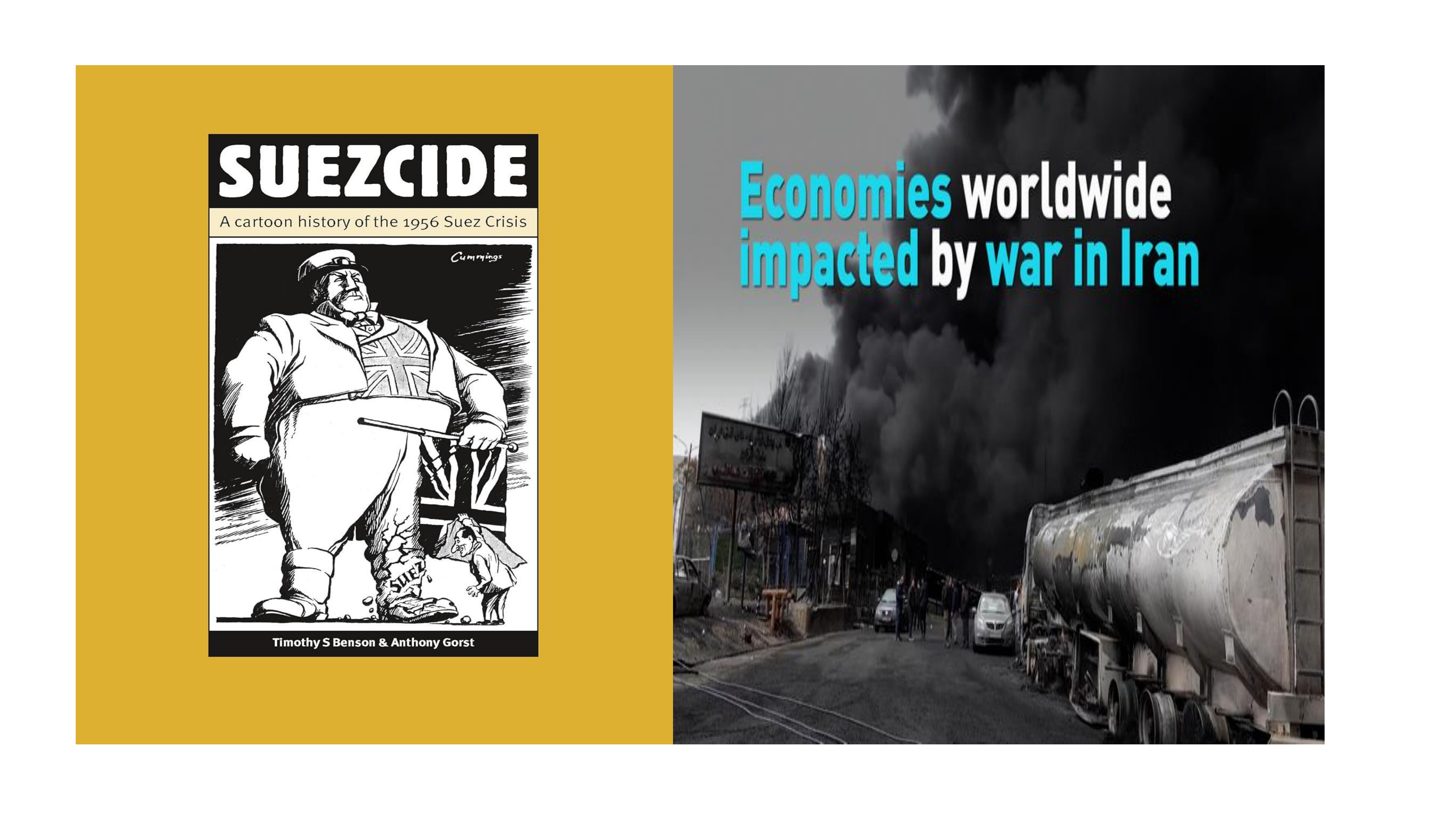
The ongoing US and Israeli war against Iran, with the resulting closure of the Strait of Hormuz and Trump’s plea for allied help, is beginning to have echoes of the 1956 Suez Crisis. While the war is not over, it suggests that the Trump administration is finding it unable to undertake some operations in the Middle East without the support of key allies. This flies in the face of the Trump administration’s militant unilateralism and braggadocio.
The Suez Crisis in a Nutshell
In October 1956, the United Kingdom (UK), France, and Israel invaded Egypt with the goal of securing the Suez Canal, which Egypt had nationalized earlier in the year, and overthrowing Nasser’s Arab Nationalist government. The UK and France opposed Nasser as they perceived him to be a direct threat to their regional colonial interests. Egypt, in fact, was actively supporting anti-French insurgents in Algeria. Israel separately was worried about Nasser’s support for anti-Israeli Arab-Palestinian groups, and Tel Aviv wanted to open up the Gulf of Aqaba, which had been closed to Israel for several years.
The UK, France, and Israel planned and executed the invasion, a move reminiscent of the actions the UK and France took in the 150 years prior to World War II; a time when they were great global powers. The US opposed the invasion diplomatically, fearing it would inflame anti-western Arab nationalism and undercut the diplomatic campaign against the Soviet Union, which invaded Hungary at the same time. Most significantly, the US brought direct financial pressure on the UK to force a ceasefire and withdrawal, inflicting a major public blow on the British government.
Echoes of History?
History does not repeat, but sometimes it echoes. While there were many consequences of the Suez Crisis that shaped the Middle East for a couple of decades, perhaps the most significant global impact was that the Suez Crisis demonstrated to the world and especially to the publics in the UK and France that they were no longer global great powers able to conduct large-scale operations without the US. For both countries, but perhaps the UK most tellingly, this was a shock to the system. (France had already been defeated in Indo-China, with the US assuming responsibility.) Beyond accelerating decolonization, the failure of their Suez intervention confirmed that they were no longer dominant powers and had to work within the US-led system, not independently. In short, they were humiliated and effectively “defeated” politically and strategically, even if not militarily.
How is this relevant to the US today?
The Trump administration launched the war against Iran without any support from US allies, other than Israel. While the ongoing air campaign is tactically successful, the US attacks are not grounded in strategic reality, with the Trump administration lacking any articulated plan to keep the Strait of Hormuz open. The US is now appealing to key allies to provide military assistance to make up for capabilities the US lacks. And this is after spending the last year trashing and threatening these same allies.
As of this writing, US allies have largely said no to Trump’s request, although they are continuing to discuss their options, in part because keeping the Strait open is in their own national interest. Regardless of whether they agree to support the US or not, this may come to represent the same type of shock to the system for the US unilateralists, whether of neo-conservative or MAGA flavor, that the US should not undertake any major operation without support from key allies.
Many parts of the US national security community and broader population who follow foreign and military affairs had long since come to the conclusion that major military operations are most effective when conducted in concert with willing partners and that our alliances were actually the foundation of our strength. However, an important part of the foreign and military affairs community has been deeply uncomfortable with these concepts. This drove much of the Iraq 2003 invasion planning, led to the US withdrawal from multiple key international treaties, and underpins Trump’s unilateralist diplomatic, military, and trade/economic policies.
This unilateralism is based on the assumption that we can muscle our way through any situation, coupled with an ideological wish that we can and should prevent any constraint on the use of American sovereign power. It is unlikely that the US unilateralists (especially Trump, Hegseth, Rubio, and the MAGA echo chamber) will ever willingly or publicly concede they were wrong. However, the potential consequences of their actions, such as increasing military costs and casualties and a growing risk of 1970s-like “stagflation,” may come to shape an image of failure and defeat, not unlike the British and French governments after Suez. Trump going hat-in-hand to the allies he has long berated as weak in order to get some minesweepers1 could be very telling as is potentially being forced to cease operations without a clear (albeit undefined today) “victory.”
Harry Hannah retired after four decades of experience in the Intelligence Community. He retired from the CIA in 2018. About half that time was focused on analyzing the capability of multiple foreign militaries in direct support of US military planning and operations and national-level decision-making. He is a member of The Steady State.
All statements of fact, opinion, or analysis expressed are those of the author and do not reflect the official positions or views of the US Government. Nothing in the contents should be construed as asserting or implying US Government authentication of information or endorsement of the author’s views.
Founded in 2016, The Steady State is a nonprofit 501(c)(4) organization of more than 390 former senior national security professionals. Our membership includes former officials from the CIA, FBI, Department of State, Department of Defense, and Department of Homeland Security. Drawing on deep expertise across national security disciplines, including intelligence, diplomacy, military affairs, and law, we advocate for constitutional democracy, the rule of law, and the preservation of America’s national security institutions.
Interestingly the online “Global Firepower Index” rates the US as the 37th most powerful minesweeper country, with 19 US treaty allies rated higher.
Powered by WPeMatico