Tag Archive for: Democracy

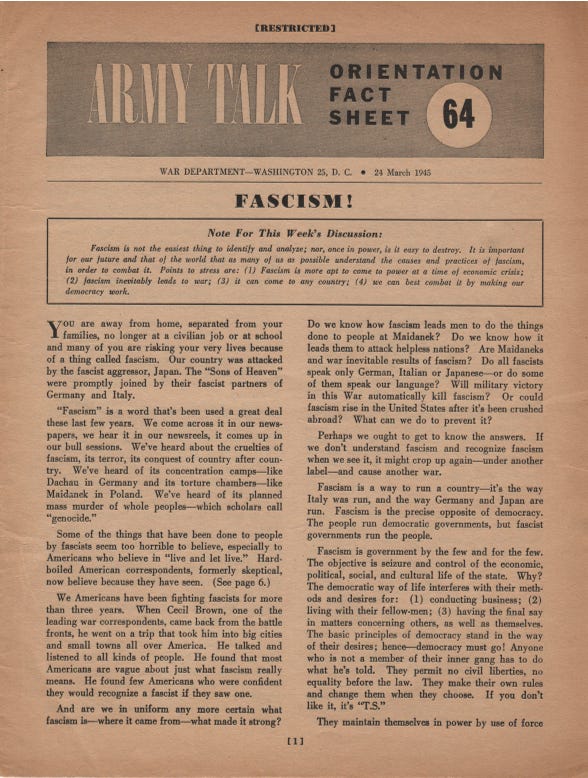
A newspaper with text on it
AI-generated content may be incorrect.

Over the past several months, the Departments of Defense and Homeland Security have become unusually active in communicating directly with the American public, particularly through social-media platforms. Much of this material shares a common aesthetic and rhetorical profile: a romanticized vision of a homogeneous American past, heavy reliance on martial symbolism, and language that frames politics as an existential struggle between insiders and enemies. Many observers have noted that this style bears an uncomfortable resemblance to official propaganda produced by authoritarian regimes in the twentieth century—most notably Germany in the 1930s.

In March 1945, just weeks before the defeat of Nazi Germany, the U.S. War Department issued Army Talk 64, a pamphlet with a blunt, one-word title: “FASCISM!” It was part of a broader series—Army Talks—distributed to American service members in the European theater. The purpose was not morale-boosting or cheerleading. It was civic education.

As historian Heather Cox Richardson recently explained, the Army Talks were designed to help soldiers “become better-informed men and women and therefore better soldiers.” The War Department understood that fighting fascism required more than weapons. It required clarity—about what fascism is, how it operates, and why it poses a mortal threat to democratic societies.

What is striking about Army Talk 64 is not merely its historical provenance, but its enduring relevance. The pamphlet warned that fascism does not announce itself with a single uniform or symbol. It grows gradually, exploiting fear, resentment, and nostalgia. It thrives, the document cautioned, on indifference and ignorance.

The pamphlet reminded American soldiers that freedom is not self-executing. It requires vigilance—not only against foreign enemies, but against domestic practices that corrode democratic norms. “If we permit discrimination, prejudice, or hate to rob anyone of his democratic rights,” the authors warned, “our own freedom and all democracy is threatened.”

This was not radical language. It was official U.S. government doctrine.

The men and women reading Army Talk 64 were preparing to liberate Europe from fascist rule. But the War Department understood that the ideology they were fighting was not confined to foreign soil. Fascism, the pamphlet made clear, is a recurring political disease. It can emerge anywhere citizens lose the habit of critical thinking or surrender democratic responsibility in exchange for a promise of restored greatness.

That clarity stands in stark contrast to our present moment.

Today, public discourse often treats “fascism” as either an insult or a taboo—too inflammatory to name, too dangerous to define. Yet the United States once insisted that its soldiers confront the concept directly, analytically, and without euphemism. The government trusted Americans to understand the warning.

Re-engaging with Army Talk 64 would not be an act of nostalgia. It would be an act of democratic self-respect. The document is not partisan. It does not target any individual or movement by name. Instead, it offers a framework—rooted in American experience—for recognizing when political culture begins to slide toward authoritarianism.

The lesson is simple and unsettling: democracies do not fail only because of force. They fail when citizens stop paying attention.

Nearly eighty years ago, the United States told its soldiers that the defense of freedom begins with understanding what threatens it. That message was true in 1945. It is no less true today.

The question is whether we are still willing to hear it.

Steven A. Cash served as a prosecutor in the Manhattan District Attorney’s office before joining the CIA in 1994 as Assistant General counsel and subsequently serving as an intelligence officer in the Directorate of Operations. In 2001 he joined the Senate Select committee on Intelligence as Counsel and designee-staffer to Senator Diane Feinstein). He later served as a senior staffer in the House Select Committee on Homeland Security, the Department of Energy, the Senate Judiciary Subcommittee on Terrorism, Technology and Homeland Security and the Department of Energy. In the private sector he has advised on national security, counterintelligence, and technology policy and served on the Biological Sciences Experts Group under the Director of National Intelligence. Mr. Cash is currently the Executive Director of The Steady State.

Founded in 2016, The Steady State is a nonprofit 501(c)(4) organization of more than 360 former senior national security professionals. Our membership includes former officials from the CIA, FBI, Department of State, Department of Defense and Department of Homeland Security. Drawing on deep expertise across national security disciplines including intelligence, diplomacy, military affairs and law, we advocate for constitutional democracy, the rule of law and the preservation of America’s national security institutions.

Powered by WPeMatico

The Steady State Executive Director Steven Cash draws on decades of experience watching foreign democracies fail to highlight the existential risks the United States faces under President Donald Trump. Award-winning CIA operative James Lawler conducts this provocative discussion about encroaching dictatorship in the United States.

Powered by WPeMatico

The Steady State Sentinel is produced by The Steady State, a community of former national security professionals who spent their careers safeguarding the United States at home and abroad. Today, we continue that mission by staying true to our oaths to defend the Constitution, uphold democracy, and protect national security. Each episode features expert hosts in conversation with accomplished guests whose experience sheds light on the crises and challenges facing the nation.

In Episode 2, The Steady State Executive Director Steven A. Cash draws on decades of experience watching foreign democracies fail to highlight the existential risks the United States faces under President Donald Trump. Award-winning CIA operative James Lawler conducts this provocative discussion about encroaching dictatorship in the United States.

Listen Here

Steven A. Cash served as a former prosecutor in the Manhattan District Attorney’s office before joining the CIA in 1994 as Assistant General counsel and subsequently serving as an intelligence officer in the Directorate of Operations. He subsequently served in the Senate Select committee on Intelligence as Counsel and designee-staffer to Senator Diane Feinstein), as a senior staffer in House Select Committee on Homeland Security, the Department of Energy, the Senate Judiciary Subcommittee on Terrorism, Technology , the Department of Homeland Security and the Department of Energy. In the private sector he has advised on national security, counterintelligence, and technology policy and served on the Biological Sciences Experts Group under the Director of National Intelligence.

Founded in 2016, The Steady State is a nonprofit 501(c)(4) organization of more than 360 former senior national security professionals. Our membership includes former officials from the CIA, FBI, Department of State, Department of Defense, and Department of Homeland Security. Drawing on deep expertise across national security disciplines, including intelligence, diplomacy, military affairs, and law, we advocate for constitutional democracy, the rule of law, and the preservation of America’s national security institutions. Founded in 2016, The Steady State is a nonprofit 501(c)(4) organization of more than 360 former senior national security professionals. Our membership includes former officials from the CIA, FBI, Department of State, Department of Defense, and Department of Homeland Security. Drawing on deep expertise across national security disciplines, including intelligence, diplomacy, military affairs, and law, we advocate for constitutional democracy, the rule of law, and the preservation of America’s national security institutions.

Powered by WPeMatico

Almost one year ago, one of the Trump Administration’s first actions on Inauguration Day was to suspend indefinitely the entry of all refugees under the US Refugee Admissions Program, a statutory body established by the 1980 Refugee Act. Refugees already approved for arrival, including Afghan allies, some of whom even had plane tickets and had sold their belongings and homes, were left stranded around the world. The State Department, Department of Homeland Security, and other agencies involved in vetting and processing these cases, suspended flights, visas, and congressionally approved funds for resettlement agencies throughout the United States and even refused to provide reimbursement for already-performed resettlement work.

As a former U.S. diplomat who served in Afghanistan and now researches the situation of the country we left behind, I saw the horror of this action at close range. I had traveled to Pakistan and Qatar in early January 2025 and heard from former judges and military officials that they faced a devastating reality. They had worked in tandem with us to pursue Taliban offenders, so they could not go back. They could not go forward to the United States, even though they had been qualified as refugees under our law. And they were no longer able to stay where they were, as most countries hosting them were not offering safety or settlement.

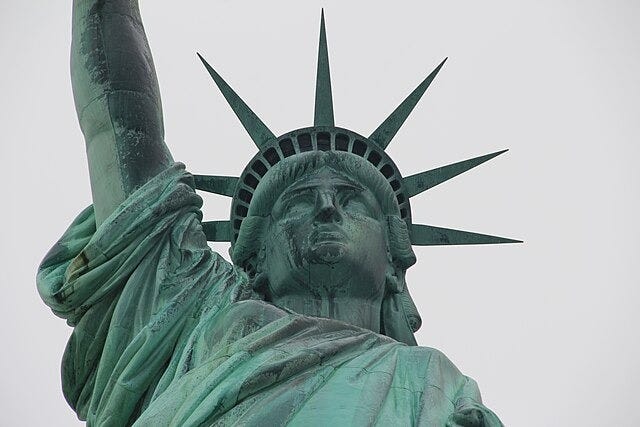
This action against refugees, besides ripping our national moral fabric (Statue of Liberty, anyone?) and giving potential allies every reason to refuse to help us fight terrorism, is yet another facet of authoritarianism.

First, using an Executive Order to enact a so-called suspension amounts to a permanent ban since it has no stipulated method of ending, violating the Constitution per a lawsuit (Pacito v Trump) filed February 10, 2025, on behalf of a group of refugees and resettlement nonprofits. The lawsuit challenges the suspension because it usurps Congressional power of spending and appropriations; the Executive Branch may not refuse to spend money already designated for a specific purpose.

Secondly, the U.S. is a signatory to the 1951 Refugee Convention, which requires states to allow refugees seeking protection to enter the country and prohibits states from sending a refugee back to a place where they will be killed or otherwise harmed. Along with the January 2025 suspension of processing, other Executive Orders and statements by the Administration have threatened to review and revoke humanitarian asylum which has been lawfully achieved. The Refugee Act, reflecting a different and generous American response to those displaced by the Vietnam War compared to those now facing danger from our Afghanistan conflict, enshrines those obligations.

Third, the Administration is demonstrating selective compliance with rulings throughout 2025 which required it to at least resettle refugees whose cases were well advanced and particularly those who had risked everything, and sold their possessions, before being ‘frozen’. In July, a U.S. District Court denied the government’s motion to dismiss the case, citing the Refugee Act, the Administrative Procedure Act (APA), and constitutional principles. But the Administration has repeatedly used legal delaying tactics and tools such as defining “refugees” only to mean White Afrikaners from South Africa. It also has used other mechanisms such as a worldwide travel ban to block refugee pathways for Afghans, Haitians, and 18 other countries, mostly African, so the lawsuit process may never restore the refugee program as envisioned by Congress.

Finally, authoritarian rule thrives on nativism, as narrowly defined as possible, with the theory that self-protection during a national emergency can – and must – override constitutional principles. This idea underpinned two occasions of U.S. national shame during World War II: internment of Japanese-American citizens, and denial of safe harbor to the Saint Louis, a ship with Jewish refugees fleeing Nazi Germany on the eve of World War II. But no national emergency could justify those actions in the past, or what is being done now to people who relied on our promise of safety. Instead, authoritarianism has come to destroy what makes America actually great, and even wonderful: our belief in the rule of law, our acceptance of our international treaty obligations, and our embrace of those “yearning to breathe free.”

Annie Pforzheimer is a retired senior U.S. diplomat who served in six foreign countries, including as Deputy Chief of Mission at the U.S. Embassy in Kabul, Afghanistan. She specialized in human rights and security issues during her thirty-year career, and is currently an adjunct professor of international relations. She holds degrees from Harvard University and the National War College. She is a member of The Steady State.

Founded in 2016, The Steady State is a nonprofit 501(c)(4) organization of more than 360 former senior national security professionals. Our membership includes former officials from the CIA, FBI, Department of State, Department of Defense and Department of Homeland Security. Drawing on deep expertise across national security disciplines including intelligence, diplomacy, military affairs and law, we advocate for constitutional democracy, the rule of law and the preservation of America’s national security institutions.

Powered by WPeMatico