Tag Archive for: National Security

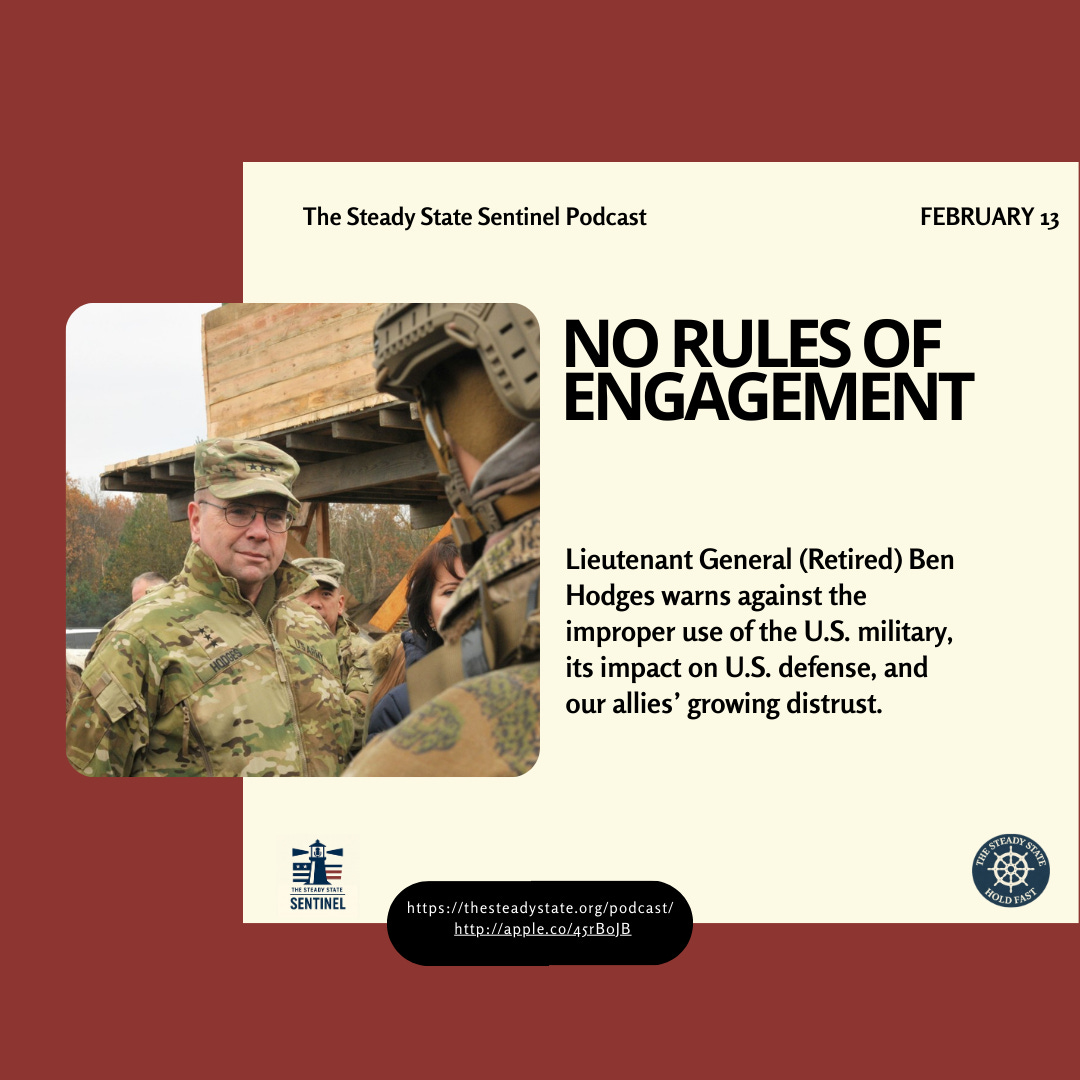
In this episode, Lieutenant General (ret.) Ben Hodges speaks with host John Sipher, warning against improper use of the U.S. military, its impact on U.S. defense and our allies’ growing distrust.

Available anywhere you listen to Podcasts !

Founded in 2016, The Steady State is a nonprofit 501(c)(4) organization of more than 360 former senior national security professionals. Our membership includes former officials from the CIA, FBI, Department of State, Department of Defense, and Department of Homeland Security. Drawing on deep expertise across national security disciplines, including intelligence, diplomacy, military affairs, and law, we advocate for constitutional democracy, the rule of law, and the preservation of America’s national security institutions.
Powered by WPeMatico

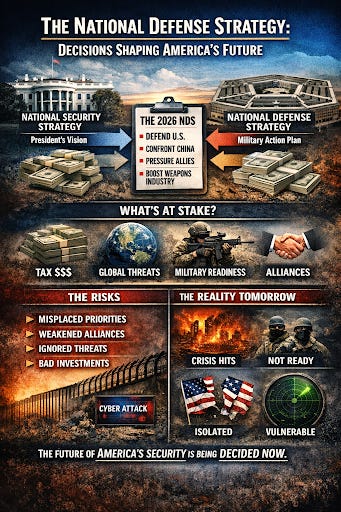
Most Americans have never heard of the National Defense Strategy.

That isn’t an accident. It’s long. It’s technical. It’s buried in government websites. And it almost never gets explained in plain English.

But here’s the reality: this document will shape how safe the United States is five, ten, and twenty years from now — long after today’s political headlines are forgotten.

If you want to know where the country is actually going on national security, you don’t watch campaign speeches. You read strategy documents.

Because that’s where governments reveal what they are really preparing for.

Where the Real Decisions Get Made

There are two documents that quietly drive U.S. national security policy.

The National Security Strategy (NSS) comes from the White House. It tells you how the president sees the world — who matters, who threatens us, and what America is supposed to do about it.

The National Defense Strategy (NDS) comes from the Pentagon. It turns that worldview into military reality: what weapons get built, where forces deploy, how alliances are structured, and what threats get priority.

If the NSS is the theory, the NDS is the execution plan.

And execution plans are where history gets written.

The 2026 Strategy Looks Normal — Until You Look Closer

The 2026 National Defense Strategy centers on four major goals:

  • Defending the U.S. homeland

  • Competing with China

  • Forcing allies to carry more of the defense burden

  • Expanding U.S. defense manufacturing

On paper, that sounds reasonable. Almost boring.

But strategy is never just about what’s listed. It’s about what gets emphasized — and what gets quietly pushed to the side.

And that’s where the stakes get real.

The Fight Inside the National Security World Right Now

There is a growing argument among defense professionals that the strategy is drifting toward domestic political framing rather than long-term global risk management.

The NSS provides a strategic outline of what the U.S. wants and the strategy for achieving it. It assesses immigration as a potential threat vector and describes border security as the primary element of national security. Meanwhile, threats like cyber infrastructure attacks, global supply chain disruption, pandemic risk, and climate-driven instability receive comparatively less attention.

You don’t have to agree with that argument to recognize the danger.

Strategy is about prediction.
Prediction is about prioritization.
And when governments mis-prioritize threats, they don’t fail immediately. They fail later. Usually, during a crisis.

This Isn’t Abstract. This Is About Power, Money, and Risk.

The National Defense Strategy decides:

Where hundreds of billions of taxpayer dollars go.
Which weapons systems get built.
Which threats agencies train to respond to.
Which alliances strengthen — and which quietly erode.

And those choices compound.

If you overinvest in one category of threat and underinvest in another, you might not notice at first, until something happens. Then, suddenly, you realize the country is incredibly well prepared, but for the wrong war.

History is full of those moments.

The Alliance Issue Should Worry People More Than It Does

For eighty years, alliances have been America’s strategic superpower.

Allies share intelligence.

They host bases.

Their existence deters conflicts before they start.

But alliances are built on trust — not just capability.

If allies start to doubt U.S. strategic judgment and resolve, cooperation won’t collapse overnight. It might get slower. Narrower. More conditional.

And in a crisis, slower, narrower, conditional can be deadly.

Strategy documents are read line by line in allied capitals. They are read just as closely by adversaries.

Everyone is trying to answer the same question:
What does the United States actually care about now?

The Most Dangerous Myth: Strategy Only Describes Today

It doesn’t. Strategy is about what the government thinks the world will look like years from now.

Weapons systems take a decade to develop.
Military doctrine takes years to institutionalize.
Alliance networks take generations to build — and can be damaged in months.

When your strategy is wrong, you don’t notice immediately.
You notice when it’s too late to fix quickly.

Why This Is a Democracy Issue — Not Just a Defense Issue

Most Americans will never read the National Defense Strategy. That’s fine.

But people should at least understand what it does.

Because these decisions shape:
Economic stability
Global influence
Military readiness
Crisis response capability
Long-term national survival

National security policy is one of the few areas where mistakes can echo for decades.

And, the less public attention these documents get, the easier it is for strategic choices to be made with minimal scrutiny.

If You Want to Understand the System Better

If you want a strong, accessible breakdown of how these strategy documents fit together, Paul Cobaugh’s article What Is the NDS, and Why Does It Matter? is a very good place to start. It translates dense doctrine into plain language without pretending the stakes are small.

The Bottom Line

The National Defense Strategy will never go viral.

It will never dominate cable news.

But it will quietly determine what kind of threats the United States is ready for — and which ones it isn’t.

And if citizens don’t understand at least the basics of how it works, they are giving up one of the most important forms of democratic oversight they have.

Whether they realize it or not.

Martha Duncan is a retired U.S. Department of Defense senior executive with 37 years of service, including 23 years as an officer in the U.S. Army Reserves, where she also served as Reserve Attache. She had three operational deployments to Panama, Bosnia, and Afghanistan. At DIA, she worked as a Latin American analyst for 11 years. A specialist in human intelligence (HUMINT), she is recognized for her leadership in intelligence operations, coalition-building, and enterprise-level policy development across the Defense Intelligence Agency (DIA), the U.S. Army, and the broader Intelligence Community. She grew up in Panama during the rise of Manuel Noriega and was instrumental in his capture. She is a member of The Steady State.

Founded in 2016, The Steady State is a nonprofit 501(c)(4) organization of more than 360 former senior national security professionals. Our membership includes former officials from the CIA, FBI, Department of State, Department of Defense, and Department of Homeland Security. Drawing on deep expertise across national security disciplines, including intelligence, diplomacy, military affairs, and law, we advocate for constitutional democracy, the rule of law, and the preservation of America’s national security institutions.
Powered by WPeMatico

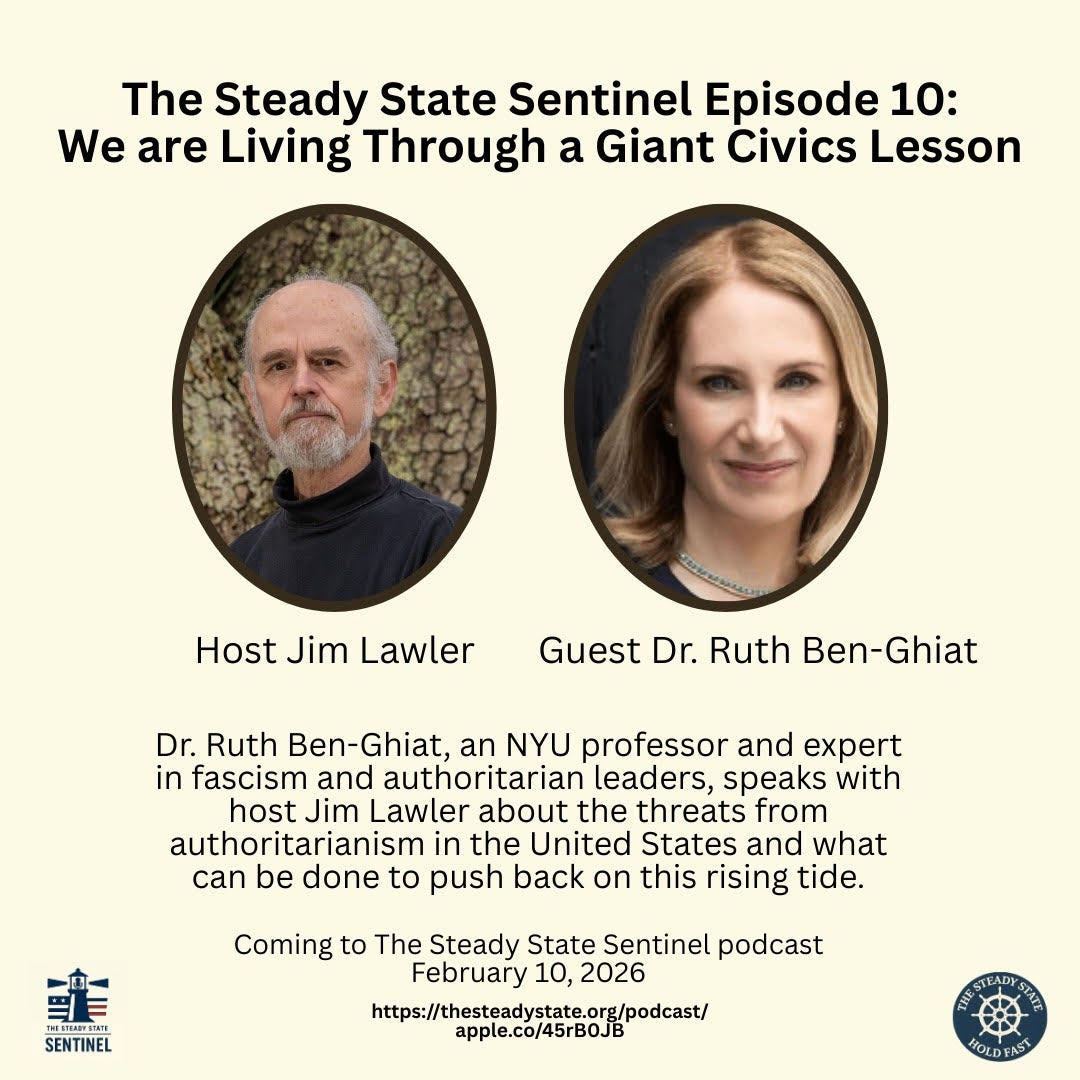
In this episode, Dr. Ruth Ben-Ghiat, an NYU professor and expert in fascism and authoritarian leaders, speaks with host Jim Lawler about the threats from authoritarianism in the United States and what can be done to push back on this rising tide. Available anywhere you listen to Podcasts.

Powered by WPeMatico

Created by Vilkasss, Pixabay

The Trump administration has undertaken a wholesale effort to gut America’s soft power, from huge budget cuts to bullying most countries around the world. One of the most insidious actions has been the brutal crack-down on immigration, including attempting to end birth-right citizenship. While these actions have major impacts domestically, a much less appreciated but nonetheless significant consequence is the severe damage it does to the US image internationally: it threatens the US global brand, or in foreign policy-speak, its soft power.

Immigration and Soft Power – America (pre-Trump) Stood Out

The US has had a different concept of immigration and citizenship from other countries for much of its history. Someone could become an American by believing and supporting certain ideals of freedom, justice, equality, democracy, and rule of law. Being an American was a choice not tied to where someone was born, what their race or ethnicity may be, or their religion. The idea that a country should be based on a set of ideals and that anybody from anywhere could become a fully equal American is substantially different from the majority of other countries in the world. Beyond this ideal being important to America’s self-identity, this is a critical component of US soft power.

I first personally appreciated the role of the relatively open and welcoming US immigration concept while working as a waiter in Australia in the mid-1970’s. All the other workers were originally from elsewhere and often referred to themselves by their origin country, e.g., French, Greek, German, etc., despite migrating to Australia. When discussing possibly moving to the US, they notably said they could become American, not just move there for a better job (as they would say about other countries), as if it were a fact and one they admired.

Fast forward four decades to June 2016, and Trump has just secured the GOP nomination. During a lively political conversation in Europe at a post-international conference dinner with several noted non-American academics, one pointedly stared at me and said, “Don’t take my America away”. Another (to paraphrase here) followed up that even if he did not want to move to the US, the idea that anybody can become an American by ascribing to a set of ideals that is not tied to blood, land, or religion, was central to the ideas of freedom and democracy around the world. He added that Americans do not appreciate how powerful that idea is in the world, noting that “even if things get desperate in my country, I know there is always America.”

Soft Power Bolsters US Influence

The Trump administration speaks out of both sides of its mouth on the importance of soft power. On one hand, some tout a dog-eat-dog worldview where only power matters. On the other hand, others still recognize the value of soft power as they extol the virtues of freedom, capitalism, European (or western) civilization, religious freedom, and democracy. For example, the administration is trying to use the US’s much-weakened soft power to support protests in Iran.

Soft power serves as the foundational backdrop for US national security policy, even though it is hard to translate into specific policy gains. But as any country’s diplomats will state, its decline or absence shows up noticeably. Several years ago, China initiated its so-called “wolf warrior” diplomacy, trumpeting Beijing’s power, thumping a nationalist message, and seeking to throw its economic and military weight around. Despite the cheers by nationalists inside China, wolf warrior diplomacy led to an international backlash, even from governments more sympathetic to China. Consequently, Beijing has largely backed off this approach and adopted a much more positive, collaborative approach, enabling it to exploit the Trump administration’s hyper-bullying nationalist diplomacy.

Trump’s Immigration Policy Damaging US International Influence

While often considered a domestic issue, immigration is central to foreign policy. The US has historically benefitted from a relatively open and welcoming immigration policy, including strengthening the US brand. In contrast, the Trump administration’s immigration policies directly weaken US influence around the world. For some in the administration, that is intentional, since the aim of the immigration policy is to make coming to the US so undesirable that people will not try, and for those who are in the country, will be so miserable that they will “self deport” — a truly Orwellian term. Such an attitude has echoes of the Vietnam War quote, “we had to destroy the village to save it.”

Harry Hannah retired after four decades of experience in the Intelligence Community. He retired from the CIA in 2018. About half that time was focused on analyzing the capability of multiple foreign militaries in direct support of US military planning and operations and national level decision making. He is a member of The Steady State.

Founded in 2016, The Steady State is a nonprofit 501(c)(4) organization of more than 360 former senior national security professionals. Our membership includes former officials from the CIA, FBI, Department of State, Department of Defense, and Department of Homeland Security. Drawing on deep expertise across national security disciplines, including intelligence, diplomacy, military affairs, and law, we advocate for constitutional democracy, the rule of law, and the preservation of America’s national security institutions.

All statements of fact, opinion, or analysis expressed are those of the author and do not reflect the official positions or views of the US Government. Nothing in the contents should be construed as asserting or implying US Government authentication of information or endorsement of the author’s views.

Powered by WPeMatico

CIA FACTBOOK 2025-2026 ————————————————————————DJT FACTBOOK 2026-???

On February 5, 2026, the Central Intelligence Agency website announced that The World Facebook would no longer be published. (The phrase used was actually “…The World Factbook, has sunset” which could have encouraged the inference that stopping publication was a natural phenomenon, not actually something done by one of the president’s men.) Multiple news sites in the US, around the world and on the internet mourned the passing of the book, often pointing toward the interesting juxtaposition of the decision to stop publishing a book filled with and dedicated to facts, with the decision of the US public to elect an administration in serious need of just such a resource.

In a news story which could have been scripted as part of a John Le Carre novel on disinformation (or a Trump administration news conference) details of the history of the Factbook varied widely and wildly. ABC news reported that the publication began in 1947 as a classified military program commissioned as a way to educate the institutions of the United States government and “standardize basic intelligence,” including “factual and fundamental knowledge about the world.” And we all know how unnecessary that is now!

The Associated Press reported that the World Factbook was first published by the CIA in 1962, and was positioned as a “printed, classified reference manual for intelligence officers” offering “a detailed, by-the-numbers picture of foreign nations, their economies, militaries, resources and societies.” This description could lead one to the conclusion that CIA publication may have been stopped when the administration’s personnel discovered that the “by-the-numbers picture of foreign nations, their economies, militaries, resources and societies,” did not mean the information was published as actual paint by numbers pictures.

The rise and popularity of the World Factbook, for a time, mirrored the popularity of, wait for it: facts. In the years between 1950 and 1980, facts were good! They were responsible for what in those olden days were the foundations of human progress: better health, better living conditions, quicker and safer travel, quicker and more efficient movement of goods! You know: No polio!, No measles, No COVID. Science meant Clean water! Clean Air! No lead paint! The airplane! The car!

The Facts used to matter (think: Dragnet: Just the facts ma’am!). But, beginning in the 1980s, facts began to lose popularity. Remember “Catchup is a vegetable” or “Trees are polluting the world?” Facts were slowly becoming the skunk at the garden party. The leaders of our education system “didn’t need no stinkin’” facts, and believed we the people didn’t either; no knowledge of civics, of how the US government works, less science, or knowledge of anything outside US borders, except Paris Disneyland and Tokyo Disney Resort.

And now facts are bad! We have a Health and Human Services Secretary who doesn’t believe in facts. We have a Vice President JD “Yale Law School” Vance, spreading malignant fantasies. And we have a President, too harrowing for a nickname. And, we actually do not need to look for an answer to the seemingly puzzling question of why the CIA will not continue to publish a widely used and often praised resource. That answer is staring us in the face: Donald Trump who is completely devoid of any capability for fact. Plus, he’s afraid of facts: they are kryptonite to his fantasy world.

The CIA website detailing the history of the World Factbook, included two sentences which are the meat of the case against facts: “In 1997, The World Factbook went digital and was posted on the CIA website, available to the public, and rapidly became a research tool for millions of people the world over.” And “The Factbook appealed to researchers, news organizations, teachers, students, and international travelers.” We already know that Trump is afraid of facts and detests and fears people he deems “others.” He lies constantly and extravagantly and people who can use actual facts are kryptonite to Trump’s autocratic leanings.

Now he has gotten rid of a big, popular, equal opportunity book of facts, the World Factbook, by the CIA. We don’t have to ask why. We already know.

Margaret Henoch served in the Clandestine Service of the CIA for 25 years, at Headquarters and in the field, focusing on operations and counterintelligence and retiring as a Senior Intelligence Officer. She is a member of The Steady State.

Founded in 2016, The Steady State is a nonprofit 501(c)(4) organization of more than 360 former senior national security professionals. Our membership includes former officials from the CIA, FBI, Department of State, Department of Defense, and Department of Homeland Security. Drawing on deep expertise across national security disciplines, including intelligence, diplomacy, military affairs, and law, we advocate for constitutional democracy, the rule of law, and the preservation of America’s national security institutions.
Powered by WPeMatico

The Department of Homeland Security (DHS) is the focus of news stories, Congressional funding and shut-down negotiations. Just what are the many components and responsibilities of DHS?

Steven A. Cash served as a prosecutor in the Manhattan District Attorney’s office before joining the CIA in 1994 as Assistant General counsel and subsequently serving as an intelligence officer in the Directorate of Operations. In 2001 he joined the Senate Select committee on Intelligence as Counsel and designee-staffer to Senator Diane Feinstein). He later served as a senior staffer in the House Select Committee on Homeland Security, the Department of Energy, the Senate Judiciary Subcommittee on Terrorism, Technology and Homeland Security and the Department of Energy. In the private sector he has advised on national security, counterintelligence, and technology policy and served on the Biological Sciences Experts Group under the Director of National Intelligence. Mr. Cash is currently the Executive Director of The Steady State.

Founded in 2016, The Steady State is a nonprofit 501(c)(4) organization of more than 360 former senior national security professionals. Our membership includes former officials from the CIA, FBI, Department of State, Department of Defense, and Department of Homeland Security. Drawing on deep expertise across national security disciplines, including intelligence, diplomacy, military affairs, and law, we advocate for constitutional democracy, the rule of law, and the preservation of America’s national security institutions.
Powered by WPeMatico

Thank you, , , , , and many others for tuning into the live video with ! Join us for our next live video in the app.

Get more from The Steady State in the Substack app
Available for iOS and Android

Powered by WPeMatico

The question “what can I do?” in response to Trump’s efforts to establish his autocratic rule is frequently asked these days…except by the people we deem to have the power by virtue of their jobs to enact laws and guardrails to protect our democracy; those holding elected, financial, or professional positions and the leverage to use them to slow and stop Trump’s rush to dictatorship. These people include, in particular, elected officials from Trump’s Republican party at city, state, and federal levels, former Republican officials whose terms are now over, and millionaires and billionaires (who made lots of their money thanks to the liberal democracy Trump hates). Elected officials have multiple constitutional governing tools at their fingertips, which they can use to stop our accelerating slide. They appear, however, to have abandoned those tools. Republicans who previously served have instant credibility and a large political stage to speak from about Trump’s anti-democratic actions and policies, but their silence is frustratingly deafening. And it’s infuriating to watch the masters of the Tech universe, the business world, and too many in the rarefied air of higher education, bend, bow, and scrape, instead of using the wealth and power that they enjoy to defend our democracy.

A shining exception to these demonstrations of apparent cowardice in the face of Trump’s onslaught has come from the worlds of art and sports, just as they always have, historically, in the face of tyranny. While those well-connected, rich, and seemingly powerful individuals mentioned above cower in front of Trump, singers, poets, entertainers, late-night comics, actors, musicians, and athletes have been standing up. We heard and sang Springsteen’s ode to Minnesota, we saw Stephen Colbert lose his position on late-night TV because he pointed out a couple of truths about Trump, and we saw Jimmy Kimmel get tossed out of his job, until the public threatened the incomes of the rich and powerful. Musicians and poets across the country are expressing themselves beautifully, loudly, and clearly about the killings and “enhanced ICE operations in Minnesota.” Big and small names from the world of sports are using their wide-reaching platforms to speak out about Trump’s cruelty and the fear it inspires. And, Bad Bunny will, this coming weekend, fuse the worlds of the arts and sports and Hispanic culture at the Super Bowl, including commentary on the effects of Trump, his administration, and the terrors of their immigration raids, at one of the most widely viewed events of the 2025-2026 time frame. Perhaps these artists and athletes are better about standing up than are the people described earlier, because their professions call them to stand up alone to share their gifts and talents in full view of the public, and each time they take their stage, or microphone or field, they do so despite the risks of anger or rejection.

Most importantly, over the last year, we have seen a gradual rise of American citizens shouldering their responsibility for responding to their country in crisis. The small gatherings of local, grassroots public demonstrations have grown with the help of movements such as “No Kings” and 50501 and Indivisible, attracting people from across the country (and world) of all backgrounds, parties, and beliefs, their signs expressing a surprisingly broad spectrum of hopes and concerns, all brought together under the umbrella of saving our democracy.

Most recently, the violent ICE invasion of Minnesota has awakened still more citizens who perhaps needed more tangible evidence of democratic decline; they are seeing with their own eyes what living under autocratic rule, with its disdain for the truth, no respect for the rule of law, constitution, or democratic norms, really means. And one can’t “unsee” the violence that is particularly emblematic of the Trump autocracy.

And so, the question, “What Can I Do” persists. Because…it must. Now is the time.

In response, here are our top 5 suggestions:

1 Develop the habit of calling or writing to federal representatives, of both/all parties, daily with your concerns or support. This can be mind-numbing, but it is absolutely the best possible way of making those who work for you listen to you.

2. Build Community: Work with your neighbors and/or repurpose your social groups to support others in need in your community, or join larger existing groups to do so. Support those whose civil liberties are being threatened and infringed.

3. Engage in the political process at every level-local, state, and federal. At a bare minimum, VOTE. Also, demand that candidates in your towns, state and at the federal level demonstrate support for the democratic process and norms.. Engage with your time and/or money and speak out, write, or participate in non-violent action.

4. Stay informed. This is a tough one, but it is vital. Now is not the time to bury heads in the sand, as dreadful as the news is each day. To do so is to play directly into the hands of our autocrat wannabe.

5. Practice Self-Care. Whatever method you choose, do practice it daily, Exercise, meditation, prayer, yoga…whatever it is, practice it. Your country and your loved ones need you engaged for the long term. Be kind to yourself. And others.

For further details, “how to’s,” additional ideas, and “how to discern fake news,” see “What We Can Do, published” on Substack November 9, 2025

Margaret Henoch served in the Clandestine Service of the CIA for 25 years, at Headquarters and in the field, focusing on operations and counterintelligence and retiring as a Senior Intelligence Officer. She is a member of The Steady State.

Jennifer Gregg served in the Clandestine Service of the CIA for 30 years, in the field, focusing on operations, intelligence collection, and counterintelligence, and retiring as a Senior Intelligence Officer. She is a member of The Steady State.

Founded in 2016, The Steady State is a nonprofit 501(c)(4) organization of more than 360 former senior national security professionals. Our membership includes former officials from the CIA, FBI, Department of State, Department of Defense, and Department of Homeland Security. Drawing on deep expertise across national security disciplines, including intelligence, diplomacy, military affairs, and law, we advocate for constitutional democracy, the rule of law, and the preservation of America’s national security institutions.
Powered by WPeMatico

Frustrated Americans take to the street in opposition to the actions of the Federal government. The President casts everyday Americans as pawns of foreign interests. He deploys National Guard units and other Federal forces to quell the protests, which only further inflames the situation. Inevitably, American citizens are shot dead by those same forces.

While the above actions can serve as a depiction of the situation in our country today, they also recount the events of the late 1960’s and early 70’s during the administration of President Richard Nixon. These earlier incidents included nationwide mass demonstrations and the deadly shooting of four students and the wounding of nine others at Kent State University by Ohio National Guard troops. Then, as now, actions by the Federal government posed a grave threat to the civil liberties of the American people. What remains to be seen is whether the other two, coequal branches of the Federal government, will fulfill their constitutional responsibility to rein in an out-of-control Executive.

In my prior role as a Deputy Assistant Secretary of Defense, I was responsible for the policy oversight of several protective programs to include the Department of Defense’s (DoD) Counterintelligence (CI) activities. The department’s CI activities were primarily directed toward protecting DoD’s intelligence activities from our nation’s foreign adversaries. A key area of my focus was ensuring that the DoD did not repeat the abuses of the late 1960’s when U.S. Army CI assets engaged in domestic data collection and surveillance. Then, as now, the U.S. military was deployed in American cities to quell unrest. Then, as now, the Federal government spied on everyday Americans to identify those it believed to be a threat.

Beginning with the Watts riot in 1965, U.S. military forces, both National Guard and active duty, were increasingly deployed domestically, culminating in deployments in scores of American cities following the assassination of Martin Luther King. Beginning in 1967, the U.S. Army Intelligence Command (USAINTC) began a massive and unauthorized program directed at collecting data and exercising surveillance over thousands of American citizens. The program was known as Continental United States Intelligence, or CONUS Intel.

At its peak, the U.S. Army deployed up to 1,500 CI agents, usually in civilian clothes, to surveil groups of as few as 20 Americans. It was later estimated that upwards of a 100,000 Americans were the subject of Army CI files. In January 1970, Christopher Pyle, a former USAINTC captain published a series of articles in a magazine revealing the existence of the military’s domestic spying network. In response to an attempt by the U.S. Army to cover up such activities, Senator Sam Ervin, a conservative senator from North Carolina, who later rose to fame during the Senate investigation into the Nixon Watergate scandal, held a series of hearings intended to highlight how the U.S. Army’s domestic surveillance threatened the liberties of everyday Americans. As a result of the pressure generated by these hearings, the Army eventually destroyed most of its civil disturbance files, and the entire U.S. Army Intelligence Command was dissolved on June 30, 1974. Many of its functions were transferred to the Defense Investigative Service, an organization within which I served early in my career as a Federal civil servant. Ervin’s hearings eventually contributed to the bipartisan Church Committee hearings, which exposed additional abuses by the Federal government’s intelligence agencies, such as the CIA, NSA, and FBI, to conduct illegal surveillance on American citizens.

The Church Committee hearings precipitated a series of reforms culminating in the initial issuance of Executive Order 12333, United States Intelligence Activities, by President Ronald Regan in 1981. In part, this order is intended to fulfill the “solemn obligation” of the Federal government “to protect fully the legal rights of all United States persons, including freedoms, civil liberties, and privacy rights guaranteed by Federal law,” when engaging in intelligence collection.

In a direct repeat of the government’s abuse of everyday American’s civil liberties, Federal agents are once again collecting data and conducting surveillance of its citizens. In Minneapolis, U.S. Immigration and Customs Enforcement (ICE) agents are using facial recognition technology to identify and track U.S. citizens simply for exercising their Constitutional rights. Reportedly, ICE is also using cellphone and social media tools to monitor American’s online activity and potentially hack into phones. With repeated threats by the President to deploy active-duty troops to American cities, it is not difficult to imagine that the military’s CI assets will be tasked with force protection responsibilities intended to identify threats on the ground. What is clear is that the current administration sees those threats to include everyday American citizens exercising their First and Second Amendment Constitutional rights.

Both Congress and the Federal courts, the two coequal branches of our Constitutional form of government, have a solemn obligation to expose and bring to a halt the blatant violation of American civil liberties by agents of the Executive branch. This is not a Republican or Democratic issue. Much the same way the two parties came together during the Ervin and Church committee hearings to expose and halt the abuses of the Nixon administration, the American people of all persuasions must be protected from Executive branch overreach by the Trump administration. Whenever some Americans’ civil liberties are threatened, all Americans’ liberties are threatened.

J. William Leonard is the Former Deputy Assistant Secretary of Defense (Security & Information Operations), Former Director, Information Security Oversight Office and Former Chief Operating Officer, National Endowment for Democracy. He is a member of The Steady State.

Founded in 2016, The Steady State is a nonprofit 501(c)(4) organization of more than 360 former senior national security professionals. Our membership includes former officials from the CIA, FBI, Department of State, Department of Defense, and Department of Homeland Security. Drawing on deep expertise across national security disciplines, including intelligence, diplomacy, military affairs, and law, we advocate for constitutional democracy, the rule of law, and the preservation of America’s national security institutions.
Powered by WPeMatico

What happens when an astronaut who’s seen Earth from 250 miles up—and an Air Force fighter pilot who’s defended it from the ground—decides that American democracy is now in more danger than at any point in his lifetime? In this conversation, Terry Virts makes a blunt, urgent case for why he’s running for Congress, why service still matters, and why the country needs leaders willing to put truth over tribe before it’s too late.

Listen on Apple Podcasts or here to choose where you tune in.

Visit on Substack.


Conversation Summary


INTRODUCTION

Narrator:
The Steady State Sentinel is produced by The Steady State—a community of former national security professionals dedicated to defending the Constitution and protecting U.S. democracy.

John Sipher:
Welcome back to The Steady State Sentinel. I’m John Sipher, former CIA operations officer and founder of Spycraft Entertainment.

Our guest today is Terry Virts—retired astronaut, former commander of the International Space Station, Air Force fighter pilot, and now a candidate for Congress in Texas’s 9th District.


SERVICE & ORIGINS

Sipher:
Service seems central to your life. Where did it begin?

Virts:
My sense of service started young. My family hosted exchange students from New Zealand and Spain. I studied French, loved foreign cultures. At 16, I lived in Finland through the AFS program—right on a lake facing the Soviet Union. Watching Soviet tourists monitored in lines stuck with me. After reading 1984, I saw the USSR as the “evil empire.”
At 17, I swore the oath and joined the Air Force. That oath still defines me.


THE DECISION TO RUN FOR OFFICE

Virts:
I got tired of yelling at Twitter. I’m not willing to watch the Constitution burn. What’s happening makes my head explode. I had to run.

Sipher:
What do you bring from non‑political service?

Virts:
Accountability. If my team is wrong, I say it. Whether it’s the Democratic Party—or the Church. Healthy organizations need truth-tellers. Yes‑men break countries. Just look at Russia.


ON PARTISANSHIP & COURAGE

Virts:
We need leaders like Adam Kinzinger and Liz Cheney who put country over party. America desperately needs courage. Too many politicians do the opposite.


CAMPAIGN LANDSCAPE IN TEXAS

Sipher:
Are you pressured by the party machine?

Virts:
When I ran for Senate? Absolutely. The national party said, “Fall in line.”
Running for House? They told me: “Run against us if you need to. Just win.” Refreshing. Even Nancy Pelosi reportedly told candidates in red districts: “Use me as the villain if it helps.”
Because if Democrats don’t start winning, we may not have future elections.

Virts:
Purity tests? Flush ’em. What works in Manhattan doesn’t work in my district—refineries, shipping channel workers, farmers, ranchers. Real people. Real problems.


AIR FORCE → NASA

Sipher:
Why the Air Force? And how did you become an astronaut?

Virts:
I grew up near the Naval Academy, but I chose the Air Force—I wanted to fly, not be on a ship with 5,000 roommates.
I flew F‑16s for 11 years in Korea, Germany, Iraq—pure operational flying. Then test pilot school. When NASA opened a class, I applied and got in as their youngest pilot.


A TALE OF TWO SPACECRAFT: SHUTTLE VS SOYUZ

Virts:
The Soyuz is tiny—basically a 1960s capsule with minimal upgrades. Mostly automated. The “control stick” doesn’t actually control anything; it’s there for emotional comfort.
Russian philosophy: execute instructions.
American philosophy: think, adapt, solve.
That difference explains a lot—from cockpit culture to battlefield outcomes.

Virts:
Even debriefs are different. In the U.S., rank disappears—you critique to get better.
In Russia, debriefs are about avoiding blame, because blame gets you reassigned… or worse. Centuries of fear-based culture.


THE STATE OF AMERICAN DEMOCRACY

Virts:
This is the most dangerous moment for America since the founding.
Our system is built on two principles:

  1. All people are created equal.

  2. Power comes from the people.

This administration is undermining both.
Gerrymandering flips the equation—politicians picking their voters.

Virts:
The Founders anticipated a would‑be king.
They did not anticipate a Congress that would surrender its power willingly.
That’s why checks and balances are failing.


WHY VOTERS SHOULD CARE ABOUT FOREIGN POLICY

Sipher:
Do foreign policy issues resonate in Texas?

Virts:
Honestly, voters talk about health care first. Then costs.
But foreign policy affects them. My district sends a lot of young people into the military. If we mismanage the world, they go to war.

Virts:
Tariffs matter. Farmers matter. Ranchers matter.
Trump’s chaos shattered trust globally. Businesses need stability. Farmers lost markets they may never get back.


ON RECRUITMENT, EGO & NATIONAL SECURITY

Virts:
If you were recruiting someone as a spy—what vulnerabilities matter?

Sipher:
Ego is the biggest. People want to feel important. Trump is easy to read and manipulate—but impossible to manage as an intelligence asset. He’s undisciplined, erratic, and would blow his own cover immediately.


THE CLASSIFIED DOCUMENTS CASE

Virts:
Seeing top‑secret documents in a Mar‑a‑Lago bathroom made me physically ill.
Pilots guard classified materials with their lives.
To see them shoved in boxes, lied about, hidden from the FBI—mind‑blowing.


CALL TO SERVICE

Virts:
I tell young people: Don’t tell yourself no. We need you.
But it’s tragic—Fulbright scholars don’t want to join State.
The next generation sees institutions failing them.
We must reverse this. America’s greatness is not guaranteed.


HOW TO SUPPORT TERRY VIRTS

Virts:
Visit TerryVirts.com for my launch video, platform, and donations.
Follow me at @AstroTerry.
Even simple actions—sharing posts, texting friends—matter.


CLOSING

Sipher:
Thanks for joining us, Terry. And thank you for stepping into the political arena when the country needs people with principles.

Narrator:
Subscribe to The Sentinel on Substack and follow The Steady State’s work protecting democracy and national security at www.thesteadystate.org.

Powered by WPeMatico