Tag Archive for: National Security

A still frame from a video taken by the ICE agent that fired at Renee Good

“It is the policy of the Department of Justice to value and preserve human life.” Department of Justice Policy on the Use of Force (Adopted May 20, 2022)

We all have seen and heard them. A picture is worth a thousand words but the appalling videos of the events that unfolded in Minneapolis on January 7, 2026 actually spoke volumes about where the Trump Administration’s corrosive war to eliminate the people that MAGA most loves to hate – immigrants – has taken America. An ICE agent named Jonathan Ross shot and killed Renee Good at point blank range in broad daylight punctuating the travesty by calling her a “f****** b****.”

Minneapolis is the victim of the largest immigration “enforcement” operation yet undertaken by this lawless administration. Violence was predictable; it is almost inevitable when DHS and its satrapy of alphabet soup agencies are involved. ICE, in particular, has become a repugnant acronym with its masked enforcers using tactics difficult to distinguish from the Gestapo or the KGB. It has lowered its recruiting standards to swell its ranks to meet Trump’s demand for 3,000 arrests a day.

There Will Be No Legitimate Federal Criminal Probe – For Now

In the aftermath of the Good shooting, the President, Vice President, and the Homeland Security Secretary publicly insulted the intelligence of everyone who had seen videos of the shooting by labeling Good’s conduct as a “domestic act of terrorism.” The FBI announced it would not cooperate with Minnesota in the investigation of Good’s death. In fact, the “investigation” contemplated by the Department of Justice (a title that increasingly catches in the throat of anyone with a memory of how justice once worked) is inexplicably directed at the activities of Good and of her widow. Deputy Attorney General Todd Blanche quickly announced “there is currently no basis for a federal civil rights investigation” despite video evidence that Renee Good had been horribly, and permanently, deprived of her civil rights. Four prosecutors from the Department’s Civil Rights Division and six from the Minnesota U.S. Attorney’s Office quit rather than align themselves with such a blatant and ignominious cover-up.

But Jonathan Ross, should not rest easy. Reflecting the seriousness of civil rights violations, the governing criminal statute has an extended statute of limitations – and no limitations period at all where the violation results in death. Minnesota state law also has no statute of limitations for murder. The convicted felon currently occupying the White House and all of his sycophantic enablers will be gone soon enough – but the window for prosecuting what happened to Renee Good will still be open.

An Alternative Course

This administration’s federal criminal justice system commentaries point to no prosecution, or even admonishment, of Jonathan Ross for Renee Good’s death. But federal law affords an alternative course that may produce some measure of justice.

The Supreme Court has established the parameters for a lawsuit alleging excessive use of force. All claims that law enforcement officers have used excessive force — deadly or not — in the course of an arrest, investigatory stop, or other “seizure” of a free citizen should be analyzed under the Fourth Amendment and its requirement of “reasonableness.” The standard is an objective one – whether the officer’s actions were “objectively reasonable” in light of the facts and circumstances confronting him, without regard to underlying intent or motivation. Last May, the Supreme Court reaffirmed this “objectively reasonable” standard for judging excessive force claims while clarifying that “objective reasonableness” must be evaluated under a “totality of the circumstances” that expands the aperture of inquiry to embrace any relevant events coming before and after the shooting (like, one would assume, the shouting of a profane epithet at the victim by the shooter after firing). The “totality of the circumstances” inquiry is designed to prevent chronological blinders that focus only on the moment of the shooting but ignore relevant background information. In Renee Good’s case, such a scope should ensure the jury’s appropriate consideration of Ross’s profane epithet as well as the Justice Department policy that tells its agents that firearms may not be discharged at a moving vehicle where other reasonable means of defense exist … like moving out of the path of the vehicle.

There are two paths to securing some measure of legal justice for what happened to Renee Good. A legitimate criminal investigation must await a new administration actually interested in justice. Fortunately, the statutes of limitations run longer than the term of this accursed administration allowing for the possibility that a future Justice Department will pursue an appropriate investigation.

Until then, justice cries out for a civil lawsuit where the facts and circumstances of Renee Good’s shooting can be examined by an impartial jury. While such an action could not criminally punish Jonathan Ross or any of his enablers, it offers one avenue to justice for Renee Good where, based on the videos we all have seen, no amount of money in the Jonathan Ross GoFundMe account will be enough to pay the judgment. Indeed, it would send a message to Ross and every masked, club-wielding, pepper-spraying ICE hooligan that Donald Trump, J.D. Vance, Kristi Noem, and even the feckless Pam Bondi can’t save them from civil excessive force claims that could leave them financially broken.

George Croner is a Senior Fellow at the Foreign Policy Research Institute and serves on the Advisory Council at the University of Pennsylvania’s Center for Ethics and the Rule of Lae. He also is a former principal litigation counsel at the National Security Agency and Special assistant U.S. Attorney. He is a member of The Steady State.

Founded in 2016, The Steady State is a nonprofit 501(c)(4) organization of more than 360 former senior national security professionals. Our membership includes former officials from the CIA, FBI, Department of State, Department of Defense, and Department of Homeland Security. Drawing on deep expertise across national security disciplines, including intelligence, diplomacy, military affairs, and law, we advocate for constitutional democracy, the rule of law, and the preservation of America’s national security institutions.

Powered by WPeMatico
Dear General Caine:

My time as an officer in the US Navy was completed well before you were born but my career as a senior official of the CIA in its later years would have corresponded with the launch of your military career. I retired from the CIA twenty years before your arrival there as Associate Director for Military Affairs. Like you, I am a veteran of military service and over the course of my working life I spent nearly fifty years in service to the National Security of our country. I have no other qualifications to be so presumptuous as to address the vexing issues you face every day, or those that you will no doubt have to face in the coming months. I can, however, speak to you as an American citizen who understands something of the precarious mix of national security, international affairs and domestic tranquility and who is deeply troubled with the state and direction of our country.

Today you and the joint chiefs are perilously close to what may be a definitive stage in our history. The American military and its proud heritage, like our country as a whole, has its blemishes, but it stands as a highly respected pillar of support that stiffens our back, keeps us safe, excels in a special kind of precision, and boasts an overpowering global capability. It is in the eyes of many today the most respected of our shattered institutions when it comes to defending the nation and its guiding principles.

A crucible of decision that can decide our republic’s immediate fate seems to loom. You may be called on to deploy US forces unnecessarily and illegally to an American city, or to seize the territory of a NATO member and friend of longstanding. What you and the Joint Chiefs do in the coming days, weeks and months may well redirect the course of American history and, in that instant, promise to set your name apart from the other 22 men who have preceded you since 1949.

Americans have paid much attention to and are agonizing in varying measures over the swelling scope and rising risks of the President’s unchecked arrogation of power. We are very unsure of his mental soundness. Our country is essentially divided into fifths, with two fifths supporting the president and three fifths desperate in the hope that there will be a reassertion of a balancing political hand from another quarter; trust in the congress has evaporated because it lacks the legislative gallantry and courage the founders so pointedly handed down to them. The courts struggle. For months now, there has been public discussion of how the officer corps would deal with an illegal order from the President or the Secretary of Defense. That broad public worry is now reduced to an assumption that such a moment will fall on you.

The President is threatening the introduction of thousands of federal forces into the state of Minnesota. Such an act would be a vulgar abuse of power with lasting consequences and would set a frightening precedent. The US Congress has abrogated constitutional protections by its inaction, and the manufactured basis for such action by the President is blatantly specious.

Worse, the US Military seizure of Greenland and the effrontery of taking it from a NATO ally by force or coercion of any type would stain us and the American military for decades and in ways difficult to foresee, justify or repair. As of this moment the President has eased his belligerence and sworn off a military incursion into Greenland. For now. Mr. Trump has a good deal of time to change his mind.

The deep concerns expressed in this letter are difficult to write. I am highly respectful of the charges you bear. I can empathize with the weight of that burden. But you must wrestle with the righteousness of choosing and following one of two divergent paths. Your sense of tradition, cohesiveness and the historical traditions of a Chairman’s relationship with the Chief Executive rest on the one hand; the misconstrued orders of an errant and confused president are stacked on the other. Somewhere in that dilemma lies the best choice for the republic, if not necessarily for the remainder of your illustrious career.

The strength of your personal grasp of where the rule of law and the path of constitutional probity lead you and the service chiefs would seem to beckon.

William R. Piekney served as US Naval officer for four years and served in the CIA for 30 years in Europe, Africa and the Middle East. He was under deep cover early in his career and later was station chief numerous times, including West Africa, Pakistan and Egypt. As a member of the Senior Executive Service he directed the Agency’s African operations and then East Asia operations, traveling extensively to those regions to maintain and develop relations with host intelligence and security services. Overall he has spent nearly fifty years in the U.S. Intelligence Community and in related national security affairs. Following his service in CIA Mr. Piekney was the DCI’s representative to the Secretary of State’s Accountability Review Board investigating a terrorist attack on a U.S. installation in Saudi Arabia; was appointed as the Director of Studies at a CIA then DNI sponsored think tank during which he lead several highly classified Intelligence Community-wide studies involving nuclear weapons in the subcontinent and countering terrorism in the United States; he headed the Human Intelligence section of the George W. Bush Presidential Commission on The Intelligence Capabilities of The United States Regarding Weapons of Mass Destruction (WMD Commission); and consulted for international clients on defense and national security issues.

Mr. Piekney received the CIA’s Distinguished Intelligence Medal, the CIA’s Intelligence Commendation Medal, and the State Department’s Superior Honor Award. He was also awarded the rank of Distinguished Officer of the Senior Intelligence Services. He is a member of The Steady State.

Founded in 2016, The Steady State is a nonprofit 501(c)(4) organization of more than 360 former senior national security professionals. Our membership includes former officials from the CIA, FBI, Department of State, Department of Defense, and Department of Homeland Security. Drawing on deep expertise across national security disciplines, including intelligence, diplomacy, military affairs, and law, we advocate for constitutional democracy, the rule of law, and the preservation of America’s national security institutions.

Powered by WPeMatico

When President Trump muses aloud about canceling elections, serving a third term, ignoring statutes he dislikes, or deciding who governs cities and states, many Americans respond with a reflexive reassurance: He can’t do that.

If by can’t we mean cannot do so in a way that is constitutional or lawful, that response is correct. The Constitution is clear. Federal statutes are clear. The norms and traditions of American governance leave little ambiguity about the limits of residential power.

But if “can’t” means to imply cannot happen, cannot be attempted, or cannot be imposed in practice, then the response is dangerously wrong. In systems governed by power rather than restraint, the only truly impossible act is the one no one attempts.

That instinct—to equate illegality with impossibility—is not a sign of civic ignorance. It is, in fact, a byproduct of living in a country where, for most of its history, the law has largely been followed. Americans are accustomed to a system in which violations of constitutional limits are exceptional, contested, corrected, and punished. Over time, we internalized a comforting assumption: that actions outside the law simply do not occur, or if they do, they collapse under their own illegitimacy.

That assumption is understandable. It is also, regrettably, a fiction.

Members of The Steady State have spent decades working in, studying, and observing countries where constitutions exist on paper but do not meaningfully constrain power. Where courts issue rulings that are ignored. Where elections are formally held but substantively hollow. Where leaders remain in office not because they are authorized to do so, but because they can. In those systems, the phrase “he can’t do that” is often spoken shortly before he does. We have seen this pattern repeatedly overseas. Leaders extend their terms by reinterpreting constitutional provisions, manipulating courts, or simply ignoring legal limits. Judges who resist are sidelined, discredited, or arrested. Legislatures are bypassed or reduced to symbolic bodies. The law remains on the books, but it no longer governs.

Authoritarianism does not announce itself with a formal repeal of constitutional order. It advances through normalization: small transgressions that go unpunished, larger ones that are rationalized, and eventually actions that would once have been unthinkable but are now met with resignation or fatigue. Each step is defended not by legality, but by power, loyalty, or the absence of effective resistance.

The critical lesson from those systems is simple: illegality does not prevent action; it merely tests the cost calculus.

President Trump has already demonstrated this reality in the American context. He has taken actions that were plainly unlawful or unconstitutional and suffered few immediate consequences. He attempted to overturn a lawful election. He pressured state officials to falsify results. He obstructed investigations. He ignored congressional subpoenas. He used federal power to reward allies and punish perceived enemies.

In none of these cases did the fact that he “couldn’t” do those things prevent him from trying—or from doing significant damage before institutions reacted.

The American system is resilient, but it is not self-executing. Laws do not enforce themselves. Courts rely on compliance. Norms depend on shared commitment. When a president is willing to violate legal boundaries and test whether anyone will stop him, the question is no longer Is this allowed? but Who will act, and at what cost? That is the question authoritarians ask every day.

Too often, American commentary treats Trump’s statements as jokes, bluster, or rhetorical excess precisely because they are unlawful. But experience abroad teaches a harsher truth: authoritarian leaders often signal their intentions openly. They normalize extreme ideas by floating them casually, watching public reaction, and adjusting tactics accordingly. Each unchallenged statement lowers the bar for the next.

Dismissing these signals as impossible is not prudence—it is complacency.

Recognizing that a president can do unlawful things is not an admission of weakness; it is the foundation of defense. Democracies fail not because their laws are unclear, but because citizens, institutions, and elites assume those laws will be honored automatically.

They are not.

The United States has reached a point where legality alone is no longer a sufficient safeguard. What matters now is enforcement, accountability, and collective refusal to normalize unlawful power. That requires abandoning the comforting fiction that unconstitutional actions cannot occur.

They can. They already have.

The choice facing Americans is not whether the Constitution permits authoritarian behavior—it does not. The choice is whether we are prepared to respond when those limits are tested, ignored, or broken. History suggests that waiting until the law is fully cast aside is always too late.

The time to recognize the danger is not when the Constitution is formally suspended, but when people stop believing that its violation is possible.

Steven A. Cash served as a prosecutor in the Manhattan District Attorney’s office before joining the CIA in 1994 as Assistant General counsel and subsequently serving as an intelligence officer in the Directorate of Operations. In 2001 he joined the Senate Select committee on Intelligence as Counsel and designee-staffer to Senator Diane Feinstein). He later served as a senior staffer in the House Select Committee on Homeland Security, the Department of Energy, the Senate Judiciary Subcommittee on Terrorism, Technology and Homeland Security and the Department of Energy. In the private sector he has advised on national security, counterintelligence, and technology policy and served on the Biological Sciences Experts Group under the Director of National Intelligence. Mr. Cash is currently the Executive Director of The Steady State.

Founded in 2016, The Steady State is a nonprofit 501(c)(4) organization of more than 360 former senior national security professionals. Our membership includes former officials from the CIA, FBI, Department of State, Department of Defense, and Department of Homeland Security. Drawing on deep expertise across national security disciplines, including intelligence, diplomacy, military affairs, and law, we advocate for constitutional democracy, the rule of law, and the preservation of America’s national security institutions.

Powered by WPeMatico
A person holding a sign with a child in front of him
AI-generated content may be incorrect.

The Fourth Amendment is one of the most celebrated protections in the American Constitution. It promises that the government will not subject people to unreasonable searches and seizures. Yet for most of modern American history, that promise has been enforced in a surprisingly narrow way: through the exclusionary rule. In broad strokes, when the government violates the Fourth Amendment while gathering evidence, that evidence cannot be used against the person in court.

For decades, this rule did much of the real work. Police officers, FBI agents, and prosecutors learned a simple lesson early in their careers: conduct an unlawful search, and you risk losing the case. Warrants, probable cause, and carefully defined exceptions were not abstract legal doctrines. They were practical constraints.

But that system only works if the government is actually trying to build a case. For most of American history, it was.

Today, in some of the most consequential uses of federal power, it isn’t.

How the Fourth Amendment Is Usually Enforced

The Fourth Amendment itself contains no enforcement mechanism. It states a legal principle, not a penalty. The exclusionary rule was created by courts to fill that gap: the government should not be permitted to benefit from violating the Constitution.

Alongside exclusion, civil lawsuits were meant to provide a backstop. But those remedies have always been weak. Even when plaintiffs succeed, damages are paid by taxpayers, not by the officers who violated the law. Over time, the Supreme Court has further limited accountability—most notably by narrowing claims under Bivens v. Six Unknown Named Agents and expanding qualified immunity.

In practice, exclusion became the Fourth Amendment’s teeth. If evidence mattered, legality mattered.

That Was Never the Founders’ Only Concern

This modern, criminal-procedure framing misses what originally terrified the Founders.

The Fourth Amendment was a direct response to the British Crown’s use of general warrants and writs of assistance—open-ended search authorities that allowed officials to search anyone, anywhere, without individualized suspicion. These searches were not always about prosecuting crimes. They were about asserting dominance and keeping the population compliant. The King used these writs not to “take care that the law” be enforced, but to preserve and protect his throne.

No one articulated this danger more vividly than James Otis, whose 1761 essay Against Writs of Assistance warned:

Every one with this writ may be a tyrant; if this commission be legal, a tyrant in a legal manner also may control, imprison, or murder any one within the realm. In the next place, it is perpetual; there is no return. A man is accountable to no person for his doings. Every man may reign secure in his petty tyranny, and spread terror and desolation around him. In the third place, a person with this writ, in the daytime, may enter all houses, shops, &c. at will, and command all to assist him. Fourthly, by this writ not only deputies, &c., but even their menial servants, are allowed to lord it over us. Now one of the most essential branches of [our] liberty is the freedom of one’s house. A man’s house is his castle; and whilst he is quiet, he is as well guarded as a prince in his castle. This writ, if it should be declared legal, would totally annihilate this privilege. …

Otis was not worried about “tainted” evidence. He was worried about fear—about a government that could intrude at will, without explanation and without consequence, into a person’s home, papers, and private life.

That concern runs throughout the Federalist Papers. The authors repeatedly emphasized that liberty depends on constraining discretionary power before it is abused, not merely punishing it afterward. The Fourth Amendment was meant to prevent the government from roaming through the population untethered from specific suspicion and judicial oversight.

In short, the Amendment was designed to prevent intimidation, not just bad prosecutions.

For much of American history, federal law enforcement operated within a criminal framework. Searches and arrests were typically tied to investigations that might end up in court. Under those conditions, the exclusionary rule worked. An unlawful search could sink a case, embarrass a prosecutor, and derail a career.

That incentive structure shaped behavior—but it depended on one crucial assumption: that the government cared whether evidence would later be admissible.

Current Immigration Enforcement Breaks the Model

Immigration and Customs Enforcement often operates outside that assumption.

ICE agents, acting more as paramilitaries than police, are not seeking evidence to present to a jury—or even to a court. Removal proceedings are administrative, with weaker procedural protections and limited suppression remedies. Many enforcement actions never meaningfully reach any adjudicative forum at all. In numerous cases, the search and detention appear to be the end goal—instilling fear and uncertainty rather than building a legal case.

In this environment, the exclusionary rule has little deterrent effect. An unlawful stop, search, or arrest does not “lose the case” because there is no case to lose. The immediate objectives—detention, disruption, signaling, fear—are achieved regardless of legality. In criminal cases, evidence derived from an unlawful arrest is excluded. But when evidence is not the objective, exclusion is irrelevant. Nor do civil lawsuits meaningfully constrain conduct. Agents face minimal personal risk, and any damages are borne by the public. This protection is enhanced by the use of military, instead of police, tactics – masked paramilitaries, wearing tactical gear, and operating in large military formations.

The result is a profound asymmetry: the Fourth Amendment still exists on paper, but its enforcement mechanism is disconnected from how power is actually exercised.

When Fear Replaces Evidence

This is not simply a story about immigration policy or rogue officers. It is a story about a government stepping outside constitutional norms—into a world where fear, not evidence, is the instrument of power. The Fourth Amendment was designed to prevent exactly this scenario. General warrants were dangerous not because they produced unreliable evidence, but because they placed the population under constant threat of arbitrary intrusion.

When government agents are engaged not in law enforcement but in intimidation and control, the traditional tools of Fourth Amendment enforcement are blunted. The Constitutional language is there, but ignored, and, from the perspective of this Administration and its paramilitary arm, irrelevant.

Unless courts or Congress develop ways to impose real consequences for unconstitutional searches and seizures outside the criminal-trial context, the Fourth Amendment risks becoming what James Otis feared in another form: a right proclaimed, but not protected.

The Administration often justifies aggressive, extra-constitutional actions by ICE and other elements of the expanding “security services” as reflecting the “will of the voters.” There is at least some truth to that claim. And the will of the voters still matters, and there will be a chance for that will to be expressed in the coming mid-term elections.

A promise honored in theory—and hollow in practice.

Steven A. Cash served as a prosecutor in the Manhattan District Attorney’s office before joining the CIA in 1994 as Assistant General counsel and subsequently serving as an intelligence officer in the Directorate of Operations. In 2001 he joined the Senate Select committee on Intelligence as Counsel and designee-staffer to Senator Diane Feinstein). He later served as a senior staffer in the House Select Committee on Homeland Security, the Department of Energy, the Senate Judiciary Subcommittee on Terrorism, Technology and Homeland Security and the Department of Energy. In the private sector he has advised on national security, counterintelligence, and technology policy and served on the Biological Sciences Experts Group under the Director of National Intelligence. Mr. Cash is currently the Executive Director of The Steady State.

Founded in 2016, The Steady State is a nonprofit 501(c)(4) organization of more than 360 former senior national security professionals. Our membership includes former officials from the CIA, FBI, Department of State, Department of Defense, and Department of Homeland Security. Drawing on deep expertise across national security disciplines, including intelligence, diplomacy, military affairs, and law, we advocate for constitutional democracy, the rule of law, and the preservation of America’s national security institutions.

Powered by WPeMatico
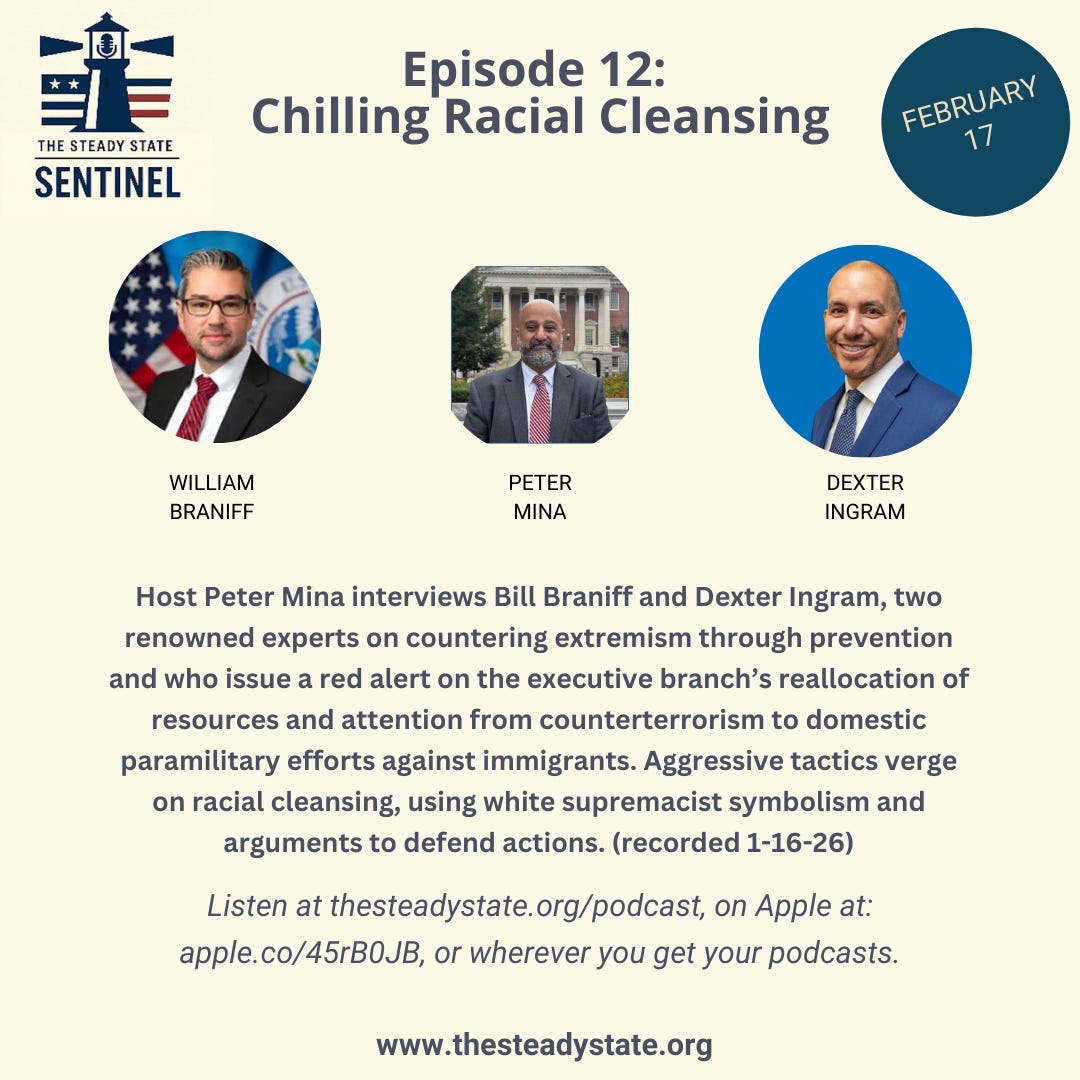
In the coming days, we will learn more about whether justice demands the prosecution of the officer who shot and killed Renee Nicole Good in Minneapolis this week. But it’s already clear that whatever the facts show, this administration intends to shield him from legal accountability. Just hours after the shooting, Homeland Security Secretary Kristi Noem declared that the officer acted in self-defense and suggested that Good was engaged in “domestic terrorism.”

This response fits a dangerous pattern. The administration quashed an investigation into its Border Czar’s acceptance of a $50,000 payment from undercover FBI agents. One federal judge is considering criminal contempt sanctions over the removal of an immigrant contrary to his orders. Another is considering whether criminal charges against another unlawfully removed immigrant constitute vindictive prosecution. More broadly, President Trump has pardoned the January 6th insurrectionists, the drug-trafficking ex-President of Honduras, and several corrupt politicians who won his favor. If Attorney General Pam Bondi chooses not to prosecute the officer who killed Nicole Good, she can also shield him from state prosecution behind federal supremacy.

What most Americans may not know is that the law already shields the officer from civil liability. Renee Good’s family could sue the federal government for assault and battery under the Federal Tort Claims Act, or FTCA, but after years of litigation, the taxpayers would pay any damages a court ultimately awards. A civil suit in state court would be removed to federal court, with the same result. That result would frustrate one of our justice system’s most important incentives—the deterrence of wrongdoing. Worse yet, the FTCA offers no remedies for violations of constitutional rights, no punitive damages, no attorney fees, and no trial by jury.

Until recently, the officer might have faced civil liability under a so-called Bivens suit, named after a landmark 1971 Supreme Court decision, which for five decades allowed individuals to sue federal officials who violated their “clearly established” constitutional and statutory rights.

But the Court’s recent decisions have sharply limited Bivens because it was a judicial and not a legislative creation, calling its continued viability into question. At the same time, the Court has upheld a damages remedy against federal officials who violate religious freedom rights, because Congress enacted that remedy into law. Indeed, in limiting the judicially created Bivens remedy, the Court invited Congress to create a statutory one instead. The protection of our civil liberties compels Congress to accept the Court’s invitation now.

It is a reversal for me to be writing these words, having once led the branch in ICE’s legal office that defended its officers against Bivens suits. But this President’s reach for unchecked executive power requires him to both intimidate the ethical public servants who oppose his abuses and offer impunity to those who would enable them. Legislation to restore a Bivens remedy can withdraw one part of that impunity and give this President’s enablers a reason to hesitate.

I know from experience what a significant deterrent the risk of a lawsuit can be, even if the defendant knows that Justice Department lawyers will probably defend the suit. Having accepted an early retirement from government this year, I also know that those I left behind are being systematically bullied into looking the other way at conduct they know to be unlawful, abusive, or wasteful. A restored Bivens remedy should target only those officials who are personally involved in violating an individual’s rights and vindicate only those rights that are specifically enumerated in statute or that are (to use a term that courts have developed in detail) “clearly established.”

Skeptics may contend that such legislation may not pass in this Congress, just as they once predicted that a resolution to release the Epstein files would never pass. But members of Congress who are worried about reelection–or who have decided not to seek it–do not give blind obedience to unpopular presidents. And even in failing to restore accountability in this Congress, the President’s critics in Congress can put checks and balances on the 2026 ballot.

Joshua Stanton is an attorney who practices criminal defense and federal employment law in the District of Columbia and Virginia, and who recently retired after 29 years of military and civilian service. He is a member of The Steady State.

Founded in 2016, The Steady State is a nonprofit 501(c)(4) organization of more than 360 former senior national security professionals. Our membership includes former officials from the CIA, FBI, Department of State, Department of Defense, and Department of Homeland Security. Drawing on deep expertise across national security disciplines, including intelligence, diplomacy, military affairs, and law, we advocate for constitutional democracy, the rule of law, and the preservation of America’s national security institutions.

Powered by WPeMatico
Over the past several months, we have heard from many people who want to be involved in The Steady State’s work — to advocate, educate, and sound the alarm about the existential threat facing American democracy: the rise of authoritarianism led by Donald Trump, his associates, and his family. The Steady State’s core membership is, by design, limited to former senior national security, intelligence, diplomatic, military, and law-enforcement officials. That restriction reflects who we are and the professional experience we bring to this moment.

But we have heard the request — clearly and repeatedly — from people who share our values, support our mission, and want to engage more directly with our work.

Today, we launch The Steady State Auxiliary.

How to Join:

  • If you are already a paid subscriber to our Substack, you can opt in using THIS FORM; you will be automatically enrolled in the Auxiliary.

  • If you are not yet a paid subscriber, you can join the Auxiliary simply by subscribing to our Substack at $10 per month and opting in.

What Auxiliary Members Will Receive:

  • We will host periodic events specifically for Auxiliary members, designed to deepen engagement with our analysis, our members, and our work. The first of these will take place in mid- to- late January, when we host an online “Ask Me Anything” session with Steady State members.

  • Some people have asked whether Auxiliary membership includes a Secret Decoder Ring. That remains a secret.

Founded in 2016, The Steady State is a nonprofit 501(c)(4) organization of more than 360 former senior national security professionals. Our membership includes former officials from the CIA, FBI, Department of State, Department of Defense and Department of Homeland Security. Drawing on deep expertise across national security disciplines including intelligence, diplomacy, military affairs and law, we advocate for constitutional democracy, the rule of law and the preservation of America’s national security institutions.

Powered by WPeMatico

In Episode 4, former Congressmember Adam Kinzinger shares the human toll of standing up to the cult of Donald Trump and putting country before party. Speaking with co-hosts and former CIA experts Jim Lawler and John Sipher, Kinzinger bares all about what 10 years of Donald Trump has done to America’s soul. (recorded 12-15-2025).

Powered by WPeMatico

As the fourth anniversary of Russian President Vladimir Putin’s unprovoked February 2022 full-scale invasion of Ukraine approaches, the Russian strongman has been suffering the consequences of his classic intelligence failure. Instead of his anticipated cakewalk, Putin has been bogged down in a bloody war of attrition — an estimated 1.1 million Russian casualties, plus another 400,000-some Ukrainian wounded or killed. Putin had aimed to weaken NATO, not strengthen the Western military alliance that has stood against Russian aggression since1949. NATO has even added two new determined neighboring countries, Sweden and Finland, which have been busy strengthening defenses in northern sea lanes.

Now, Putin must be delighted that America’s president, Donald Trump who, having publicly welcomed Putin’s covert measures on his behalf during his 2016 presidential campaign, is again proving useful. The American president has embarked upon a course of action that seriously threatens NATO’s survival, leaving the Russian Army free to continue to grind Ukraine down, and looking ahead to future military adventures in, say, Baltic countries and Scandinavian waters that Peter the Great once enjoyed.

As numerous unnerving headlines have been screaming, Trump threatens to wrest control of the strategically important island of Greenland, positioned between the Arctic and Atlantic Oceans, from our NATO ally, Denmark. If the Danes won’t sell their semi-autonomous territory, whose 56,000 residents are European Union citizens, Trump vows to seize it. (Never mind the absurdity: America has enjoyed free rein in Greenland’s defense throughout our lifetimes.)

Why? Imagine the American map in the president’s eye: “Greenland” morphs into “Trumpland” — a historic triumph trumping (pardon me!) Thomas Jefferson’s Louisiana Purchase. Not to mention the potential lucrative commercial opportunities: The business pages have speculated on the usual familiar MAGA names, including Donald Trump, Jr., Devin Nunes, Peter Thiel, Elon Musk.

Outraged, the Danes and Greenlanders have poured into the streets, saying they cannot believe an American president would even think such things. Denmark has been supported by fellow NATO allies, including Norway, Sweden, France, and Germany, in subtle-but-significant moves to beef up their military presence on Greenland to defend it from America!!

Unimpressed, Trump has said America’s European allies are playing a “very dangerous game,” threatening to punish them with crippling tariffs. Infuriated, NATO allies are talking about 1930’s-style trade retaliations involving $100-plus billion in punitive tariffs on American exports. This time, they vow, they will not bow to American bullying. Once again, the dictator in the Kremlin has to be smiling, especially at the prospect of Trump walking out of Nato and abandoning Ukraine.

The world will find out more this Wednesday, when Trump will address the World Economic Forum’s annual meetings of the world’s great-and-good in Davos, Switzerland. NATO’s Secretary General, top European political and economic leaders, and Ukrainian President Volodymyr Zelensky will be in the Swiss resort this week.

This week in Davos looks to be a historical moment, playing out in real time. Possibly this time the Europeans will (finally) stand up to American bullying. But if they do, that would quite likely play into Putin’s hands —the threat that is always lurking with Trump, his Vice President, J.D. Vance, and White House deputy chief of staff Stephen Miller, to walk away from NATO.

A good guess is that the Europeans will try to find a way to advance the Trump crowd’s fortunes, not just involving Greenland but in future reconstruction contracts in Ukraine, should a peace deal actually emerge.

But this guesstimate is very tricky business.

On one hand, Trump has repeatedly shown he doesn’t care about Ukraine, in the Western moral tradition of resisting aggression from Moscow. Remember Trump’s 28-point “peace” plan for Ukraine, on Moscow’s terms, aimed at Kyiv’s capitulation? And in recent days, Trump has again blamed Zelensky for being the obstacle to a lasting peace deal.

But on the other hand, Trump also appears very much invested in his self-image of being a peacemaker, and throwing Ukraine to The Bear would mark Trump as a loser. So, the Europeans who will be looking to manipulate Trump in Davos this week might have some diplomatic and psychological leverage.

There’s a final observation to be made concerning the prospect of American bullying of Denmark and Greenland, which have long histories of helping Western democracies. It was weather stations on Greenland, controlled by Allied intelligence during World War II, that provided the clear-weather window that Dwight Eisenhower used to launch the successful invasion across the English Channel on D-Day, 1944. And throughout the Cold War, Danish intelligence, along with the Brits and other NATO allies, were there to help protect Central Europe, and America, in too many historical episodes to mention in this space.

Now, America’s friends deserve better.

Greg Rushford ran congressional investigations involving Soviet aggression in the 1970s as a staff member of the House Appropriations and Intelligence committees and is a former Washington journalist. He is a member of The Steady State.

Founded in 2016, The Steady State is a nonprofit 501(c)(4) organization of more than 360 former senior national security professionals. Our membership includes former officials from the CIA, FBI, Department of State, Department of Defense, and Department of Homeland Security. Drawing on deep expertise across national security disciplines, including intelligence, diplomacy, military affairs, and law, we advocate for constitutional democracy, the rule of law, and the preservation of America’s national security institutions.

Powered by WPeMatico

Founded in 2016, The Steady State is a nonprofit 501(c)(4) organization of more than 360 former senior national security professionals. Our membership includes former officials from the CIA, FBI, Department of State, Department of Defense, and Department of Homeland Security. Drawing on deep expertise across national security disciplines, including intelligence, diplomacy, military affairs, and law, we advocate for constitutional democracy, the rule of law, and the preservation of America’s national security institutions.

Powered by WPeMatico

The latest National Security Strategy (NSS) highlighted the direct threat the Trump administration poses to Europe. This threat extends beyond seizing Greenland and affects a broader array of issues and groups, including various non-government organizations. As a driving policy goal, the administration seeks to internationalize its authoritarian MAGA vision to undermine democracy, rule of law, and civil/human rights in Europe, which will also weaken allies of those in the US who oppose authoritarianism domestically.

Internationalizing the MAGA Agenda

The NSS undertakes unprecedented criticism of European governance, society, and culture, reversing over 80 years of US policy. It reflects the administration’s domestic ideology and seeks to transform European societies along similar lines—ideological imperialism designed around a far-right, traditionalist concept of white, Christian, European civilization. The NSS denounces mass migration (people from non-white, Christian societies) and criticizes efforts to combat hate speech and disinformation as attacks on free speech. It also disparaged global organizations, norms, and rules guiding the European and international order since WWII.

These goals reflect an ideological stream that has secured strong positions in the administration. At the Munich Security Conference last February, Vice President Vance attacked Europe, stating his greatest fear was “the threat within.” He supported Germany’s Alliance for Democracy, which the German state considers an extremist group. Last May, the State Department issued “The Need for Civilizational Allies,” laying out similar concepts. In Fall 2025, the State Department sent talking points to US Embassies advocating harsh immigration crackdowns. In December 2025, the US revoked travel visas of five Europeans involved in restricting disinformation and hate speech.

Broad Role for Far Right Non-government Organizations

These official actions draw roots from the wider non-governmental far-right community. In June 2025, the Heritage Foundation (authors of Project 2025) produced “Toward a Nationalist Internationalism: The Case for Building a National Conservative Alliance.” This presaged elements of the NSS and indicates the administration’s ambitions to change European governments by supporting parties and movements in order to impose far-right policies on immigration, religion, culture, gender/sexuality, and traditional families—essentially taking Project 2025 on a European tour. Their goals parallel domestic policies and reflect the objective of establishing a far-right “Internationale” vaguely similar to the Soviet-led COMINTERN of the pre-WWII era.

The administration builds upon an expanding network of like-minded parties. All European countries have far-right parties with similar ideologies. Hungary, under Prime Minister Orban and FIDESZ, has emerged as the dominant element and poster-child for what the far right seeks to achieve. Since Orban returned to power in 2010, Hungary has seen significant decline in rule of law, adherence to democratic principles and policies, protection of minority rights, and free speech as measured by multiple rating groups, while corruption has steadily increased. Consequently, the EU placed sanctions on Budapest, and in early January 2025 the US sanctioned its intelligence minister for corruption.

Beyond political parties, there’s a growing web of advocacy groups and think tanks in Europe with ties to US counterparts that the administration leverages. Perhaps the two most prominent in Europe are Hungary’s Mathais Corvin Collegium (MCC) and Poland’s Ordi Luris Institute. In the US, the Conservative Political Action Committee (CPAC), for example, holds conferences in Europe, Hungary in 2022 and Poland in 2025 and regularly invites European far-right groups to US conferences. All focus on building a stronger international network for mutual support to advance their shared ideological agendas.

The growing ties among these non-governmental groups may be the greatest threat to Europe because of the administration’s embrace of changing non-far-right governments and pressuring European states to adopt authoritarian MAGA policies. From Vance’s February 2025 statement through the November NSS, the administration has a vision for Europe—parallel “Make (country) Great Again” movements running the governments.

America First Leadership Needs a Far-Right Europe to Follow It

The administration’s policy towards Europe will be shaped by trade, commercial, and traditional national security concerns, and consequently, it may turn to non-governmental allies to push its ideological agenda—not unlike the Soviet Union’s use of Communist parties in the 20th century. While the State Department embraces this far-right agenda, the administration has not yet harnessed the US military or intelligence community to pursue authoritarian policies in Europe. Such action could undermine NATO and essential intelligence relationships, especially if seeking to actively subvert democratic governance. While once unimaginable, given actions against Venezuela and threats to Greenland and Canada, this may be on the policy menu.

Despite its advocacy of national sovereignty, the administration and wider far-right movement ironically see international ties as essential and view strong, far-right, non-government organizations operating in multinational networks as vital to their ideological success. In a further irony, despite disparaging views of Europe, they view Europe as essential to building a white, Christian, far-right society in the US. European heritage is central to their worldview. The movement recognizes that achieving domestic goals requires parallel success in Europe, both to legitimize itself and weaken allies of its opponents inside the US.

Some have interpreted the NSS as dividing the world into spheres of influence—the US gets the Americas, China gets East Asia, and Russia gets Europe. The NSS and administration appear to disagree; they want Europe in their sphere, but it must be a MAGA-like Europe. As the Heritage paper states, America First may become America Alone. Even as the administration downplays traditional relationships with Europe, especially the EU, it clearly has a high-priority agenda to undermine European governments that don’t adhere to its authoritarian ideology via official actions and a non-government network.

Harry Hannah retired after four decades of experience in the Intelligence Community. He retired from the CIA in 2018. About half that time was focused on analyzing the capability of multiple foreign militaries in direct support of US military planning and operations and national level decision making. He is a member of The Steady State.

Founded in 2016, The Steady State is a nonprofit 501(c)(4) organization of more than 360 former senior national security professionals. Our membership includes former officials from the CIA, FBI, Department of State, Department of Defense, and Department of Homeland Security. Drawing on deep expertise across national security disciplines, including intelligence, diplomacy, military affairs, and law, we advocate for constitutional democracy, the rule of law, and the preservation of America’s national security institutions.

All statements of fact, opinion, or analysis expressed are those of the author and do not reflect the official positions or views of the US Government. Nothing in the contents should be construed as asserting or implying US Government authentication of information or endorsement of the author’s views.

Powered by WPeMatico