Tag Archive for: National Security

I served as a Senate staffer in the aftermath of September 11, 2001, and was part of the effort that ultimately resulted in the creation of the Department of Homeland Security. In the days and months after the attacks, Washington was shaken in a way that is difficult to convey to those who did not experience it firsthand. Nearly three thousand people had been murdered in a coordinated assault on the United States, and it was widely believed that more attacks were likely. There was an overwhelming sense—shared across party lines—that the U.S. government was not effectively organized to meet what seemed, at the time, a terrifying and novel threat: transnational Islamist terrorism, embodied by al-Qa’ida.

The response was a massive reorganization of the federal government, the largest since the creation of the Department of Defense. Disparate functions, immigration enforcement, border control, emergency management, presidential protection, port security, and others, were brought together under a single new cabinet-level department. The theory was straightforward: unity of effort would bring speed, coordination, and effectiveness. The costs of fragmentation, we believed, were simply too high.

But even at the moment of its creation, there was a bipartisan recognition that what we were doing was fraught with danger. Concentrating coercive and protective power inside a single institution is efficient, but efficiency cuts both ways. The same machinery that can prevent attacks can also be turned inward, to our own society.. Protective efficiency can become equally efficient tyranny.

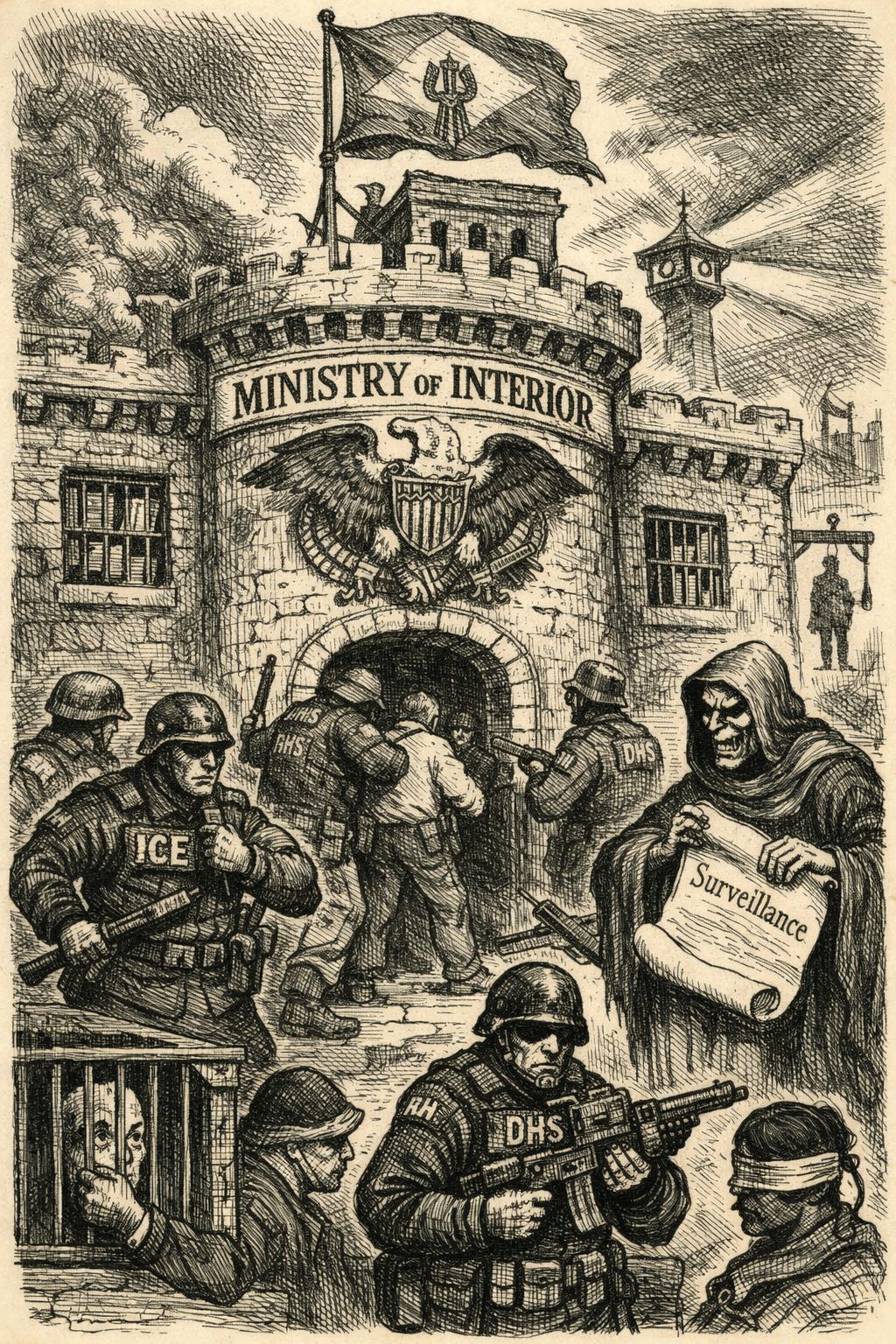
Many of us were acutely aware of that risk which was a regular topic of conversation and debate. More than once, sometimes seriously, sometimes darkly, and sometimes a bit tongue-in-cheek, we referred to the worst-case outcome as creating a “Ministry of Interior.” It was not a hypothetical phrase. Ministries of Interior are often a feature of authoritarian systems, particularly in the former Soviet Union and its client states. In authoritarian states, similar institutions become the institutions responsible not merely for law enforcement, but for political control: surveillance, internal security, intimidation, and the suppression of dissent. We recognized that many non-authoritarian states have Ministries of Interior, including many of our allies. But the Ministry of Interior as a shorthand reference to the former Soviet Union and other dictatorships, rang, and still rings, true.

We tried, consciously, to mitigate that risk.

Guardrails were built in, some internal, some external. We allowed, even designed for, a degree of inefficiency. The Department was divided into semi-autonomous “components.” Customs and Border Protection, Immigration and Customs Enforcement, the Coast Guard, the Secret Service, each with distinct authorities, cultures, and chains of command. This internal friction was often frustrating. It slowed decision-making. It annoyed operators. But it was intentional. Fragmentation was a feature, not a bug.

We also limited intelligence authorities. Rather than granting DHS broad, free-standing intelligence powers, Congress created a narrowly scoped Office of Intelligence & Analysis, led by a Senate-confirmed Under Secretary. The idea was to ensure that intelligence activity inside DHS would be subject to meaningful oversight, integrated into the broader Intelligence Community, and constrained by law. DHS was not meant to become a domestic intelligence leviathan. It was meant to be a coordinating department, not a political police.

In retrospect, it is clear that we failed due to a tragic lack of imagination. We did not anticipate the election of a president who in fact admired the Soviet model, who would seek to suppress our citizens, to scare and intimidate rather than to protect. We assumed that any American president would instinctively recoil from the idea of centralized internal security power being used for political ends. That assumption was wrong.

A would-be autocrat does what autocrats always do, and must do. He gathers the tools of repression and coercion, consolidates them, and deploys them to enhance and protect power. This is not a matter of ideology or temperament; it is structural. Authoritarianism requires enforcement. It requires fear. It requires institutions capable of acting quickly, forcefully, and with minimal accountability.

That is what we are confronting now.

The Department of Homeland Security has, in effect, become a tool of a dictator, our Ministry of Interior. Its sprawling law-enforcement elements have been remade into a paramilitary force: heavily armed, lightly restrained, and increasingly insulated from meaningful oversight. Immigration enforcement, in particular, has been transformed from a regulatory and investigative function into a domestic security apparatus operating in American communities with a posture that looks far less like civilian law enforcement and far more like internal security services abroad.

We now have our own version of the Soviet KGB, Russian FSB without the name, an East German Stasi, a Serbian MUP without the uniform. The labels differ, but the logic is the same. Centralize authority. Blur legal boundaries. Normalize force. Declare opponents dangerous. Treat dissent as disorder.

The warning signs were always there. Many of us saw them. Some of us said so, quietly at first, then more openly. We built guardrails for a system that assumed an executive who would respect the rule of law. That assumption no longer holds. And when it collapses, the machinery in place is his to use, in whatever way he deems is in his interest .

None of this is accidental. None of it is unprecedented. And none of it is unfamiliar to those who have spent careers studying how democracies erode from within.

A Ministry of Interior was always a risk. We are living with the consequences of refusing to believe that it could ever happen here.

Steven A. Cash served as a prosecutor in the Manhattan District Attorney’s office before joining the CIA in 1994 as Assistant General counsel and subsequently serving as an intelligence officer in the Directorate of Operations. Until January 20, 2025, he served as Senior Advisor to the Under Secretary for Intelligence & Analysis at DHS. In 2001 he joined the Senate Select committee on Intelligence as Counsel and designee-staffer to Senator Diane Feinstein. He later served as a senior staffer in the House Select Committee on Homeland Security, at the Department of Energy, and on the Senate Judiciary Subcommittee on Terrorism, Technology and Homeland Security . In the private sector he has advised on national security, counterintelligence, and technology policy and served on the Biological Sciences Experts Group under the Director of National Intelligence. Mr. Cash is currently the Executive Director of The Steady State.

Founded in 2016, The Steady State is a nonprofit 501(c)(4) organization of more than 360 former senior national security professionals. Our membership includes former officials from the CIA, FBI, Department of State, Department of Defense, and Department of Homeland Security. Drawing on deep expertise across national security disciplines, including intelligence, diplomacy, military affairs, and law, we advocate for constitutional democracy, the rule of law, and the preservation of America’s national security institutions.

Powered by WPeMatico

A blue and white logo
AI-generated content may be incorrect.

Statement on the January 24, 2026, Minneapolis Shooting

For Immediate Release January 24, 2026

The Steady State unequivocally condemns the fatal shooting earlier today in Minneapolis by ICE paramilitary officers, in which a 37-year-old Minneapolis resident was shot and killed at the intersection of 26th Street West and Nicollet Avenue. This incident constitutes another lethal use of force by heavily armed federal agents in the city, following the January 7 killing of 37-year-old Renée Nicole Good by an ICE paramilitary.

Video circulating from the scene shows federal officers wrestling a person to the ground before multiple shots were fired, highlighting troubling questions about necessity, proportionality, and command accountability. Today’s killing, carried out during what has effectively become a militarized federal operation on Minneapolis streets, underscores a pattern in which ICE units are operating not as civilian law enforcement but as a paramilitary force, deploying overwhelming military force rather than restraint. Such actions, using these forces, are characteristic of dictators and authoritarians.

The Steady State rejects any characterization of such actions as acceptable or inevitable. These shootings, executed by federal paramilitaries equipped for combat rather than community policing, are not isolated incidents; they reflect an authoritarian approach, typical of autocrats, that diminishes civil liberties and erodes the foundational principles of accountable law enforcement in a democratic society. At a time when Minneapolis residents and many across the country are calling for transparency and oversight, the continued framing of these killings as justified without a full, independent investigation only deepens public distrust and compounds community injury.

We call for a fully independent, transparent inquiry into today’s shooting, immediate release of all relevant footage and evidence, and a suspension of all aggressive federal immigration enforcement operations that place heavily armed paramilitary agents in direct encounters with civilian populations.

A Message to Fellow Americans

We recognize the profound anger, fear, and grief that this shooting and the broader pattern of federal violence have ignited in communities nationwide. These emotions reflect real pain and legitimate concerns about the future of civil and constitutional order.

There is a natural temptation, in the face of state-sanctioned violence, to respond with violence to take up arms, to escalate, to meet force with force. But from the hard-won experience of many in The Steady State who have served in intelligence and diplomatic roles around the world, we must be clear: violent resistance against a technologically superior, fully resourced federal security apparatus will surely fail and only deepen harm. Agencies like DHS, ICE, the Department of Defense, and the FBI possess overwhelming material advantages that cannot be matched in armed conflict. A turn to violence will accomplish nothing, and the forces deployed by the Government will triumph.

If meaningful change is to come, it must be through strategic, disciplined, and peaceful civic engagement: sustained legal challenges, legislative reform, peaceful protest, documentation of abuses, and broad coalition building that centers on accountability and democratic norms. These pathways preserve life, protect community safety, and strengthen the long-term integrity of our republic. Violence begets violence. Democracy requires resolve, courage, and strategy, not an inevitably failed escalation.

Founded in 2016, The Steady State is a nonprofit 501(c)(4) organization of more than 360 former senior national security professionals. Our membership includes former officials from the CIA, FBI, Department of State, Department of Defense, and Department of Homeland Security. Drawing on deep expertise across national security disciplines, including intelligence, diplomacy, military affairs, and law, we advocate for constitutional democracy, the rule of law, and the preservation of America’s national security institutions.

Powered by WPeMatico
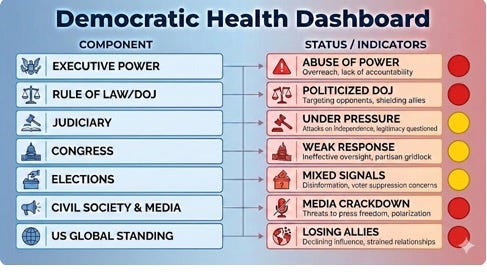
A question asked often these days is whether the U.S. is approaching a slide downwards toward authoritarianism.

According to a report from The Steady State, an organization of over 300 former national security and intelligence professionals, we are, regrettably, not on the precipice, but moving down that slope.

The report, “Accelerating Authoritarian Dynamics: Assessment of Democratic Decline,” can be found at steadystate1.substack.com/p/accelerating-authoritarian-dynamics, but some highlights should be sufficient to raise the alarm for any clear thinker.

Executive overreach, or efforts to establish a unitary executive who is subject to no control or limitation, is being established daily by executive orders and actions that test the limits of constitutionally designated executive authority, such as the military actions related to Venezuela.

The state is being weaponized through questionable deployments of National Guard units in cities that are falsely being described as “war zones,” dismantling the civil service, and selective prosecution of individuals viewed as opponents of the administration.

Independence of the judicial branch is being eroded through the appointment of compliant judges and, in some cases, outright defiance of judicial orders.

The legislative branch, in which the president’s party currently holds the majority, appears to have surrendered its constitutional prerogatives to the executive in establishing the federal budget, declaring war, and performing oversight of the executive branch.

Our electoral system is being reshaped to favor one party, not through the will of the American voter, but by executive fiat and at the direction of the executive branch, undermining the voting rights of marginalized groups that were won through hard work and spilled blood since the end of the Civil War.

Taken together, all of the foregoing indicate significant changes to the governing order around a cult of the personality, with loyalty toward an individual rather than the Constitution.

Unless there is sustained resistance by institutions, civil society, and the public to these changes, we will continue this downward spiral until the United States is no longer the nation envisioned by the Founding Fathers, that is devoted to “establishing a more perfect union,” and serving as a beacon to freedom-loving people around the world.

We are in danger of losing our credibility as a model democracy and becoming just another gold-plated, tinpot dictatorship.

Editor’s note: Charles A. Ray was the U.S. ambassador to Cambodia from 2002 to 2005 and U.S. ambassador to Zimbabwe from 2009 to 2012, when he retired from the U.S. Foreign Service.

Charles A. Ray spent 20 years in the U.S. Army with two tours in Vietnam. He retired as a senior US diplomat, serving 30 years in the U.S. Foreign Service, with assignments as ambassador to the Kingdom of Cambodia and the Republic of Zimbabwe, and was the first American consul general in Ho Chi Minh City, Vietnam. He also served in senior positions with the Department of Defense and is a member of The Steady State.

Powered by WPeMatico

Thank you , , , , , and many others for tuning into my live video! Join me for my next live video in the app.

Get more from The Steady State in the Substack app
Available for iOS and Android

Powered by WPeMatico

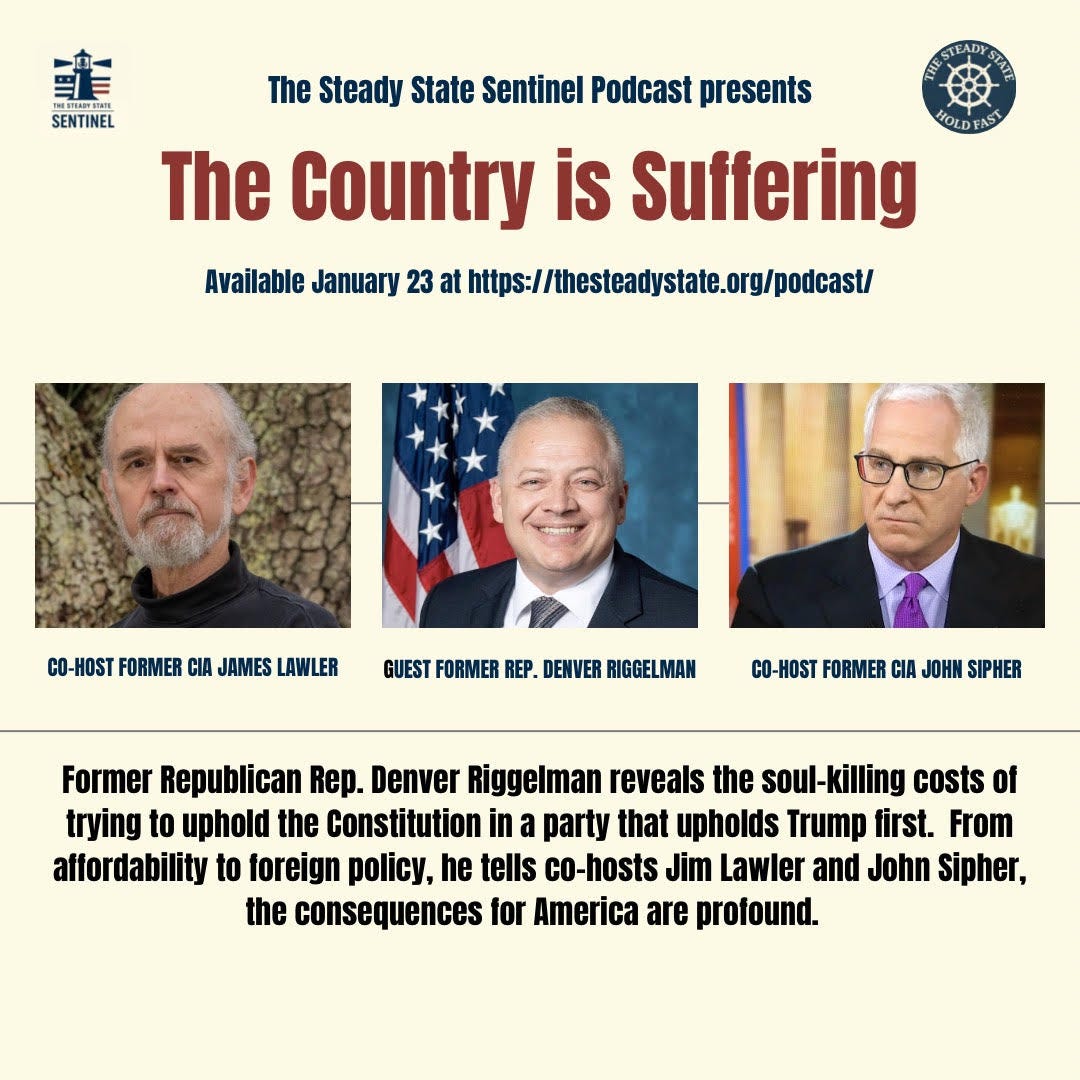
Denver Riggleman, a former Republican member of Congress, reveals the soul-killing costs of trying to uphold the Constitution in a party that upholds Trump first. From affordability to foreign policy, he tells co-hosts Jim Lawler and John Sipher, the consequences for America are profound.

Powered by WPeMatico

Contrary to the views of some in this administration, American power was never just about tanks, missiles or aircraft carriers. It was about trust. For decades, allies believed that the United States might be imperfect, sometimes frustrating, often slow but ultimately serious. That, when Washington made commitments, it meant them. That American leadership, while messy, was anchored in strategy rather than impulse.

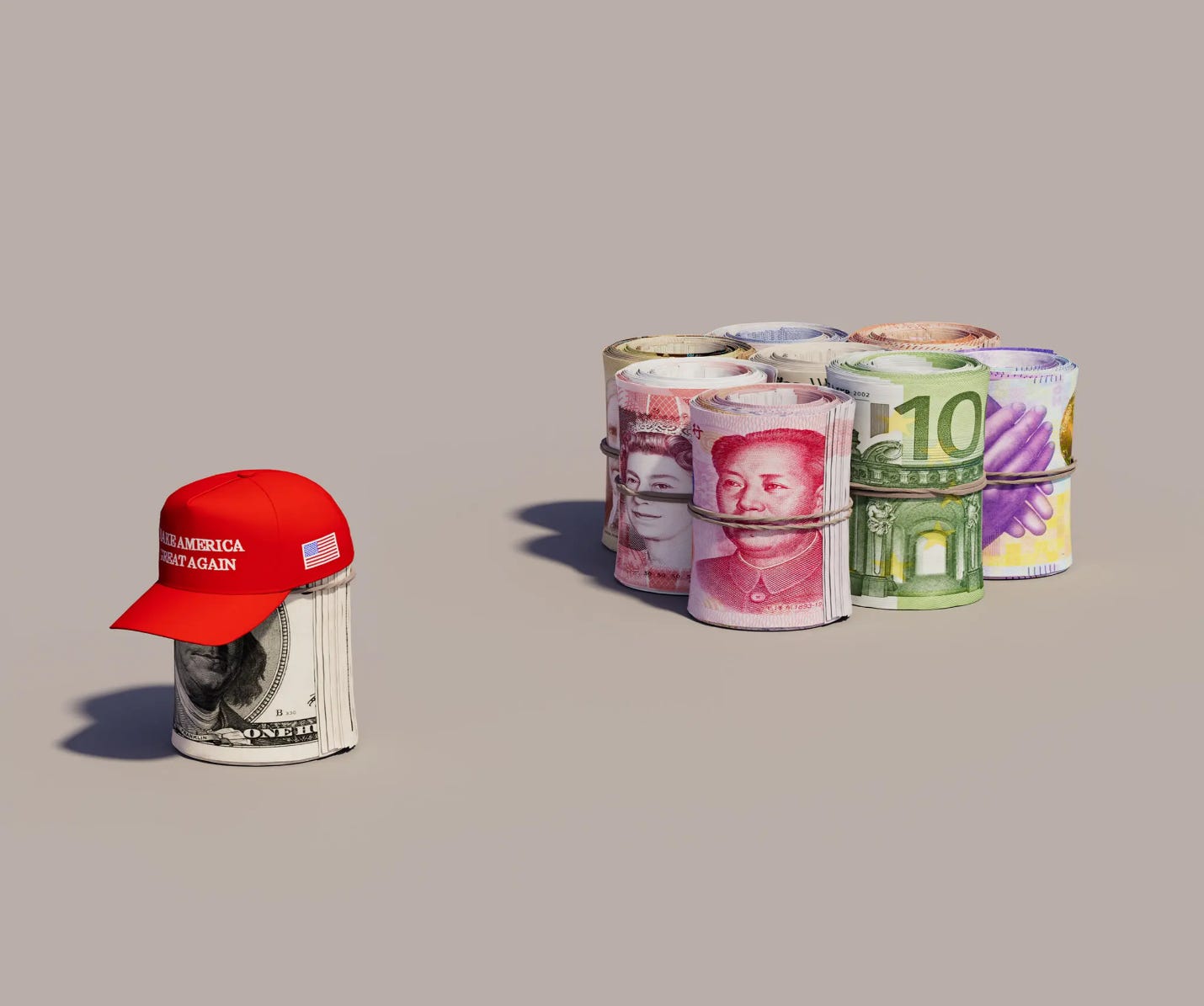
That assumption is now collapsing in real time. Under Donald Trump, U.S. foreign economic policy has devolved into a series of public tantrums: tariff threats issued on a whim, allies treated like adversaries, and complex global relationships reduced to autocratic personal slights and wounded pride, where fealty to the dear leader is all that matters.

But while Washington lashes out, the rest of the world is doing something far more consequential. It is making plans, and doing so without us.

While Washington Postures, the World Partners

While the U.S. was removing Nicolas Maduro from Venezuela (more on that below), the European Union finalized a sweeping free trade agreement with four Latin American countries, including Brazil, by far the continent’s largest economy. After decades of negotiation, the deal lowers tariffs, expands market access, and deepens economic integration between two regions that understand the value of predictability.

This is precisely the kind of agreement the United States once championed, not only to grow markets but to shape geopolitics. Trade was never just commerce. It was leverage, alignment, and influence. Today, Washington is nowhere to be found. Instead of helping write the rules of the global economy, the United States is watching from the outside while others do it.

Even Our Closest Allies Are Hedging

Nowhere is this more alarming than in North America itself. As Trump renews tariff threats against Canada, one of America’s closest allies and largest trading partners, Ottawa has begun insulating itself from U.S. volatility. Canada and China have reached a new trade arrangement easing restrictions on agricultural exports and electric vehicles, protecting Canadian industries from the uncertainty created by Washington’s unpredictability.

This is not an ideological alignment with Beijing. It makes business sense. When the United States weaponizes trade against friends, those friends do what rational actors always do: they diversify their risk. And in a quiet, deliberate and possibly permanent way, the U.S. loses influence.

Back to Venezuela: Transaction Without Strategy

The same absence of vision is evident in Venezuela.

The administration trumpeted the capture of Maduro as a geopolitical victory, yet left the same corrupt system largely intact, with no credible plan for democratic transition, economic recovery, or regional stability. U.S. engagement now appears focused almost entirely on oil access, reinforcing the perception that American policy is transactional rather than strategic.

Latin American governments are watching closely. The lesson is unmistakable: U.S. involvement is episodic, personality-driven, and untethered from long-term commitments. So they are planning accordingly, with trade agreements and investment partnerships that will increasingly exclude Washington.

BTW, Tariffs Don’t Punish Foreign Countries, They Punish Americans

At the core of Trump’s trade worldview is a stubborn fiction: that tariffs are paid by other countries.

A new economic study confirms what economists have long known. Tariffs are overwhelmingly paid by American consumers and American businesses (at a rate of 96%). They function as a tax, raising prices, distorting supply chains, and draining purchasing power from households already under strain.

The rhetoric is nationalist. The result is self-inflicted economic harm. Protectionism may sound tough, but in Trump’s America, it weakens the country it claims to defend.

Playing Directly Into Putin’s Hands

The damage extends well beyond the Western Hemisphere. Trump’s tariff threats against European allies, combined with his fixation on Greenland and open contempt for multilateralism, undermine NATO unity at the precise moment it matters most.

Every trade fight weakens political cohesion. Every insult erodes trust. Every manufactured grievance distracts from the collective challenge posed by Russia. From Moscow’s perspective, this is not chaos. It is an opportunity.

Trade Is Security, Whether We Admit It or Not

Trade policy is not separate from national security. It is one of its foundations. For generations, the United States used economic integration to reinforce alliances, stabilize regions, and extend influence without firing a shot. That system was imperfect, but it was intentional. Trump has replaced it with impulse. There is no articulated strategy. No theory of influence. No sense of what comes next. Only the belief that threats alone will compel loyalty.

Sadly, none of this is accidental. The hostility toward alliances, the disregard for rules, and the insistence on personal dominance are not flaws in Trump’s approach; they are its defining features. Abroad, he treats treaties as inconveniences and partners as subordinates. At home, he proposes to do the same to courts, Congress, and the civil service.

The through line is unmistakable: a belief that power should flow from loyalty to the leader, not adherence to institutions. Foreign policy and trade chaos are not distractions from his authoritarian ambition. They are its clearest preview.

The world is not abandoning the United States. It is adapting to an America that no longer has a plan beyond the fantasies of a wannabe dictator. And once countries learn to live without American leadership, they may not feel compelled to invite it back.

Bruce Berton served as a U.S. diplomat for over three decades, ultimately rising to the senior ranks of the Foreign Service, including two years as Ambassador and Head of Mission at the Organization for Security and Cooperation in Europe’s (OSCE) Mission to Bosnia and Herzegovina. He is a native of the Pacific Northwest and a graduate of Pacific Lutheran University. He is a member of The Steady State.

Founded in 2016, The Steady State is a nonprofit 501(c)(4) organization of more than 360 former senior national security professionals. Our membership includes former officials from the CIA, FBI, Department of State, Department of Defense and Department of Homeland Security. Drawing on deep expertise across national security disciplines including intelligence, diplomacy, military affairs and law, we advocate for constitutional democracy, the rule of law and the preservation of America’s national security institutions.

Powered by WPeMatico

Founded in 2016, The Steady State is a nonprofit 501(c)(4) organization of more than 360 former senior national security professionals. Our membership includes former officials from the CIA, FBI, Department of State, Department of Defense, and Department of Homeland Security. Drawing on deep expertise across national security disciplines, including intelligence, diplomacy, military affairs, and law, we advocate for constitutional democracy, the rule of law, and the preservation of America’s national security institutions.

Powered by WPeMatico
PDF AVAILABLE HERE

We assess with high confidence that the cumulative effect of the Trump Administration’s ongoing actions indicates that democratic backsliding continues. While some institutional resistance exists and may be growing, the trajectory poses both immediate and long-term risks to constitutional order and national security.

The period from October 1, 2025—January 18, 2026 saw renewed efforts by the Trump Administration to establish autocracy and entrench his cult of personality, likely fearing that his plunging poll numbers, fragmenting political coalition, and a Congress that has finally begun to exhibit a few signs of life place his agenda at risk. President Donald Trump frequently appears befuddled and exhausted, falling asleep in meetings even when his Cabinet is present and praising him, and he lashes out at reporters and politicians (some within his own party) alike. While some recent events offer hope that at least some quarters in our government are waking up, our allies question whether America can ever return to being the reliable ally it once was.

Executive Overreach and the Weaponization of the State

Executive branch overreach remains the key driver of America’s shift toward authoritarianism. Trump on 3 January, without Congressional approval, attacked Venezuela, kidnapping Venezuelan leader Nicolas Maduro and reportedly killing upward of 80 people. Trump insists Venezuelan oil belongs to America, and in a clearly corrupt move set up a bank account in Qatar for the oil revenue, claiming personal control of the funds. Trump also threatened Colombia and Mexico, and threatened to annex Greenland by force if necessary. Even some Republicans in Congress expressed concern about this, with Congressman Don Bacon (R-NE) saying he would lean toward impeachment if Trump moved forward.

Trump’s lust for violence is increasingly taking a domestic focus. ICE operations in Minneapolis are brutal, with officers going door-to-door asking people to identify immigrants, forcing their way into homes without warrants, forcibly removing people from vehicles, throwing flashbangs and tear gas at moving vehicles and injuring children, and, horrifically, shooting a woman in the chest and head, killing her.

Trump increasingly attacks perceived enemies, and his White House has published a “media watch list” naming media outlets and reporters who have been critical of his embrace of authoritarianism and corruption. He accused six members of Congress of sedition and suggested they deserve the death penalty after they made a video reminding the military and intelligence communities that they do not have to obey illegal orders; investigations have been launched into at least two of the six, Senator Mark Kelly (D-AZ) and Senator Elissa Slotkin. Finally, in disturbing displays of misogyny, Trump has attacked female reporters who have asked questions he disliked, calling them degrading names (“stupid,” “piggy,” “obnoxious”) to humiliate and discredit them in front of the American public.

Weakening Judicial Independence

There are some promising signs amid continued moves by the Trump administration to appoint unqualified loyalists to key positions. Efforts by the unlawfully appointed attorney for the Eastern District of Virginia, Lindsay Halligan, to indict New York Attorney General Letitia James were rejected by a grand jury on three separate occasions, and an indictment of former FBI Director James Comey was tossed when an appeals court ruled that Halligan’s appointment was illegal. While this is good news, the administration will likely renew its attempt to charge both.

At the same time, it is clear that Bondi has abandoned even the pretense of a Department of Justice (DOJ) that is independent of the White House. She has operationalized Trump’s executive order naming “antifa” a terrorist organization by nearly eliminating any focus on right-wing, white supremacist groups and turning the focus of the DOJ and FBI toward Trump’s imagined enemies on the left. Under Bondi, the DOJ and FBI will now target individuals or groups that hold what the administration considers “extreme” views on immigration, LGBTQ rights, or “anti-American sentiment.”

Legislative Weakness

Congress continues to delegate much of its constitutional authority to the Executive Branch, ceding its right to check Trump’s power—but signs of life offer some hope. Speaker of the House Mike Johnson ensured Congress would remain ineffective during October’s long government shutdown—sending House members home and refusing to swear in Arizona’s new representative, Adelita Grijalva, for seven weeks, probably fearing Trump’s wrath if the House voted to release the Epstein files. However, outrage from the public—which likely prompted sudden, inexplicable support from Trump—forced Johnson to not only reverse his stance on the release of the files, but to vote for it. The DOJ is dragging its feet on the release of the files, however, and Johnson refuses to press for compliance with the law.

Systemic Electoral Flaws

We remain concerned by gerrymandering efforts that continue apace, but there are positive signs that, at least in some quarters, the electoral system holds. While Texas moved forward with redistricting efforts meant to help Republicans ahead of the 2026 midterms, Indiana Republicans rejected such a measure, much to the ire of President Trump, who threatened to cut off all federal aid to the state. Kudos to the Indiana Republicans who stood for the rule of law in the face of threats to their safety. In addition, there was no effort to delegitimize November elections that were swept by Democrats, including hotly contested governor’s races in New Jersey and Virginia.

Undermining Faith in Public Institutions

We assess that Trump’s assault on democratic institutions continues to weaken Americans’ belief in a constitutional republic. Investigations into Trump’s political opponents (e.g., Comey, James, former CIA Director John Brennan, former Director of National Intelligence James Clapper, the “seditious six”) are meant to convince his base that government agencies that form the foundation of our republic are run by a “deep state” that attempts to subvert the will of the people. Threats to revoke the citizenship of naturalized citizens—including elected officials like Representative Ilhan Omar (D-MN) or New York City Mayor Zohran Mamdani—are meant to terrorize anyone not born here, undermine the foundational concept “out of many, one,” and suggest to non-white, naturalized Americans that they do not merit representation in Congress. This also undermines Americans’ belief in a multicultural democracy based on ideas and shared values, not ethnicity.

Trump continues to undermine support for higher education by suggesting admission is not merit-based, that widespread anti-semitism exists, and that scientific research is biased. He uses federal funding to leverage universities into compliance with his views of “DEI” and to extort funds in the form of “settlements” or “fines” for offenses that were never established. Unfortunately, several universities have chosen to cave to his demands in order to receive research funds. Northwestern University recently agreed to pay $75 million over three years in order to restore hundreds of millions in federal funds. Columbia, Cornell, Brown, Penn, and the University of Virginia have entered similar agreements, with Penn only agreeing to modify the records of transgender swimmers, and UVA only agreeing to follow DOJ’s interpretation of civil rights laws.

Trump has also made a mockery of the pardon power, pardoning former Honduran President Juan Orlando Hernandez, who was extradited to the US in 2022 and convicted of trafficking hundreds of millions of dollars of cocaine into the US. Trump also pardoned David Gentile, sentenced to seven years for conspiring to defraud investors of $1.6 billion. Gentile served only two weeks, and will not have to pay millions in restitution. In a calculated attempt to reward a political ally, he “pardoned” convicted Colorado election clerk Tina Peters—who was convicted on state charges of election interference and sentenced to nine years in prison.Trump cannot issue pardons for state offenses. And in a craven admission of the rationale behind these pardons, Trump rebuked Representative Henry Cuellar (D-TX)—pardoned by Trump in a bribery case—for not switching parties to repay him.

Continuing the Administration’s dangerous assault on soft power, the State Department notified at least two dozen senior diplomats—career foreign service officers who served both Republican and Democrat administrations—that they must depart their posts in early January. Upon their departure, more than half of US embassies will lack a confirmed ambassador, dramatically eroding America’s ability to exert influence overseas.

Assault on Public Knowledge and Civil Society

Trump continues to attempt to create a new reality in which truth and facts do not exist in themselves, but are whatever Trump insists they are. This will weaken America’s role as a leader in medical and scientific research and eventually make us a less attractive option for foreign talent. We have seen this in the administration’s attacks on American universities, as well as lies about the efficacy and risks of vaccines—most recently the decision to recommend against vaccinating newborns against hepatitis B.

Focused on helping Trump shore up his shaky personality cult, Trump’s handpicked board of directors at the Kennedy Center—almost certainly at his behest, as Trump has long mused about adding his name to the Center—voted to change the name of The Kennedy Center to “The Donald J. Trump and The John F. Kennedy Center.” Several dozen performers promptly backed out of scheduled performances. Trump has also ended the leases of public golf courses near D.C, and mulled a second floor above the West Wing. These actions—especially when viewed with his aggressive foreign agenda—suggest he is primarily obsessed with establishing a legacy, and envisions remaking not only America’s political landscape, but its public landscape as well.

Founded in 2016, The Steady State is a nonprofit 501(c)(4) organization of more than 360 former senior national security professionals. Our membership includes former officials from the CIA, FBI, Department of State, Department of Defense, and Department of Homeland Security. Drawing on deep expertise across national security disciplines, including intelligence, diplomacy, military affairs, and law, we advocate for constitutional democracy, the rule of law, and the preservation of America’s national security institutions.

Powered by WPeMatico
A still frame from a video taken by the ICE agent that fired at Renee Good

“It is the policy of the Department of Justice to value and preserve human life.” Department of Justice Policy on the Use of Force (Adopted May 20, 2022)

We all have seen and heard them. A picture is worth a thousand words but the appalling videos of the events that unfolded in Minneapolis on January 7, 2026 actually spoke volumes about where the Trump Administration’s corrosive war to eliminate the people that MAGA most loves to hate – immigrants – has taken America. An ICE agent named Jonathan Ross shot and killed Renee Good at point blank range in broad daylight punctuating the travesty by calling her a “f****** b****.”

Minneapolis is the victim of the largest immigration “enforcement” operation yet undertaken by this lawless administration. Violence was predictable; it is almost inevitable when DHS and its satrapy of alphabet soup agencies are involved. ICE, in particular, has become a repugnant acronym with its masked enforcers using tactics difficult to distinguish from the Gestapo or the KGB. It has lowered its recruiting standards to swell its ranks to meet Trump’s demand for 3,000 arrests a day.

There Will Be No Legitimate Federal Criminal Probe – For Now

In the aftermath of the Good shooting, the President, Vice President, and the Homeland Security Secretary publicly insulted the intelligence of everyone who had seen videos of the shooting by labeling Good’s conduct as a “domestic act of terrorism.” The FBI announced it would not cooperate with Minnesota in the investigation of Good’s death. In fact, the “investigation” contemplated by the Department of Justice (a title that increasingly catches in the throat of anyone with a memory of how justice once worked) is inexplicably directed at the activities of Good and of her widow. Deputy Attorney General Todd Blanche quickly announced “there is currently no basis for a federal civil rights investigation” despite video evidence that Renee Good had been horribly, and permanently, deprived of her civil rights. Four prosecutors from the Department’s Civil Rights Division and six from the Minnesota U.S. Attorney’s Office quit rather than align themselves with such a blatant and ignominious cover-up.

But Jonathan Ross, should not rest easy. Reflecting the seriousness of civil rights violations, the governing criminal statute has an extended statute of limitations – and no limitations period at all where the violation results in death. Minnesota state law also has no statute of limitations for murder. The convicted felon currently occupying the White House and all of his sycophantic enablers will be gone soon enough – but the window for prosecuting what happened to Renee Good will still be open.

An Alternative Course

This administration’s federal criminal justice system commentaries point to no prosecution, or even admonishment, of Jonathan Ross for Renee Good’s death. But federal law affords an alternative course that may produce some measure of justice.

The Supreme Court has established the parameters for a lawsuit alleging excessive use of force. All claims that law enforcement officers have used excessive force — deadly or not — in the course of an arrest, investigatory stop, or other “seizure” of a free citizen should be analyzed under the Fourth Amendment and its requirement of “reasonableness.” The standard is an objective one – whether the officer’s actions were “objectively reasonable” in light of the facts and circumstances confronting him, without regard to underlying intent or motivation. Last May, the Supreme Court reaffirmed this “objectively reasonable” standard for judging excessive force claims while clarifying that “objective reasonableness” must be evaluated under a “totality of the circumstances” that expands the aperture of inquiry to embrace any relevant events coming before and after the shooting (like, one would assume, the shouting of a profane epithet at the victim by the shooter after firing). The “totality of the circumstances” inquiry is designed to prevent chronological blinders that focus only on the moment of the shooting but ignore relevant background information. In Renee Good’s case, such a scope should ensure the jury’s appropriate consideration of Ross’s profane epithet as well as the Justice Department policy that tells its agents that firearms may not be discharged at a moving vehicle where other reasonable means of defense exist … like moving out of the path of the vehicle.

There are two paths to securing some measure of legal justice for what happened to Renee Good. A legitimate criminal investigation must await a new administration actually interested in justice. Fortunately, the statutes of limitations run longer than the term of this accursed administration allowing for the possibility that a future Justice Department will pursue an appropriate investigation.

Until then, justice cries out for a civil lawsuit where the facts and circumstances of Renee Good’s shooting can be examined by an impartial jury. While such an action could not criminally punish Jonathan Ross or any of his enablers, it offers one avenue to justice for Renee Good where, based on the videos we all have seen, no amount of money in the Jonathan Ross GoFundMe account will be enough to pay the judgment. Indeed, it would send a message to Ross and every masked, club-wielding, pepper-spraying ICE hooligan that Donald Trump, J.D. Vance, Kristi Noem, and even the feckless Pam Bondi can’t save them from civil excessive force claims that could leave them financially broken.

George Croner is a Senior Fellow at the Foreign Policy Research Institute and serves on the Advisory Council at the University of Pennsylvania’s Center for Ethics and the Rule of Lae. He also is a former principal litigation counsel at the National Security Agency and Special assistant U.S. Attorney. He is a member of The Steady State.

Founded in 2016, The Steady State is a nonprofit 501(c)(4) organization of more than 360 former senior national security professionals. Our membership includes former officials from the CIA, FBI, Department of State, Department of Defense, and Department of Homeland Security. Drawing on deep expertise across national security disciplines, including intelligence, diplomacy, military affairs, and law, we advocate for constitutional democracy, the rule of law, and the preservation of America’s national security institutions.

Powered by WPeMatico