Tag Archive for: The Steady State

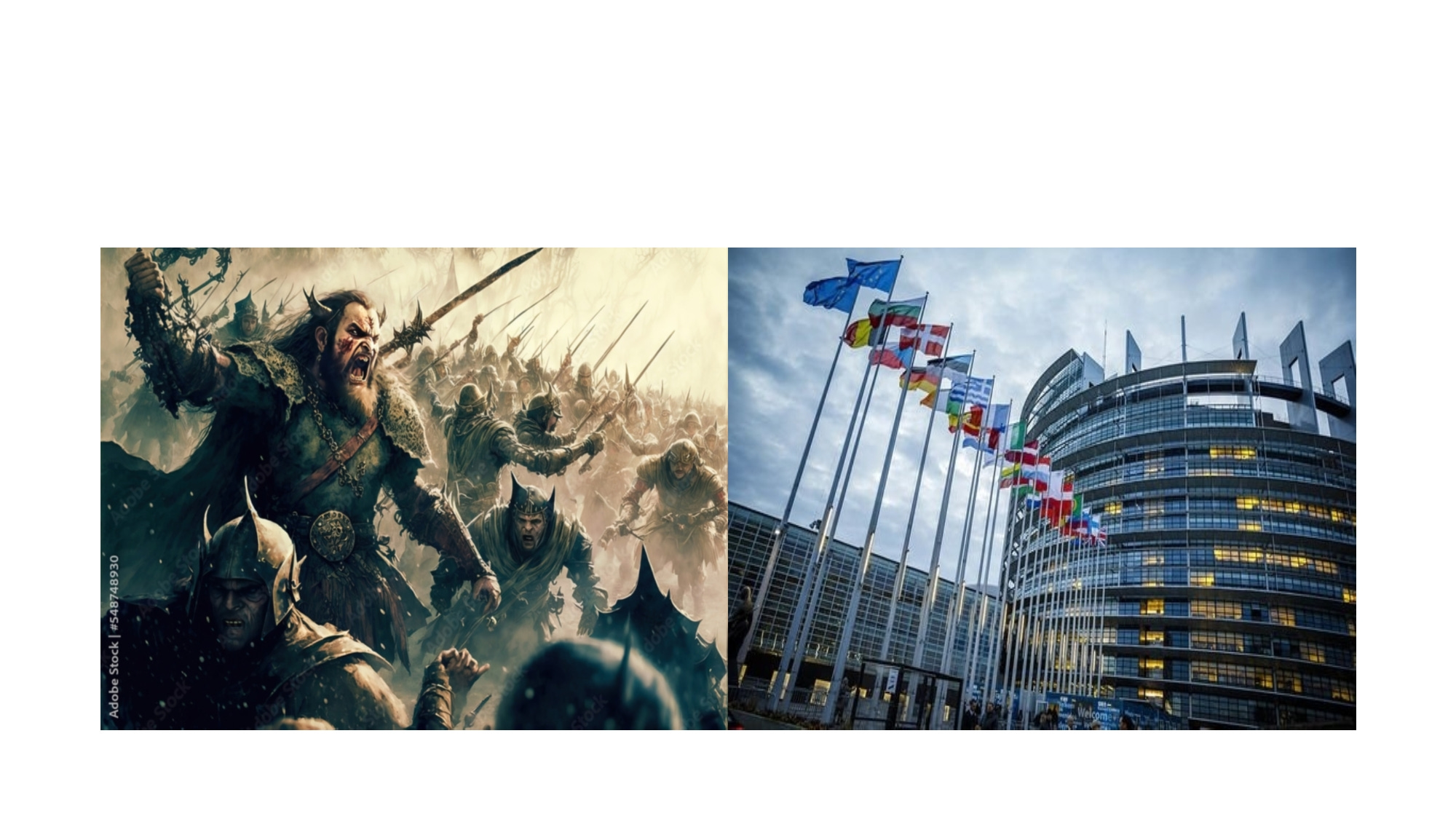
The latest National Security Strategy (NSS) highlighted the direct threat the Trump administration poses to Europe. This threat extends beyond seizing Greenland and affects a broader array of issues and groups, including various non-government organizations. As a driving policy goal, the administration seeks to internationalize its authoritarian MAGA vision to undermine democracy, rule of law, and civil/human rights in Europe, which will also weaken allies of those in the US who oppose authoritarianism domestically.

Internationalizing the MAGA Agenda

The NSS undertakes unprecedented criticism of European governance, society, and culture, reversing over 80 years of US policy. It reflects the administration’s domestic ideology and seeks to transform European societies along similar lines—ideological imperialism designed around a far-right, traditionalist concept of white, Christian, European civilization. The NSS denounces mass migration (people from non-white, Christian societies) and criticizes efforts to combat hate speech and disinformation as attacks on free speech. It also disparaged global organizations, norms, and rules guiding the European and international order since WWII.

These goals reflect an ideological stream that has secured strong positions in the administration. At the Munich Security Conference last February, Vice President Vance attacked Europe, stating his greatest fear was “the threat within.” He supported Germany’s Alliance for Democracy, which the German state considers an extremist group. Last May, the State Department issued “The Need for Civilizational Allies,” laying out similar concepts. In Fall 2025, the State Department sent talking points to US Embassies advocating harsh immigration crackdowns. In December 2025, the US revoked travel visas of five Europeans involved in restricting disinformation and hate speech.

Broad Role for Far Right Non-government Organizations

These official actions draw roots from the wider non-governmental far-right community. In June 2025, the Heritage Foundation (authors of Project 2025) produced “Toward a Nationalist Internationalism: The Case for Building a National Conservative Alliance.” This presaged elements of the NSS and indicates the administration’s ambitions to change European governments by supporting parties and movements in order to impose far-right policies on immigration, religion, culture, gender/sexuality, and traditional families—essentially taking Project 2025 on a European tour. Their goals parallel domestic policies and reflect the objective of establishing a far-right “Internationale” vaguely similar to the Soviet-led COMINTERN of the pre-WWII era.

The administration builds upon an expanding network of like-minded parties. All European countries have far-right parties with similar ideologies. Hungary, under Prime Minister Orban and FIDESZ, has emerged as the dominant element and poster-child for what the far right seeks to achieve. Since Orban returned to power in 2010, Hungary has seen significant decline in rule of law, adherence to democratic principles and policies, protection of minority rights, and free speech as measured by multiple rating groups, while corruption has steadily increased. Consequently, the EU placed sanctions on Budapest, and in early January 2025 the US sanctioned its intelligence minister for corruption.

Beyond political parties, there’s a growing web of advocacy groups and think tanks in Europe with ties to US counterparts that the administration leverages. Perhaps the two most prominent in Europe are Hungary’s Mathais Corvin Collegium (MCC) and Poland’s Ordi Luris Institute. In the US, the Conservative Political Action Committee (CPAC), for example, holds conferences in Europe, Hungary in 2022 and Poland in 2025 and regularly invites European far-right groups to US conferences. All focus on building a stronger international network for mutual support to advance their shared ideological agendas.

The growing ties among these non-governmental groups may be the greatest threat to Europe because of the administration’s embrace of changing non-far-right governments and pressuring European states to adopt authoritarian MAGA policies. From Vance’s February 2025 statement through the November NSS, the administration has a vision for Europe—parallel “Make (country) Great Again” movements running the governments.

America First Leadership Needs a Far-Right Europe to Follow It

The administration’s policy towards Europe will be shaped by trade, commercial, and traditional national security concerns, and consequently, it may turn to non-governmental allies to push its ideological agenda—not unlike the Soviet Union’s use of Communist parties in the 20th century. While the State Department embraces this far-right agenda, the administration has not yet harnessed the US military or intelligence community to pursue authoritarian policies in Europe. Such action could undermine NATO and essential intelligence relationships, especially if seeking to actively subvert democratic governance. While once unimaginable, given actions against Venezuela and threats to Greenland and Canada, this may be on the policy menu.

Despite its advocacy of national sovereignty, the administration and wider far-right movement ironically see international ties as essential and view strong, far-right, non-government organizations operating in multinational networks as vital to their ideological success. In a further irony, despite disparaging views of Europe, they view Europe as essential to building a white, Christian, far-right society in the US. European heritage is central to their worldview. The movement recognizes that achieving domestic goals requires parallel success in Europe, both to legitimize itself and weaken allies of its opponents inside the US.

Some have interpreted the NSS as dividing the world into spheres of influence—the US gets the Americas, China gets East Asia, and Russia gets Europe. The NSS and administration appear to disagree; they want Europe in their sphere, but it must be a MAGA-like Europe. As the Heritage paper states, America First may become America Alone. Even as the administration downplays traditional relationships with Europe, especially the EU, it clearly has a high-priority agenda to undermine European governments that don’t adhere to its authoritarian ideology via official actions and a non-government network.

Harry Hannah retired after four decades of experience in the Intelligence Community. He retired from the CIA in 2018. About half that time was focused on analyzing the capability of multiple foreign militaries in direct support of US military planning and operations and national level decision making. He is a member of The Steady State.

Founded in 2016, The Steady State is a nonprofit 501(c)(4) organization of more than 360 former senior national security professionals. Our membership includes former officials from the CIA, FBI, Department of State, Department of Defense, and Department of Homeland Security. Drawing on deep expertise across national security disciplines, including intelligence, diplomacy, military affairs, and law, we advocate for constitutional democracy, the rule of law, and the preservation of America’s national security institutions.

All statements of fact, opinion, or analysis expressed are those of the author and do not reflect the official positions or views of the US Government. Nothing in the contents should be construed as asserting or implying US Government authentication of information or endorsement of the author’s views.

Powered by WPeMatico

In 1972, the late folk singer-songwriter and Chicago native Steve Goodman recorded Lincoln Park Pirates about a notorious car-towing service in Chicago, often accused of breaking the law. In the song, the owner is not satisfied with dragging away automobiles but also wants to tow the boats in the city’s marinas and planes on local runways. It’s an apt symbol for what we see from the President.

Although Trump’s lust for power has long been evident, we now have it from the source. One of the driving forces and more consistent molders of Administration policy, White House deputy chief of staff Stephen Miller, recently lectured CNN that “power” is the only force in world affairs that has ever counted. Trump himself subsequently told the New York Times that the only restraint on his power was his “own morality.” (Since Trump has always been weak on demonstrating any moral framework, what precisely that constraint might be is not clear.) But is this recklessly unchecked ambition – feeding illegal and unconstitutional actions — equal to mastering the forces it sets in motion? Evidence suggests the answer is no, and that endangers the country.

There is a pattern to this autocratic exercise of power. Trump loves the splashy move, leaving it until afterwards to figure out next steps toward often poorly-defined goals. While the Administration would claim that such actions serve its “vision” of dominating the Western Hemisphere and inspiring fear and “respect” in the rest of the world, it fails to understand that this vision is actually an illusion. It seeks to imitate the big-power, exclusive spheres-of-influence rivalries of the nineteenth century, ignoring the reality of a simultaneously interconnected, interdependent, but dangerous 21st-century world.

Most people would recognize the inherent pitfalls of such superficiality and not conduct their own lives this way. Trump and his people insist that they are making the United States safer, more secure, and more prosperous, but these claims lose more credibility with each passing week.

Most Presidents would seek to limit the number of international crises demanding their attention at any one time. Trump, despite assuring his supporters that he would avoid foreign entanglements, has intervened in diverse flashpoints and created problems where none existed.

Trump was happy to take a victory lap after the spring cease-fire and partial Israeli pull-back in Gaza, but his claims about bringing peace were tragically risible. His elaborate peace plan is equally far-fetched. Not only has none of the disciplined hard work been done, which conceivably could breathe some life into it – starting with creating effective arrangements to bring real security to Gaza – but Trump has ceded the key role in determining what comes next to Israeli Prime Minister Netanyahu, who has little interest in serious compromise and none in an eventual Palestinian state, however delineated.

The June bombing of Iran’s nuclear facilities set back the country’s progress toward a weapons capability but did not destroy the effort. (Whether Iran actually intends to build a bomb is in dispute.) Meanwhile, the ability to evaluate any remaining threat has been reduced, as Iran no longer allows in International Atomic Energy Agency inspectors. Should the U.S. nevertheless discover an unexpectedly resurgent program, we have no indication that the Administration has any thought beyond resorting to using force in a similar way again.

The dramatic snatching of Venezuelan President Maduro was an impressive display of military prowess but does very little to further progress toward Trump’s stated objective of securing the country’s oil reserves for the U.S. and demanding obeisance to U.S. wishes. Only after proclaiming that the U.S. would “run” Venezuela did Trump, promising riches, convene major U.S. oil companies to urge them to get involved. Most, predictably, were reluctant to commit vast sums over many years in order to restore profitability to the country’s dilapidated infrastructure, particularly under uncertain political conditions. Moreover, Trump might in fact have complicated progress on that second point, having quickly sidelined the democratic opposition victor in the last presidential election, in favor of preserving Maduro’s government.

Trump and, particularly, Secretary of State Rubio, very hopefully expect that the Cuban Communist government will fall soon. But there is no policy in sight to deal with the aftermath. Whom would the Administration install in power? Cuban security forces have ensured, over many years, that there is no organized opposition. Or would Trump proclaim that we will “run” that country, too? Does the Administration plan to devote huge sums to repair a shattered economy? Local conditions are now reportedly so dire that an end to Communist emigration restrictions could easily produce new crowds of people seeking a better life in the U.S., presumably an undesirable effect from the Administration’s point of view. Does the Administration expect Cuban Americans to go back to the island in significant numbers to help rebuild?

Trump has also not forgotten his demands for the Panama Canal, based on the distortion of a long-running local commercial dispute into a hypothetical Chinese threat to international shipping.

Trump’s dogged insistence that the U.S. must have Greenland (someone else’s territory where we already have basing rights) has shaken the foundations of NATO, a cornerstone of U.S. security for decades. Moreover, Denmark has made very clear that it is happy to work with the U.S. and NATO partners to improve the Alliance’s defensive capabilities in the region. Greenland has been equally clear that it is willing to negotiate arrangements jointly to develop important natural resources. But the Administration considers these views merely unwelcome resistance.

A U.S. missile attack in northwestern Nigeria was allegedly meant to protect Christians victimized by a terrorist group (an offshoot of a more dangerous group, centered in the country’s northeast). Reportedly, however, a quarter of the missiles did not detonate, and several were found hundreds of miles away. U.S. officials admitted that they had had no intelligence of their own to verify intended targets; such information had come solely from the Nigerian government.

Russia’s war on Ukraine at times has consumed Trump and at others seemed to bore him. Trump would like to see this settled and claim personal credit, but without doing the necessary hard work of pressuring Putin to desist.

Trump has not shied away from threatening possible military action in an Iran convulsed by anti-government protests, but what that could achieve, and how it would fit into any broader approach to the possible end of the Islamic Republic is undiscernible.

The Administration’s push-pull approach to China reveals an inability to decide whether China is an adversary or a partner. Administration policy swings back and forth between aggressive bluster and efforts to seek accommodation, each tactic undercutting the other.

Not to be left off this list is the totally unnecessary and worsening fight he has picked with Canada, which, he seems to feel, is, like Greenland, a better bet for U.S. security if it is in American hands. The intense resentment this has created right next door, and the huge losses incurred by U.S. exporters and U.S. tourism-related businesses, do not seem to have made an impression.

Foreign affairs analysts, reasonably enough, keep trying to discover policy rationales for Trump’s ambitions. In a recent “New Yorker” article, however, Dexter Filkins wrote that a former National Security staffer put it this way: “With Trump, you have to resist the temptation to intellectualize what he is doing. They’re emotional responses, flying all over the place.” That is no way to run a children’s play group, much less the most powerful country in the world.

Tom Wolfson is a former senior U.S. diplomat who has lived and worked in six foreign countries, occasionally multiple times. His work representing the U.S. has included assignments at the United Nations, in the U.S. Congress, and with an international democracy-building organization. He is a member of The Steady State.

Founded in 2016, The Steady State is a nonprofit 501(c)(4) organization of more than 360 former senior national security professionals. Our membership includes former officials from the CIA, FBI, Department of State, Department of Defense, and Department of Homeland Security. Drawing on deep expertise across national security disciplines, including intelligence, diplomacy, military affairs, and law, we advocate for constitutional democracy, the rule of law, and the preservation of America’s national security institutions.

Powered by WPeMatico

What happens when the rules stop protecting those who follow them? In the latest episode of The Steady State Sentinel podcast, Immigration attorney Amy Peck and former FBI executive Lauren Anderson examine how unpredictable enforcement erodes trust, legitimacy, and the rule of law—and why the consequences extend far beyond immigration.

Listen here or subscribe on your favorite platform including Apple, YouTube and Spotify.

Powered by WPeMatico

US President Donald Trump posted this photo of Nicolas Maduro aboard the USS Iwo Jima on Truth Social. Madruo is wearing large noise-blocking headphones and a blindfold.

PHOTO CREDIT: US President Donald Trump posted this photo of Nicolas Maduro aboard the USS Iwo Jima on
Truth Social.

Having removed Nicolás Maduro from power in Venezuela through military force, the United States is now the decisive external actor shaping Venezuela’s near-term political and economic trajectory.

Much attention will focus on the legality of the operation, on Maduro’s fate in U.S. courts, and on how other major powers respond. Those debates will play out in Washington and abroad. But they are unlikely to determine what happens inside Venezuela itself.

What will matter there is more prosaic and more unforgiving: whether authority is exercised and obeyed; whether basic services function; whether armed actors are managed rather than unleashed; and whether the United States can avoid being drawn into an open-ended commitment whose costs exceed its benefits. The success or failure of the intervention will turn not on declarations or press briefings, but on observable behavior in six concrete areas.

Click Here to read the entire Washington Spectator Article, published January 12, 2026

Jonathan M. Winer is the former Special Envoy for Libya and Deputy Assistant Secretary of State for International Law Enforcement and a Distinguished Diplomatic Fellow at MEI. He is a member of The Steady State.

Founded in 2016, The Steady State is a nonprofit 501(c)(4) organization of more than 360 former senior national security professionals. Our membership includes former officials from the CIA, FBI, Department of State, Department of Defense, and Department of Homeland Security. Drawing on deep expertise across national security disciplines, including intelligence, diplomacy, military affairs, and law, we advocate for constitutional democracy, the rule of law, and the preservation of America’s national security institutions.

Powered by WPeMatico

An often-asked question since January 21, 2025, “Is America really in danger of slipping into authoritarianism?” On July 4, 2025, I wrote an essay outlining indicators of the slide toward an autocratic government, which was expanded upon in an August 8 essay. In October, it felt to me as if the authoritarianism we fear was already upon us, and I compared what I was observing to the Jim Crow era that I grew up in.

As the first anniversary of this administration approaches, I’ve been reflecting on recent events and see nothing to contradict my conclusion from October. I am convinced that the United States is now an elected autocracy closely resembling Viktor Orban of Hungary, Vladimir Putin of Russia, Nayib Bukele of El Salvador, Narendra Modi of India, and Recep Tayyip Erdogan of Turkey, and, lest we forget, the man recently deposed by the U.S., Nicolas Maduro of Venezuela. These are (or were, in Maduro’s case) leaders who gained power through elections (sometimes even honest elections), but who rule through manipulation and repression, and who, once in power, dismantle democratic processes and institutions. We’re not yet a full-blown dictatorship, but the signs are ever clear that this is where we could end up if the trend is not reversed.

As hard as it might be for Americans to accept that this country falls into that category, it behooves us to take a hard look at what has happened in the last year and evaluate it against the key characteristics of authoritarianism.

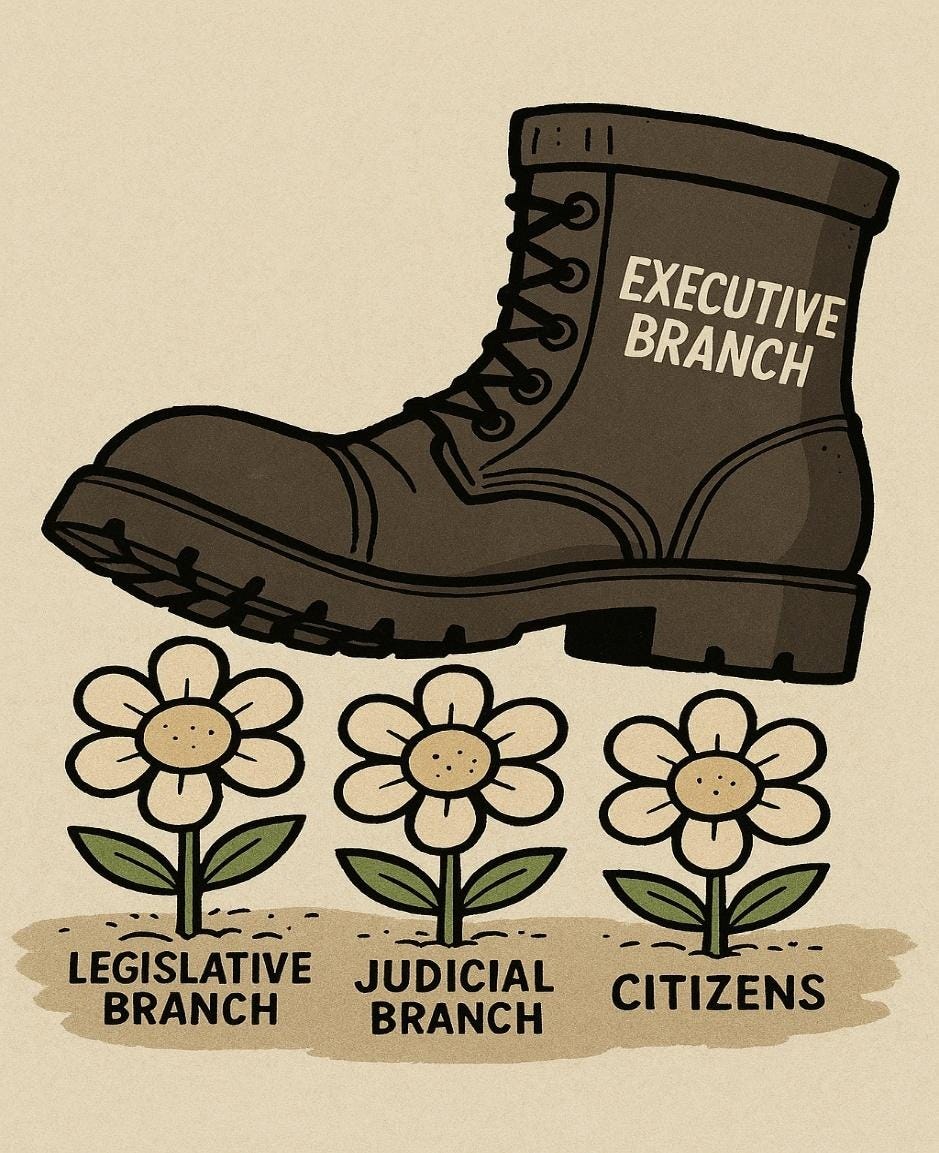
Concentration of Power. Since day one, the Trump administration has sought to expand the power of the executive branch, weaken institutional checks and balances, and undermine the independence of the judiciary. From the dismantling of USAID to an executive order ending birthright citizenship, actions that have been challenged in court, but not yet decided, Trump and his advisors have continued to assert that his power over the executive branch is unlimited and unquestionable. The capstone of his quest for power, and his views on limitations on his power, were highlighted in a January 8, 2026, interview with The New York Times, when he said, in answer to a question if there were any limits on his global powers, “Yeah, there is one thing. My own morality. My own mind. It’s the only thing that can stop me. I don’t need international law.”

Restriction of Civil Liberties. In the first 100 days of Trump’s second term, he went full bore in undoing decades of civil rights work, including eliminating diversity initiatives across all federal agencies, firing staffers of agencies working on civil rights issues, and pushing to roll back provisions of the Civil Rights Act; dismantling laws intended to protect people from discrimination in schools, the workplace, and at the voting polls. In a January 11, 2026, article in The New York Times, Trump’s views on civil rights were summed up in his remarks that white people were ‘very badly treated’ by civil rights-era protections.

Political Repression. During the 2024 presidential campaign, Trump pledged to punish his political opponents. As of November 26, 2025, a Reuters tally indicated that at least 470 Americans, individuals, institutions, and organizations had been targeted for retribution. The list included prosecutors who investigated his efforts to overturn the 2020 election, media organizations he deemed hostile, law firms associated with opponents, and government employees who questioned his policies. On January 11, 2026, Federal Reserve Chair Jerome Powell received a subpoena and a threat of criminal indictment from the DOJ regarding his 2025 congressional testimony on renovations to the Federal Reserve’s buildings. In a video statement, Powell said the subpoena was an effort to undermine the Fed’s independence when it comes to setting interest rates. Trump has denied knowledge of the case but has clashed with Powell (whom he appointed during his first term) over interest rates, which he seeks to manipulate for political reasons, whereas Powell insists on using economic indicators to make that call.

Manipulation of Democratic Processes. While many of Trump’s early actions by executive order have been challenged in the courts, and some of those orders have been declared unconstitutional, he continues to look for workarounds and loopholes in the law to implement the proposals in the Heritage Foundation’s 900-page Project 2025, a blueprint for placing the federal bureaucracy under direct presidential control without Congressional or Judicial Branch oversight. He has tried eliminating job protections for federal employees and has weaponized federal agencies against his political opponents, overwhelming the courts—and the public—with constant policy changes, in an effort to normalize authoritarian governance through the sheer volume of controversial actions.

Use of Propaganda and Control of Information. Control of the media and use of propaganda to shape public perception is right out of the authoritarian playbook, and this has been Trump’s tactic from the start of his second administration. Even now, he continues the ‘big lie’ that the 2020 election was ‘stolen’; he denigrates and mocks opponents with ad hominem attacks; and he uses threats and intimidation to force the media to hew to his line. A prime example of the use of propaganda (outright lies) to shape public opinion and control the narrative was Trump’s comments after an ICE officer shot and killed Renee Ncole Good in Minneapolis, Minnesota, on January 7, 2026. Despite video evidence showing that Good was turning her car away from the agents when the first shot was fired, and the next two shots were fired through the left front window, Trump, in a statement to The New York Times, accused the victim of “trying to run over policemen…”

Institutional Support. During his first administration, Trump, who was new to the federal government scene, appointed officials who, in many cases, placed their oath to ‘support and defend the Constitution’ over personal loyalty to him. Thus, he was restrained in some of his worst impulses, such as his desire to deploy the army to DC to deal with the demonstrations after the murder of George Floyd by a Minneapolis policeman. In his second administration, however, he appointed only loyalists to key positions, such as the DOJ, the FBI, and the DOD, which has led to National Guard deployments, primarily to Democratic-run cities and states, until the courts ordered them out of California, Oregon, and Illinois. Because he has more direct control over the DC National Guard, troops remain in the capital, and at the request of Louisiana’s Republican governor, in New Orleans. Until his raid on Venezuela and abduction of its president and his wife, and the DOJ subpoena to Fed Chair Powell, the Republican-led Congress has, for the most part, either supported his actions or looked the other way. Democratic legislators’ efforts to rein him in have been blocked by the Republican majority. The Venezuela crisis, the attack on the Fed, and his obsession with taking over Greenland, however, have exposed cracks in Congressional support that have yet to stop his actions—but they offer hope. Right-wing media outlets have been consistently supportive, or silent on his abuses of power, and his efforts to bring the rest of the media in line continue.

Fear and Violence. Finally, there is the use of fear and violence to manipulate and control the population. One need look no further than the aggressive and militarized tactics that ICE uses in its raids, and the demographics of those being detained and deported to conclude that instilling fear is as much—if not more—a goal of the administration as its stated goal of removing the worst and most dangerous undocumented alien criminals. Targets of these raids have increasingly been those with no ‘criminal’ record, legal permanent residents, and even U.S. citizens.

It is maybe premature to call the U.S. a full-blown autocracy, but it’s hard to deny that we are no longer ‘approaching’ that status. We’re now a hybrid, perhaps still more free than unfree, but the move to dictatorship seems to be accelerating each day, and one can only wonder when we’ll reach the point at which a U-turn becomes difficult.

Charles A. Ray served 20 years in the U.S. Army, including two tours in Vietnam. He retired as a senior US diplomat, serving 30 years in the U.S. Foreign Service, with assignments as ambassador to the Kingdom of Cambodia and the Republic of Zimbabwe, and was the first American consul general in Ho Chi Minh City, Vietnam. He also served in senior positions with the Department of Defense and is a member of The Steady State.

Founded in 2016, The Steady State is a nonprofit 501(c)(4) organization of more than 360 former senior national security professionals. Our membership includes former officials from the CIA, FBI, Department of State, Department of Defense, and Department of Homeland Security. Drawing on deep expertise across national security disciplines, including intelligence, diplomacy, military affairs, and law, we advocate for constitutional democracy, the rule of law, and the preservation of America’s national security institutions.

Powered by WPeMatico

Federal Reserve leaves interest rates ...

As the administration threatens criminal indictment of Federal Reserve Chairman Powell, here is a replay for those who might have this, originally published on The Steady State Substack, August 3, 2025.

When President Donald Trump suggested he might fire Federal Reserve Chair Jerome Powell over disagreements about interest rate policy, it wasn’t just a breach of political decorum—it was a threat to a cornerstone of American economic stability. The Federal Reserve’s independence has long been a bipartisan norm, respected by presidents from Franklin D. Roosevelt to Ronald Reagan to Barack Obama. While leaders have always expressed opinions on interest rates—some more vocally than others—rarely have they implied the Fed should act at their behest, or worse, that the Fed chair should be removed for disobedience. The consequences of such political interference would be far-reaching—and potentially devastating.

At its core, the Federal Reserve exists to manage the U.S. money supply, stabilize prices, and maintain employment—all while ensuring the financial system operates smoothly. To do this effectively, the Fed must be free to act based on economic indicators and long-term interests, not the electoral calendar or political popularity. If a central bank becomes a political tool, it risks losing the credibility that underpins its effectiveness. And once that credibility is lost, restoring it would be very difficult if not impossible.

Economic Volatility and the Cost of Political Influence

Imagine a world where interest rates are set not according to inflation data or economic output, but by a president trying to goose the economy before an election. In the short term, such politically motivated rate cuts might stimulate spending. But the long-term consequences would be inflation, currency instability, and increased uncertainty for investors and businesses alike. No prudent investor or business owner likes uncertainty. And a weak jobs report followed by the President firing the head of the Bureau of Labor Statistics simply because he didn’t like the news exacerbates those doubts.

A politically captured Fed could also delay raising rates even when inflation surges, for fear of triggering a recession during an election year. No need to imagine that, it’s exactly what played out in the 1970s, when political pressure on the Fed helped fuel a decade of stagflation—high inflation combined with stagnant growth. Only with the painful but necessary rate hikes in the 1980s did the Fed tame inflation and restore credibility. But those hikes triggered a deep recession, which could have been avoided had the Fed been allowed to act earlier and independently.

Markets function best when they can predict, to some degree, the likely response of central banks to economic developments. An independent Fed sends clear signals based on data and deliberation. A politicized Fed, by contrast, introduces a dangerous element of unpredictability. Investors, both domestic and foreign, become less certain about the future of inflation, interest rates, and the value of the dollar. Over time, this uncertainty raises borrowing costs and weakens the economic foundation of the country.

The Dollar’s Role—and the National Security Risk

Beyond economics, there’s a powerful national security argument for defending the Fed’s independence. The U.S. dollar serves as the world’s primary reserve currency. More than 50% of global trade is conducted in dollars, and central banks around the world hold over $6 trillion in dollar-denominated reserves. This “exorbitant privilege,” as former French President Valéry Giscard d’Estaing once called it, gives the U.S. enormous geopolitical leverage.

That leverage depends on global trust—trust in the rule of law, in the independence of institutions, and in the predictability of U.S. monetary policy. If the rest of the world begins to see the Fed as a tool of partisan politics, that trust begins to erode. Central banks in Beijing, Frankfurt, or Brasília may start to reduce their exposure to the dollar. If enough of them do, the cost of borrowing for the U.S. government would rise, potentially by hundreds of billions of dollars. Worse, the U.S. could lose its unique position in the global financial system, diminishing our ability to impose sanctions, manage crises, or even defend our economy against foreign shocks.

Authoritarian regimes around the world already exploit chaos and dysfunction in democratic institutions to bolster their own narratives. A Fed that looks like an extension of the Oval Office hands them another propaganda tool. It also makes coordinated economic diplomacy far more difficult. Allies may begin to hedge their bets, moving away from the dollar and U.S.-led institutions in favor of more neutral alternatives.

Guardrails for the Future

Preserving the Fed’s independence is not just about economic orthodoxy—it’s about protecting the long-term stability and security of the United States. Presidents may always grumble about interest rates. That’s part of the democratic process. But when those complaints turn into threats or outright interference, it’s time to draw a bright line and call it what it is: a recipe for economic disaster. Central bank independence isn’t a luxury—it’s a pillar of modern governance, a guarantor of prosperity, and a shield against the erosion of American leadership in the world.

Bruce Berton served as a U.S. diplomat for over three decades, ultimately rising to the senior ranks of the Foreign Service, including two years as Ambassador and Head of Mission at the Organization for Security and Cooperation in Europe’s (OSCE) Mission to Bosnia and Herzegovina. He is a native of the Pacific Northwest and a graduate of Pacific Lutheran University. He is a member of The Steady State.

Founded in 2016, The Steady State is a nonpartisan, nonprofit 501(c)(4) organization of more than 300 former senior national security professionals. Our membership includes former officials from the CIA, FBI, Department of State, Department of Defense and Department of Homeland Security. Drawing on deep expertise across national security disciplines including intelligence, diplomacy, military affairs and law, we advocate for constitutional democracy, the rule of law and the preservation of America’s national security institutions.

Powered by WPeMatico

A newspaper with text on it
AI-generated content may be incorrect.

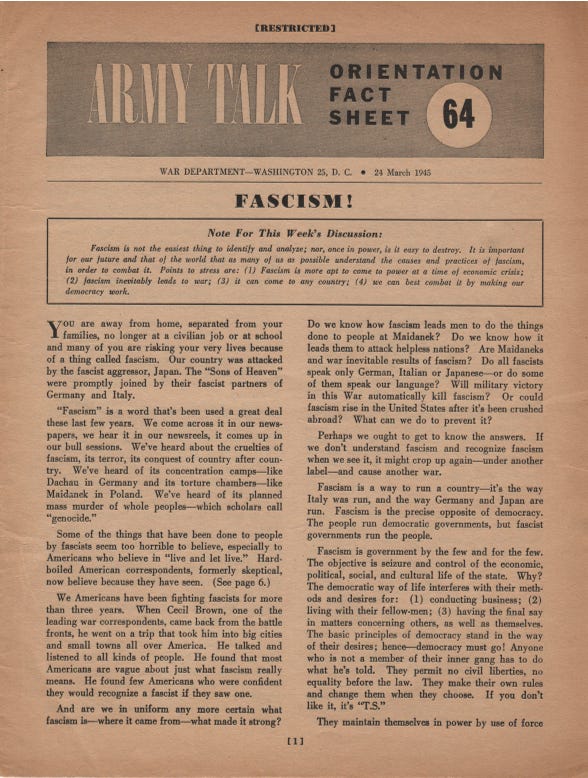
Over the past several months, the Departments of Defense and Homeland Security have become unusually active in communicating directly with the American public, particularly through social-media platforms. Much of this material shares a common aesthetic and rhetorical profile: a romanticized vision of a homogeneous American past, heavy reliance on martial symbolism, and language that frames politics as an existential struggle between insiders and enemies. Many observers have noted that this style bears an uncomfortable resemblance to official propaganda produced by authoritarian regimes in the twentieth century—most notably Germany in the 1930s.

In March 1945, just weeks before the defeat of Nazi Germany, the U.S. War Department issued Army Talk 64, a pamphlet with a blunt, one-word title: “FASCISM!” It was part of a broader series—Army Talks—distributed to American service members in the European theater. The purpose was not morale-boosting or cheerleading. It was civic education.

As historian Heather Cox Richardson recently explained, the Army Talks were designed to help soldiers “become better-informed men and women and therefore better soldiers.” The War Department understood that fighting fascism required more than weapons. It required clarity—about what fascism is, how it operates, and why it poses a mortal threat to democratic societies.

What is striking about Army Talk 64 is not merely its historical provenance, but its enduring relevance. The pamphlet warned that fascism does not announce itself with a single uniform or symbol. It grows gradually, exploiting fear, resentment, and nostalgia. It thrives, the document cautioned, on indifference and ignorance.

The pamphlet reminded American soldiers that freedom is not self-executing. It requires vigilance—not only against foreign enemies, but against domestic practices that corrode democratic norms. “If we permit discrimination, prejudice, or hate to rob anyone of his democratic rights,” the authors warned, “our own freedom and all democracy is threatened.”

This was not radical language. It was official U.S. government doctrine.

The men and women reading Army Talk 64 were preparing to liberate Europe from fascist rule. But the War Department understood that the ideology they were fighting was not confined to foreign soil. Fascism, the pamphlet made clear, is a recurring political disease. It can emerge anywhere citizens lose the habit of critical thinking or surrender democratic responsibility in exchange for a promise of restored greatness.

That clarity stands in stark contrast to our present moment.

Today, public discourse often treats “fascism” as either an insult or a taboo—too inflammatory to name, too dangerous to define. Yet the United States once insisted that its soldiers confront the concept directly, analytically, and without euphemism. The government trusted Americans to understand the warning.

Re-engaging with Army Talk 64 would not be an act of nostalgia. It would be an act of democratic self-respect. The document is not partisan. It does not target any individual or movement by name. Instead, it offers a framework—rooted in American experience—for recognizing when political culture begins to slide toward authoritarianism.

The lesson is simple and unsettling: democracies do not fail only because of force. They fail when citizens stop paying attention.

Nearly eighty years ago, the United States told its soldiers that the defense of freedom begins with understanding what threatens it. That message was true in 1945. It is no less true today.

The question is whether we are still willing to hear it.

Steven A. Cash served as a prosecutor in the Manhattan District Attorney’s office before joining the CIA in 1994 as Assistant General counsel and subsequently serving as an intelligence officer in the Directorate of Operations. In 2001 he joined the Senate Select committee on Intelligence as Counsel and designee-staffer to Senator Diane Feinstein). He later served as a senior staffer in the House Select Committee on Homeland Security, the Department of Energy, the Senate Judiciary Subcommittee on Terrorism, Technology and Homeland Security and the Department of Energy. In the private sector he has advised on national security, counterintelligence, and technology policy and served on the Biological Sciences Experts Group under the Director of National Intelligence. Mr. Cash is currently the Executive Director of The Steady State.

Founded in 2016, The Steady State is a nonprofit 501(c)(4) organization of more than 360 former senior national security professionals. Our membership includes former officials from the CIA, FBI, Department of State, Department of Defense and Department of Homeland Security. Drawing on deep expertise across national security disciplines including intelligence, diplomacy, military affairs and law, we advocate for constitutional democracy, the rule of law and the preservation of America’s national security institutions.

Powered by WPeMatico

The Steady State Executive Director Steven Cash draws on decades of experience watching foreign democracies fail to highlight the existential risks the United States faces under President Donald Trump. Award-winning CIA operative James Lawler conducts this provocative discussion about encroaching dictatorship in the United States.

Powered by WPeMatico

The Steady State Sentinel is produced by The Steady State, a community of former national security professionals who spent their careers safeguarding the United States at home and abroad. Today, we continue that mission by staying true to our oaths to defend the Constitution, uphold democracy, and protect national security. Each episode features expert hosts in conversation with accomplished guests whose experience sheds light on the crises and challenges facing the nation.

In Episode 2, The Steady State Executive Director Steven A. Cash draws on decades of experience watching foreign democracies fail to highlight the existential risks the United States faces under President Donald Trump. Award-winning CIA operative James Lawler conducts this provocative discussion about encroaching dictatorship in the United States.

Listen Here

Steven A. Cash served as a former prosecutor in the Manhattan District Attorney’s office before joining the CIA in 1994 as Assistant General counsel and subsequently serving as an intelligence officer in the Directorate of Operations. He subsequently served in the Senate Select committee on Intelligence as Counsel and designee-staffer to Senator Diane Feinstein), as a senior staffer in House Select Committee on Homeland Security, the Department of Energy, the Senate Judiciary Subcommittee on Terrorism, Technology , the Department of Homeland Security and the Department of Energy. In the private sector he has advised on national security, counterintelligence, and technology policy and served on the Biological Sciences Experts Group under the Director of National Intelligence.

Founded in 2016, The Steady State is a nonprofit 501(c)(4) organization of more than 360 former senior national security professionals. Our membership includes former officials from the CIA, FBI, Department of State, Department of Defense, and Department of Homeland Security. Drawing on deep expertise across national security disciplines, including intelligence, diplomacy, military affairs, and law, we advocate for constitutional democracy, the rule of law, and the preservation of America’s national security institutions. Founded in 2016, The Steady State is a nonprofit 501(c)(4) organization of more than 360 former senior national security professionals. Our membership includes former officials from the CIA, FBI, Department of State, Department of Defense, and Department of Homeland Security. Drawing on deep expertise across national security disciplines, including intelligence, diplomacy, military affairs, and law, we advocate for constitutional democracy, the rule of law, and the preservation of America’s national security institutions.

Powered by WPeMatico

Almost one year ago, one of the Trump Administration’s first actions on Inauguration Day was to suspend indefinitely the entry of all refugees under the US Refugee Admissions Program, a statutory body established by the 1980 Refugee Act. Refugees already approved for arrival, including Afghan allies, some of whom even had plane tickets and had sold their belongings and homes, were left stranded around the world. The State Department, Department of Homeland Security, and other agencies involved in vetting and processing these cases, suspended flights, visas, and congressionally approved funds for resettlement agencies throughout the United States and even refused to provide reimbursement for already-performed resettlement work.

As a former U.S. diplomat who served in Afghanistan and now researches the situation of the country we left behind, I saw the horror of this action at close range. I had traveled to Pakistan and Qatar in early January 2025 and heard from former judges and military officials that they faced a devastating reality. They had worked in tandem with us to pursue Taliban offenders, so they could not go back. They could not go forward to the United States, even though they had been qualified as refugees under our law. And they were no longer able to stay where they were, as most countries hosting them were not offering safety or settlement.

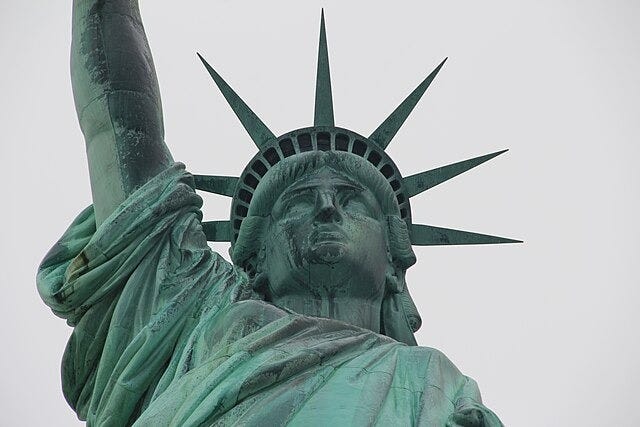
This action against refugees, besides ripping our national moral fabric (Statue of Liberty, anyone?) and giving potential allies every reason to refuse to help us fight terrorism, is yet another facet of authoritarianism.

First, using an Executive Order to enact a so-called suspension amounts to a permanent ban since it has no stipulated method of ending, violating the Constitution per a lawsuit (Pacito v Trump) filed February 10, 2025, on behalf of a group of refugees and resettlement nonprofits. The lawsuit challenges the suspension because it usurps Congressional power of spending and appropriations; the Executive Branch may not refuse to spend money already designated for a specific purpose.

Secondly, the U.S. is a signatory to the 1951 Refugee Convention, which requires states to allow refugees seeking protection to enter the country and prohibits states from sending a refugee back to a place where they will be killed or otherwise harmed. Along with the January 2025 suspension of processing, other Executive Orders and statements by the Administration have threatened to review and revoke humanitarian asylum which has been lawfully achieved. The Refugee Act, reflecting a different and generous American response to those displaced by the Vietnam War compared to those now facing danger from our Afghanistan conflict, enshrines those obligations.

Third, the Administration is demonstrating selective compliance with rulings throughout 2025 which required it to at least resettle refugees whose cases were well advanced and particularly those who had risked everything, and sold their possessions, before being ‘frozen’. In July, a U.S. District Court denied the government’s motion to dismiss the case, citing the Refugee Act, the Administrative Procedure Act (APA), and constitutional principles. But the Administration has repeatedly used legal delaying tactics and tools such as defining “refugees” only to mean White Afrikaners from South Africa. It also has used other mechanisms such as a worldwide travel ban to block refugee pathways for Afghans, Haitians, and 18 other countries, mostly African, so the lawsuit process may never restore the refugee program as envisioned by Congress.

Finally, authoritarian rule thrives on nativism, as narrowly defined as possible, with the theory that self-protection during a national emergency can – and must – override constitutional principles. This idea underpinned two occasions of U.S. national shame during World War II: internment of Japanese-American citizens, and denial of safe harbor to the Saint Louis, a ship with Jewish refugees fleeing Nazi Germany on the eve of World War II. But no national emergency could justify those actions in the past, or what is being done now to people who relied on our promise of safety. Instead, authoritarianism has come to destroy what makes America actually great, and even wonderful: our belief in the rule of law, our acceptance of our international treaty obligations, and our embrace of those “yearning to breathe free.”

Annie Pforzheimer is a retired senior U.S. diplomat who served in six foreign countries, including as Deputy Chief of Mission at the U.S. Embassy in Kabul, Afghanistan. She specialized in human rights and security issues during her thirty-year career, and is currently an adjunct professor of international relations. She holds degrees from Harvard University and the National War College. She is a member of The Steady State.

Founded in 2016, The Steady State is a nonprofit 501(c)(4) organization of more than 360 former senior national security professionals. Our membership includes former officials from the CIA, FBI, Department of State, Department of Defense and Department of Homeland Security. Drawing on deep expertise across national security disciplines including intelligence, diplomacy, military affairs and law, we advocate for constitutional democracy, the rule of law and the preservation of America’s national security institutions.

Powered by WPeMatico