
The Cost of Gaslighting: Trump Must Now Reap What He Has Sown.

Since the Trump administration launched Operation Epic Fury on February 28, 2026, the public has been subjected to a torrent of misinformation, disinformation, and conflicting accounts regarding everything about the action, from its motives to who is responsible for what. A good term for the way information has been managed in Epic Fury is “gaslighting.”
Gaslighting, a form of psychological manipulation where the perpetrator attempts to make the victim doubt their memory, perception, or sanity, has emerged as a significant term in contemporary discourse and seems to be a tool of choice in Trump’s authoritarian playbook as he increasingly employs the technique to sway public opinion, manipulate narratives, and consolidate power. The term comes from the 1938 play ‘Gas Light,” and its film adaptations, in which a husband manipulates a wife into believing that she is losing her mind by subtly altering elements of their environment and then denying the changes when confronted. In politics, gaslighting involves deliberately distorting facts, denying reality, and creating false narratives to disorient the public. In both of his terms, we’ve seen Trump use these tactics to create confusion and manipulate reality. Gaslighting has been in full-speed-ahead mode since the US launched in Epic Fury.
During Trump’s first term in office, he frequently teased pulling out of NATO, and since his second inauguration, relations with our European allies have been strained by his erratic tariff policies and his threat to ‘take’ Greenland from Denmark. Then, there was his failure to notify NATO allies in advance of the launch of Epic Fury. The attack came as no surprise, given the buildup of US naval forces in the Gulf prior to the attack, but there was no official notice of the start of hostilities to enable our allies to protect their installations and embassies.
Once the fighting started, and the Iranians closed the Strait of Hormuz, Trump then demanded the allies come to our support, and expressed anger when, one by one, they rebuffed him. Ignored during his outburst of anger, which included a threat to pull the US out of NATO, was were his remarks in January, dismissing the sacrifices of NATO and other allies in their support of the US in Operation Enduring Freedom (OEF) in Afghanistan, which began on October 7, 2001, and lasted for two decades. In public remarks about NATO in January of this year, Trump said that the US had never needed its NATO allies and that allied troops had stayed “a little off the front lines” in Afghanistan. Statistics available from official US sources on OEF show the remarks to be misinformation at best, and outright lies at worst.
According to a White House web page dated October 7, 2002, one year after the start of OEF, 27 coalition countries had forces in Afghanistan, totaling 5,000. The US had 9,000 troops on the ground. During that first year, coalition nations deployed more than 14,000 troops in support of OEF, and while no numbers were given, it was reported that coalition forces also suffered deaths and injuries in support of OEF. Coalition partners provided a wide range of combat, logistics, and training support to OEF, including special operations force deployments.
NATO allies participated in combat operations from the start of OEF and also provided logistical and intelligence support.
The illustration below shows the organization of coalition forces during OEF.
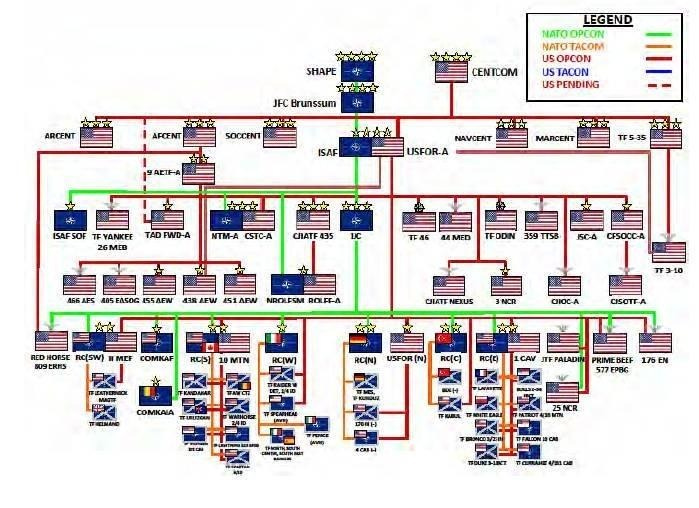
Organization of OEF Forces (Courtesy of CENTCOM)
The following chart presents coalition military fatalities in the Afghanistan War (Operation Enduring Freedom/ISAF) relative to each contributing nation’s population. Values include total Killed in Action, national population (in millions), deaths per million population, and the equivalent percentage of national population. Nations with smaller populations and substantial combat deployments—such as Georgia, Denmark, Estonia, the United States, and the United Kingdom—show the highest per-capita fatality rates. Countries with limited combat roles or larger populations show correspondingly lower per-capita rates.
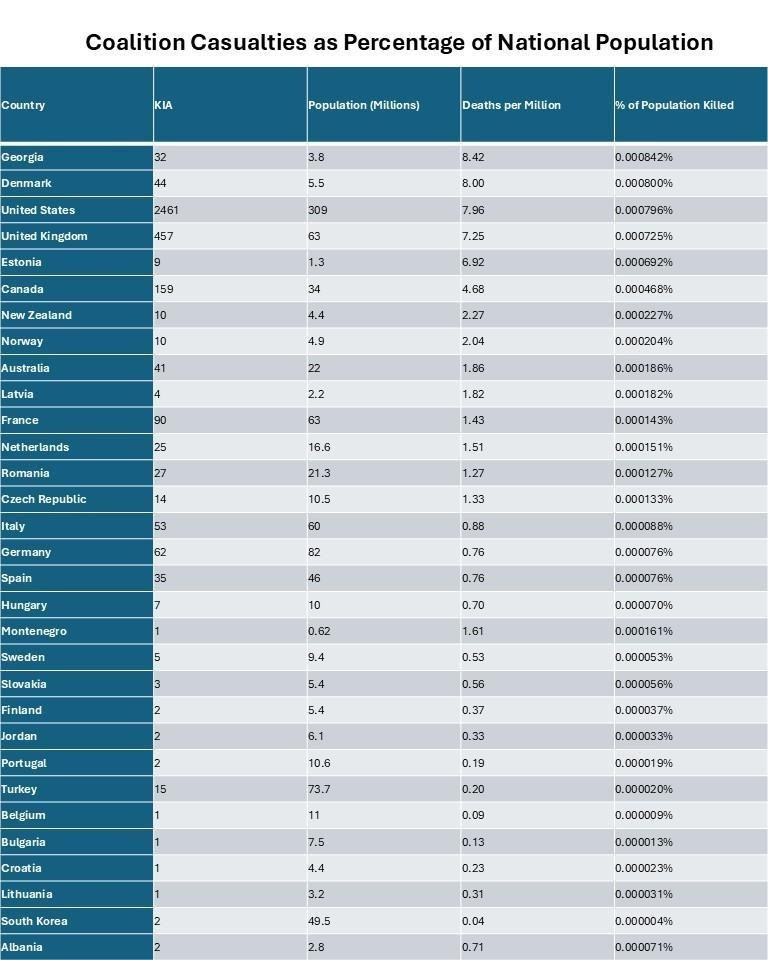
What these charts show is the gaslighting tactic of outright denial of verifiable facts, creating an environment where truth becomes subjective, and we are left questioning the validity of established information. The deliberate distortion of facts and denial of reality threatens the very concept of objective truth. When political leaders manipulate information to suit their agenda, the line between truth and lies blurs, undermining our ability to make informed decisions. It also weakens the foundations of democratic governance.
That this situation has security implications for all of us is undeniable. One has but to look at the current cost of a gallon of regular gasoline. Gaslighting is not the only fault to be found with the way the administration has handled Epic Fury, but as the refusal of our NATO allies to be pulled into the quagmire illustrates, it certainly imposes its own costs.
Much of the damage done will be hard to undo. Some of it is permanent. Our relationship with our NATO allies, for example, which has endured for over 75 years, will probably never be the same again, as they form new partnerships to compensate for America’s vacillating resolve from election to election. The question, though, is how will we survive? Or will we, like the boy who cried ‘wolf’ too many times, be eaten by that wolf?
Charles A. Ray served 20 years in the U.S. Army, including two tours in Vietnam. He retired as a senior US diplomat, serving 30 years in the U.S. Foreign Service, with assignments as ambassador to the Kingdom of Cambodia and the Republic of Zimbabwe, and was the first American consul general in Ho Chi Minh City, Vietnam. He also served in senior positions with the Department of Defense and is a member of The Steady State.
Founded in 2016, The Steady State is a nonprofit 501(c)(4) organization of more than 400 former senior national security professionals. Our membership includes former officials from the CIA, FBI, Department of State, Department of Defense, and Department of Homeland Security. Drawing on deep expertise across national security disciplines, including intelligence, diplomacy, military affairs, and law, we advocate for constitutional democracy, the rule of law, and the preservation of America’s national security institutions.
Powered by WPeMatico