
The Forgotten Parties of January 6
By Steven A. Cash
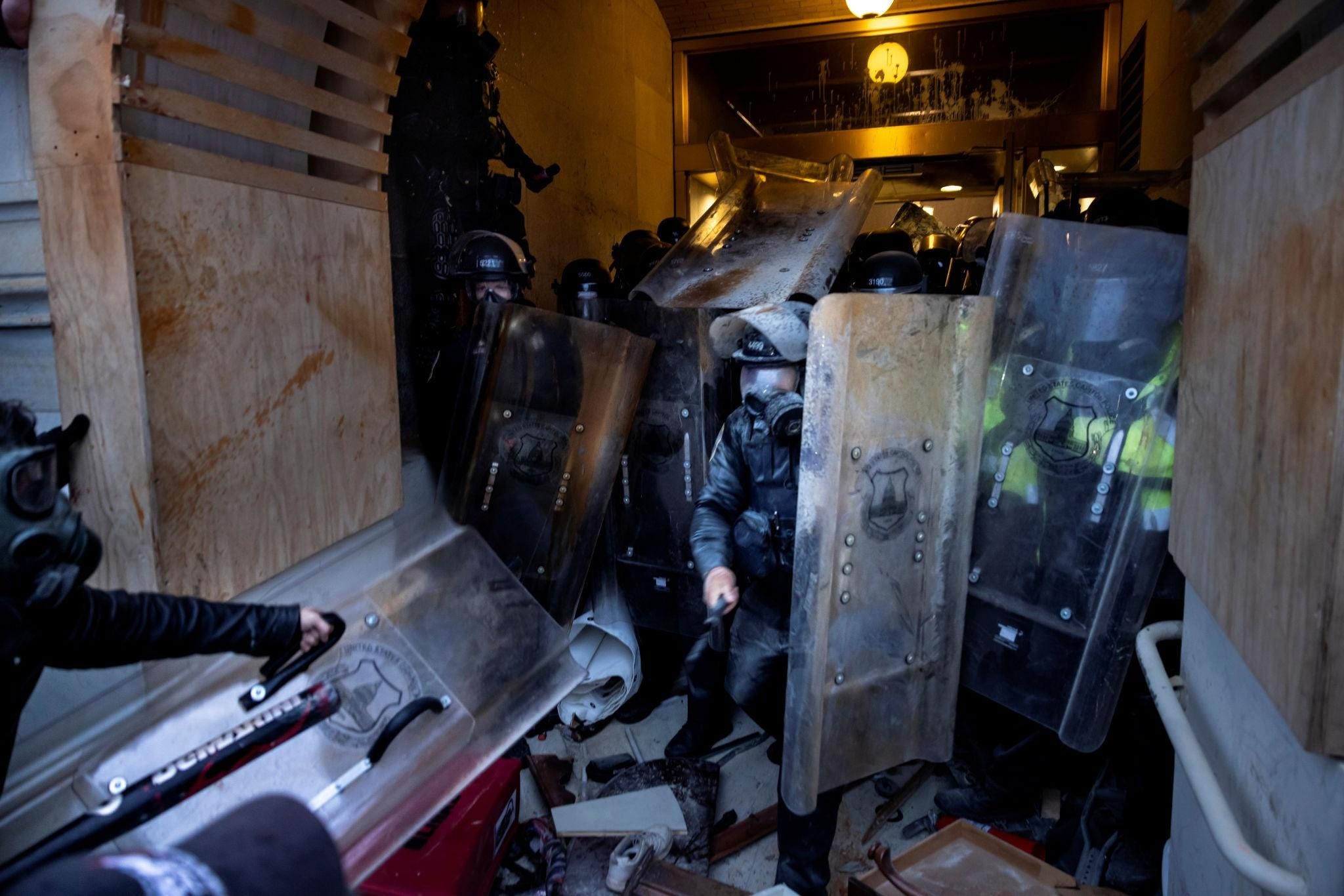
Capitol Police Holding the Line on January 6 2021
Much of the recent public discussion surrounding January 6 has focused on defendants: their prosecutions, convictions, pardons, clemency, and efforts to revisit or dismiss prior proceedings. Far less attention has been paid to another group with legally recognized interests in those cases: the victims.
Congress addressed the status of crime victims in federal proceedings through the Crime Victims’ Rights Act (“CVRA”), codified at 18 U.S.C. § 3771. The statute represented a deliberate shift away from a criminal justice system in which the victim was often treated merely as a witness to a dispute between the government and the accused. The Act instead recognizes that victims possess independent rights and interests that courts and prosecutors must consider throughout the criminal process.
The CVRA grants victims several substantive rights, including:
the right to be reasonably protected from the accused;
the right to notice of court proceedings;
the right to attend public proceedings;
the right to confer with government attorneys;
the right to be heard regarding release, plea agreements, sentencing, and parole;
the right to restitution where authorized by law;
the right to proceedings free from unreasonable delay; and
the right to be treated with fairness and respect for their dignity and privacy.
The threshold question, therefore, is whether January 6 produced legally cognizable “crime victims” within the meaning of the statute.
The answer is plainly yes.
More than 140 law enforcement officers were assaulted during the attack on the United States Capitol. Many suffered serious physical injuries. Others experienced psychological trauma that continues to this day. Members of the United States Capitol Police and the Metropolitan Police Department of the District of Columbia were punched, kicked, crushed in doorways, sprayed with chemical irritants, struck with weapons, and threatened with death. Numerous officers later testified publicly regarding continuing injuries and trauma arising from those events. But the victim class extends beyond police officers.
Members of Congress and congressional staff who were forced to evacuate or shelter in place while a violent mob searched the Capitol were victims of crimes ranging from threats and intimidation to obstruction offenses directed at the functioning of Congress itself. Employees of the Architect of the Capitol and other support personnel who were present during the attack likewise suffered direct harm. Damage to government property and interruption of constitutional proceedings created institutional victims as well as individual ones.
The fact that some of these crimes were offenses against governmental institutions does not eliminate the existence of identifiable human victims. Federal courts have repeatedly recognized that individuals harmed by crimes directed at government functions may nevertheless qualify as victims under the CVRA.
This becomes particularly significant as current litigation increasingly seeks to revisit, vacate, or dismiss January 6 convictions and related proceedings.
Ordinarily, a criminal defendant and the government may jointly seek dismissal of charges, vacatur of convictions, modification of sentences, or settlement of related matters. Under the CVRA, however, the government does not act entirely alone. Prosecutors have statutory obligations to consult with victims and to afford them an opportunity to be heard in proceedings affecting their interests. A court considering such relief may therefore confront questions not only about executive authority and prosecutorial discretion, but also about the procedural and substantive rights of victims under federal law.
The statute does not create a victim veto. Crime victims cannot compel prosecution, prevent a pardon, or dictate litigation strategy. Presidential pardon authority under Article II remains extraordinarily broad, and prosecutorial discretion remains primarily vested in the Executive Branch.
But neither are victims legally invisible.
If the government seeks to dismiss pending charges, vacate convictions, abandon restitution claims, or otherwise alter the legal status of January 6 defendants, victims may possess rights to notice, consultation, and an opportunity to address the court regarding the consequences of those actions. Courts may be required to consider whether those statutory rights have been honored before granting requested relief.
These questions become even more complicated where the government itself appears to have changed positions regarding the underlying conduct. Recent developments, including reconsideration of certain January 6 matters and settlements involving litigation arising from the attack, raise novel questions regarding the interaction between executive policy choices and congressionally created victims’ rights.
The broader point is simple.
January 6 was not an abstract constitutional controversy. It was not merely a dispute over election procedures or competing interpretations of executive power. It was a day on which real people suffered real injuries in service of the constitutional order.
The officers who stood in the tunnels and doorways of the Capitol, the staff members who barricaded offices, and the lawmakers and employees who believed they might not leave the building safely that day are not incidental participants in the legal story of January 6. Under federal law, they are victims.
As the legal and political system revisits the events of that day, it would be a profound irony if the one group Congress specifically sought to protect from exclusion from the justice process were once again pushed to its margins.
The Crime Victims’ Rights Act exists precisely to prevent that result.
Steven A. Cash served as a prosecutor in the Manhattan District Attorney’s office before joining the CIA in 1994 as Assistant General Counsel and subsequently serving as an intelligence officer in the Directorate of Operations. In 2001, he joined the Senate Select Committee on Intelligence as Counsel and designee-staffer to Senator Diane Feinstein. He later served as a senior staffer in the House Select Committee on Homeland Security, the Department of Energy, the Senate Judiciary Subcommittee on Terrorism, Technology and Homeland Security, and the Department of Energy. In the private sector, he has advised on national security, counterintelligence, and technology policy and served on the Biological Sciences Experts Group under the Director of National Intelligence. Mr. Cash is currently the Executive Director of The Steady State.
Founded in 2016, The Steady State is a nonprofit 501(c)(4) organization of more than 400 former senior national security professionals. Our membership includes former officials from the CIA, FBI, Department of State, Department of Defense, and Department of Homeland Security. Drawing on deep expertise across national security disciplines, including intelligence, diplomacy, military affairs, and law, we advocate for constitutional democracy, the rule of law, and the preservation of America’s national security institutions.
Powered by WPeMatico