
The Republic and the Ballroom
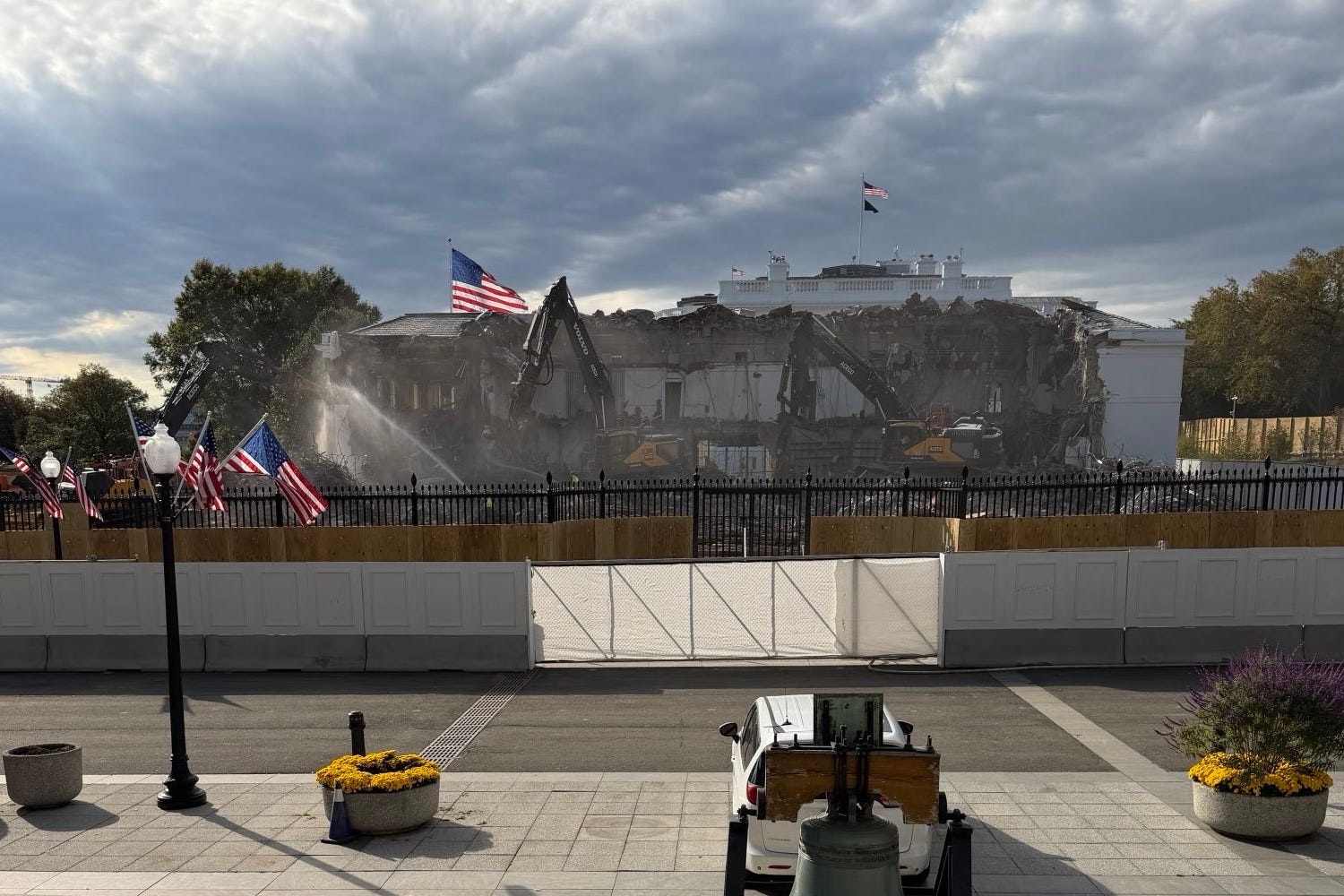
The debate is not fundamentally about architecture or design. It is a debate about whether public institutions reflect democratic values—or increasingly reflect the image and tastes of a single leader.
The current controversy surrounding the proposed White House ballroom, the “Trump Arch,” and now the repainting of the Old Executive Office Building has generated intense debate. Architects, historians, preservationists, and critics have weighed in passionately on whether these projects are tasteful, vulgar, grand, garish, historically sensitive, or historically destructive. To many Americans, arguments over the color of a federal building or the construction of a ballroom may seem trivial. There are wars overseas, inflation at home, political violence, and deep institutional distrust. Compared to such matters, a gold-toned interior or an oversized ceremonial hall can appear merely eccentric, even harmless.
But the issue is not the architecture itself. The issue is what the architecture is intended to communicate.
We at the Steady State are not art critics. Our expertise is not beauty. It is power. More specifically, it is the study of how democratic systems weaken, how authoritarian systems emerge, and how strongmen consolidate personal rule. And those of us who have watched autocrats rise overseas have seen this pattern before.
In authoritarian systems, aesthetic disagreement gradually becomes framed not as disagreement with a design choice, but as disrespect toward the leader himself. State symbolism and personal symbolism begin to merge. Criticism of the ruler’s tastes becomes criticism of the nation. The distinction between public property and personal property begins to erode. This is not unique to any one ideology or region. Variants of this phenomenon have appeared in right-wing and left-wing dictatorships alike. It appears in palaces, triumphal arches, massive portraits, monumental architecture, carefully choreographed ceremonies, and the cultivation of a highly personalized visual culture centered on the leader.
Authoritarian systems are intensely personal. Democracies are institutional; autocracies are individual. Democracies emphasize offices, laws, and procedures. Autocracies emphasize leaders, personalities, tastes, and symbols. Over time, the state ceases to represent the people collectively and instead becomes an extension of one man’s preferences, ambitions, image, and ego. The personalization of rule is often heralded, reinforced, and normalized through aesthetics.
The leader’s image becomes ubiquitous. His preferred style becomes “national” style. Buildings, monuments, ceremonies, and visual symbolism become instruments not merely of government but of personal dominance. The point is not beauty. The point is authority. And, we have seen this dynamic repeatedly abroad.
What matters is not whether any individual project is attractive. What matters is the assertion embedded within the project.
President Trump increasingly presents himself not as the President of the United States, temporarily vested with powers defined and constrained by the Constitution, but as the dominant leader of the nation whose personal instincts should define national identity itself. What he thinks is beautiful, Americans are expected to affirm as beautiful. What he considers patriotic becomes patriotism. What he considers appropriate becomes what institutions are expected to display. That is a profound shift in civic culture.
A president may certainly have preferences. Every president does. But there is a difference between preference and command. There is a difference between advocacy and expectation. There is a difference between influence and cultural domination. In healthy democracies, citizens retain the right to reject the ruler’s tastes without being treated as enemies of the state or opponents of the nation itself. That principle may sound abstract. It is not.
The American constitutional tradition was designed specifically to resist this form of personalized rule. The Framers had lived under monarchy. They were deeply suspicious of political systems that merged state identity with the identity of a single leader. The Constitution does not establish an elected king. It establishes a temporary officeholder whose authority is limited and guided by the entire constitutional structure: Congress, the courts, federalism, civil liberties, elections, and law. Article II grants executive power. It does not grant aesthetic supremacy.
The erosion of democratic culture rarely begins with tanks in the streets. More often, it begins with normalization of speech and actions previously viewed as abnormal. Citizens gradually become accustomed to treating the leader’s personality as synonymous with the nation. Public institutions become stages for personal branding. Governing becomes theater centered on one man’s image, one man’s tastes, one man’s grievances, and one man’s desires. By the time societies recognize the danger clearly, the underlying civic habits that sustain democracy are often already weakened.
This is not fundamentally about a ballroom. It is not fundamentally about paint. It is not fundamentally about arches, columns, drapery, or ornamentation. You may not care what color a federal building is painted. You may not care whether a ballroom is constructed near the White House. You may even genuinely like the aesthetic choices being proposed. But you should care deeply whether any man in the White House acquires the cultural authority to tell Americans what they must admire, what they must praise, what they must consider patriotic, and ultimately what they are permitted to value.
That is not a question of architecture. It is a question of freedom.

Steven A. Cash served as a prosecutor in the Manhattan District Attorney’s office before joining the CIA in 1994 as Assistant General counsel and subsequently serving as an intelligence officer in the Directorate of Operations. In 2001 he joined the Senate Select committee on Intelligence as Counsel and designee-staffer to Senator Diane Feinstein). He later served as a senior staffer in the House Select Committee on Homeland Security, the Department of Energy, the Senate Judiciary Subcommittee on Terrorism, Technology and Homeland Security and the Department of Energy. In the private sector he has advised on national security, counterintelligence, and technology policy and served on the Biological Sciences Experts Group under the Director of National Intelligence. Mr. Cash is currently the Executive Director of The Steady State.
Founded in 2016, The Steady State is a nonprofit 501(c)(4) organization of more than 400 former senior national security professionals. Our membership includes former officials from the CIA, FBI, Department of State, Department of Defense, and Department of Homeland Security. Drawing on deep expertise across national security disciplines, including intelligence, diplomacy, military affairs, and law, we advocate for constitutional democracy, the rule of law, and the preservation of America’s national security institutions.
Powered by WPeMatico