
Twelve Years of Warnings. Now Iran.
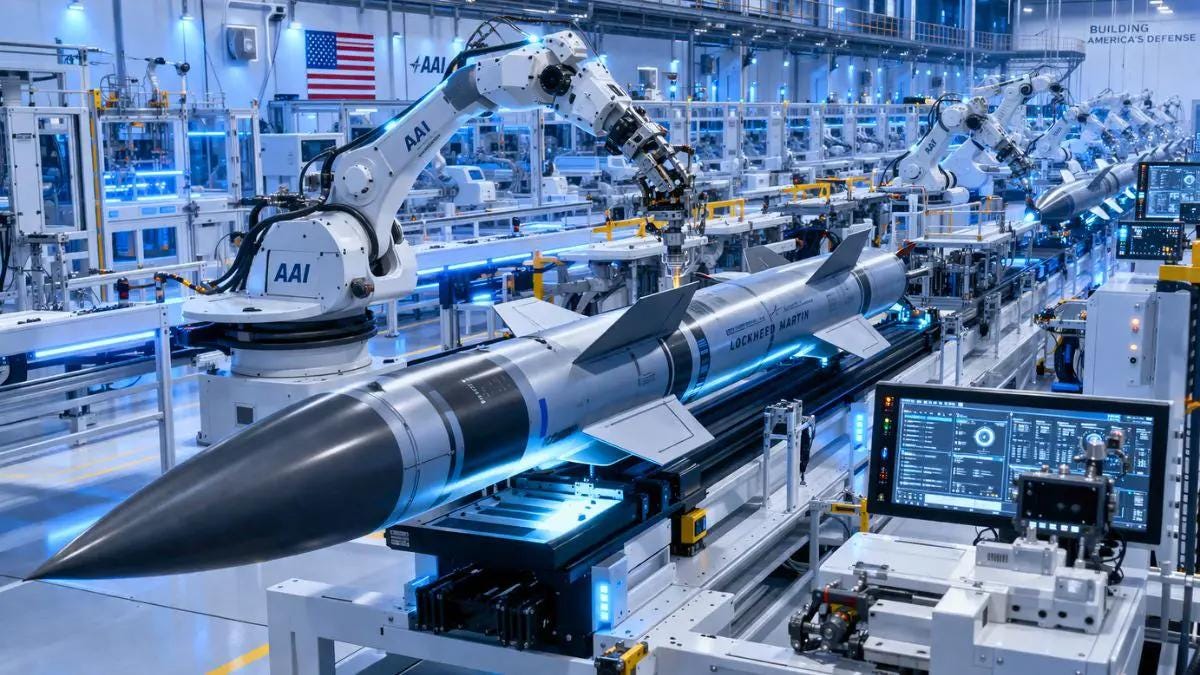
Patriot Missile Production
For more than a decade, Washington watched Russia, China and North Korea expand their military capabilities while U.S. weapons production struggled to keep pace. Then the United States entered another major conflict—just as its air-defense inventories were already under strain.
Since Russia seized Crimea in 2014, Washington has had ample evidence that the post-Cold War security environment was deteriorating. The United States watched Russia become increasingly aggressive, China expand its military reach, and North Korea deepen its nuclear and military relationship with Moscow and Beijing. But four US administrations failed to translate that knowledge into sufficient production of critical air-defense and other munitions to deal with the multiple theaters. And our current leadership obstinately chose to ignore it all and went to war with Iran.
2014-2024 – Russian Expansionism
Russia has been unmistakably aggressive and unchallenged in a bloodthirsty irredentism for the last twelve years and across four American administrations. In 2014 Putin invaded, occupied then annexed Crimea. Europe and the West grumbled a bit but did nothing concrete. During the first Trump administration Russian consolidated its grip on Syria, preserving the Assad regime, escalated its hybrid attacks on Ukraine through cyber and fomenting insurrection in Ukraine’s Donbass, closed off much of the Black Sea, and built up its forces along the Ukraine border for the full invasion of 2022, during the Biden administration. President Biden began a program of military and intelligence support to Ukraine that President Trump, early in his second term, diminished, nearly to termination.
From 2014 through the closing months of 2024 the United States and Western Intelligence knew the scope and determination of the Russian policy. In the last 20 months, the Russians have ramped up attacks on Ukrainian civilian infrastructure, stacking war crimes on war crimes, and are now militarily poking bordering NATO states’ defenses provocatively with dangerous and reckless abandon.
Initially, the United States made clear our opposition to Russian aggression and worked productively with NATO states to help Ukraine defend itself. The effort crumpled quickly, however, as Trump’s government focused on the Western Hemisphere and autocracy at home, leaving the rest of the world to spin its policies freely. Meanwhile, Russia has lost somewhere in the vicinity of a million and a half troops in Ukraine, its economy is reeling and its only friends are China, North Korea, and to a much lesser extent BRICS nations and Iran. It is a weakened country, but it continues to live on a wartime, military budget and is more of a pugilistic global thug than a nation, capable of fielding a half million more men if necessary and is awash with tactical and strategic nuclear weapons.
For over twelve years, in addition to a newly belligerent Russia keen on recreating a modern Tsarist era, the US watched China expand its military resources by orders of magnitude, particularly the construction of naval shipping and development of high-technology Long-reach defensive systems well out into the Western Pacific. We watched North Korea tighten its relationship with Beijing, build its nuclear warhead inventory to 50-60 and accumulate enough fissile material to build nearly another 100. Moreover, we saw Pyongyang send fighting forces to Moscow for deployment in Ukraine and sell Russia munitions.
Four administrations, two Republican under Donald Trump and two Democratic: A Limited US Stockpile
The Pentagon clearly understood the scene: There was one war underway in Eurasia, China quietly threatening muscular hegemony over East Asia with a bellicose North Korean ally, and tough guy Vladimir Vladimirovich Putin feeling his Cheerios anew. During those 12 years, those four US administrations —Two republican Trump administrations and Two democratic Biden administrations, failed to build the production capacity and stockpiles, in particular, the critical air-defense and other munitions needed for a world in which more than one major conflict could occur at once.
What on earth were our military planners thinking over those years that would allow them to conclude that they would have enough to ward off a potential attack by China on our Far East installations or Taiwan, or a full Russian aggression against a NATO country? With a five-year time frame to restock Patriots alone, how could Pentagon planners have considered they had enough? Why was nothing done in Trump’s first term or during the Biden administration to vastly beef up that part of the military industrial complex to manufacture greater numbers of these essential weapons systems—on demand—when they had the chance?
And then, Trump, elected to a second term and with the benefit of this historical knowledge and full access to current intelligence, decides to go to war with Iran. And he makes this decision without any clear statement of objectives or comprehensive strategy, ignores Pentagon briefings that our defensive weapon supplies are limited, ignores the reported Vice-President’s and Secretary of State recommendations against attack, and ignores CIA’s intelligence analysis that the “regime change” strategy of his sole ally, Netanyahu, was “farcical.”
In just five months of Middle East Warfare, we have reduced by half the number of air defense munitions (Patriots, Standard Missiles, THAAD). And Mr. Trump Pooh-poohs it all. Our self-proclaimed “very stable genius” autocrat-wannabe, who ignores a tractable congress, disdains federal institutions and refuses counsel in favor of his gut instinct, is sleepwalking the United States into the mighty Middle Eastern Bog to greet the ghosts of so many others who foolishly went there before him.
William R. Piekney served as a U.S. Naval officer for four years and served in the CIA for 30 years in Europe, Africa and the Middle East. He was under deep cover early in his career and later was station chief numerous times, including Africa, South Asia, and the Middle East. As a member of the Senior Executive Service, he directed the Agency’s African operations and then East Asia operations, traveling extensively to those regions to maintain and develop relations with host intelligence and security services. Overall, he has spent nearly fifty years in the U.S. Intelligence Community and in related national security affairs. He is a member of The Steady State.
Founded in 2016, The Steady State is a nonprofit 501(c)(4) organization of more than 400 former senior national security professionals. Our membership includes former officials from the CIA, FBI, Department of State, Department of Defense, and Department of Homeland Security. Drawing on deep expertise across national security disciplines, including intelligence, diplomacy, military affairs, and law, we advocate for constitutional democracy, the rule of law, and the preservation of America’s national security institutions.
Powered by WPeMatico