
What We’re Fighting For Is the Right to Fight
By Steven A. Cash
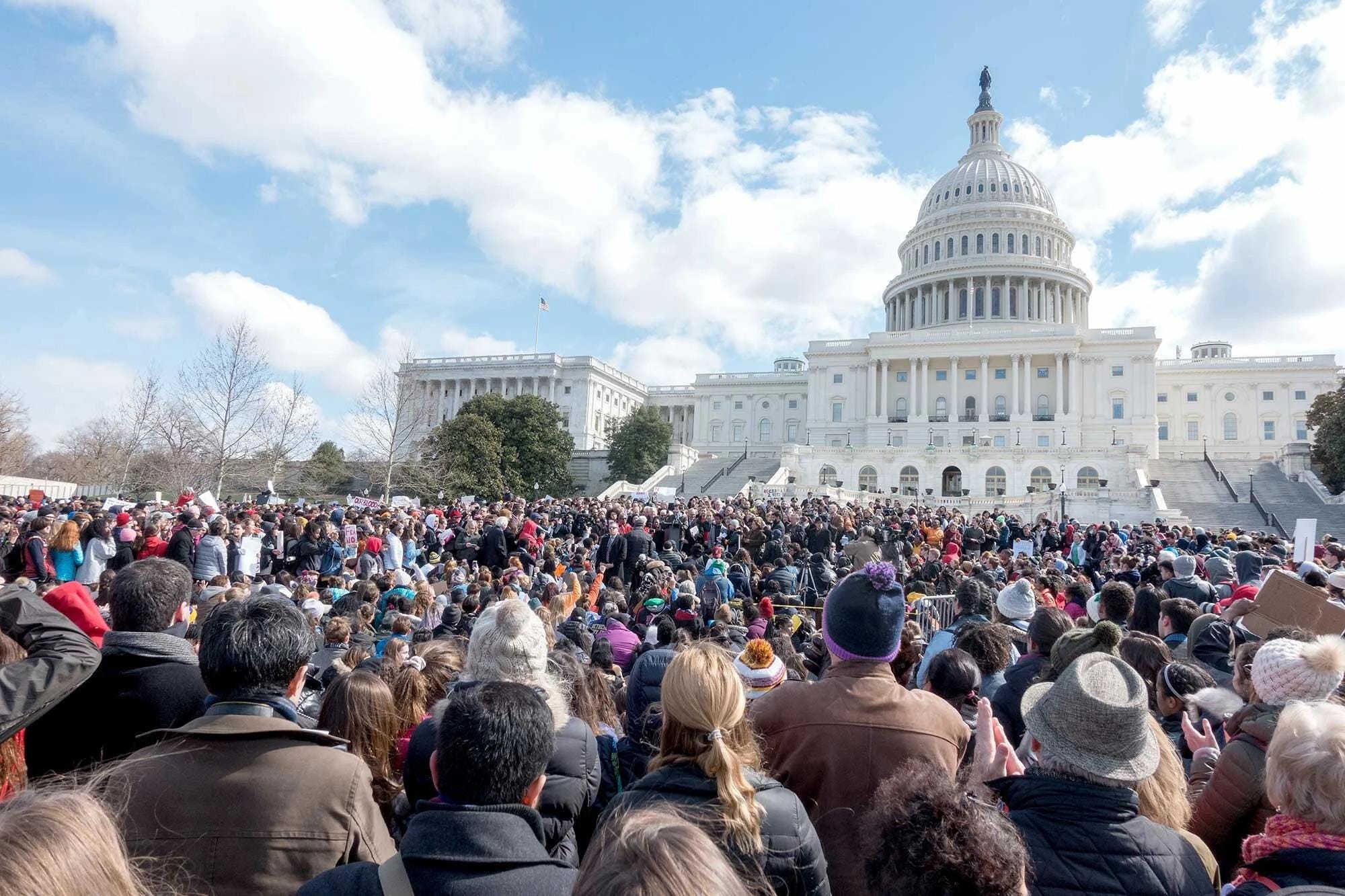
photo: Democracy Funders Network
We aren’t united by what we think America should do about Gaza, climate, abortion, immigration, or taxes. We’re united by the conviction that Americans must remain free to fight those battles themselves.
We don’t write about Gaza, climate change, or almost any other of the great issues confronting the country. People sometimes ask why. Israel and Gaza? Climate change? Abortion? Immigration policy? Gun control? Tax policy? Health care? The proper size of government? It is not because these issues are unimportant. Quite the opposite. They are enormously important. They affect people’s lives, sometimes profoundly. And there are Americans with strongly held, and often entirely good-faith, views on different sides.
But there is something more fundamental than any one of these questions: How do we make decisions about each of these issues? For nearly 250 years, the American answer has been representative democracy. We argue. We organize. We write. We protest. We vote. We elect representatives. They enact laws. Courts interpret those laws and determine whether they comply with the Constitution. Elections change governments and policies. And then we argue some more.
It is messy, frustrating, inefficient, and frequently infuriating. It is also an extraordinary achievement. That democratic process does not guarantee wise policy. It does not guarantee that any of us will get the outcome we want.
Nor is the system beyond criticism. Questions about how our democracy itself should work, voting rights, campaign finance, the Electoral College, congressional representation, judicial power, and countless others, are themselves legitimate subjects for democratic debate and reform.
But all of that presupposes something: that the democratic system survives. We are not silent on Gaza or climate change or abortion or immigration because we think those questions don’t matter. We are silent because we believe the structure through which Americans have the right to debate and ultimately decide those questions is itself in danger.
Effects of Democratic Structural Failure
And if that structure fails, the other debates don’t go away. They simply get decided differently.
Instead of being resolved through elections, legislatures, courts, advocacy, journalism and public debate, they will increasingly be resolved by Donald Trump and the people around him. Imagine a table in a Mar-a-Lago ballroom. The President and a collection of loyalists, donors, business interests and cronies are sitting around it, deciding what the government of the United States will do. There is one thing Americans of the left, right, and center should understand about that table: You will not have a seat at it. Neither will we.
That is why preserving the democratic system must, for the moment, take priority over our disagreements about what that system should produce.
There are two additional reasons for The Steady State’s narrow focus.
The first has to do with who we are.
Our membership is composed largely of people who spent their careers in intelligence, diplomacy, national security, law enforcement, the military, and government oversight. And that gives us a particular reason not to believe that we should be deciding the great questions of domestic policy.
We have seen what happens in other countries when people from backgrounds like ours decide that ordinary democratic politics is inadequate to the task. Intelligence officers, generals, police officials and national-security professionals begin intervening in political questions because they believe the stakes are too high, the politicians too incompetent, or the public too divided to handle them.
History offers plenty of examples of where that road can lead.
It does not want intelligence officers deciding climate policy, generals settling questions of reproductive rights, or law-enforcement officials determining tax policy. However honorable their intentions or distinguished their service, people entrusted with the instruments of national security and state power have no special democratic entitlement to decide those questions.
Preserving Democracy
Indeed, one of the principles many of us spent our careers defending was precisely the opposite: in a democracy, members of the national security institutions serve the elected government and the Constitution. They do not govern.
That makes what we are doing now profoundly unusual for many of us.
We are participating, as a group, in domestic political life because we believe the threat to the democratic system itself has become extraordinary. Growing autocracy is an existential threat to our democracy. We are not trying to determine what choices Americans should make through their democracy. We are trying to preserve the democracy that allows Americans to make those choices for themselves.
If the threat of growing autocracy did not exist, there would be little reason for The Steady State to exist as a political organization at all.
The second reason for our narrow focus is simpler.
We don’t agree.
The Steady State includes Democrats, Republicans, and Independents; conservatives, liberals, and people who fit comfortably into none of those categories. Ask our members about Israel and Gaza, climate policy, immigration, taxation, abortion, or any number of other questions, and you will hear vigorous disagreement.
But there is one thing on which we have reached an extraordinary degree of agreement: American democracy itself is in danger.
That agreement is what brought us together.
Our purpose is not to tell Americans what policies they should choose. It is to help preserve their ability to choose them.
And that points toward what many of us hope will ultimately be The Steady State’s greatest success.
We hope to become unnecessary.
If we succeed in helping protect American democracy from Donald Trump and those who would replace constitutional government with personal rule, many of us hope The Steady State will simply go away. Its members can return to being ordinary citizens; arguing, voting, and taking different sides on all the questions on which Americans have always disagreed.
We may disagree bitterly. We may campaign against one another. We may think the other side’s ideas are foolish, misguided, or profoundly wrong.
Good.
Because the goal was never to end those arguments.
It was to make sure Americans remain the ones who get to have them—and decide them.

Steven A. Cash served as a prosecutor in the Manhattan District Attorney’s office before joining the CIA in 1994 as Assistant General counsel and subsequently serving as an intelligence officer in the Directorate of Operations. In 2001 he joined the Senate Select committee on Intelligence as Counsel and designee-staffer to Senator Diane Feinstein). He later served as a senior staffer in the House Select Committee on Homeland Security, the Department of Energy, the Senate Judiciary Subcommittee on Terrorism, Technology and Homeland Security and the Department of Energy. In the private sector he has advised on national security, counterintelligence, and technology policy and served on the Biological Sciences Experts Group under the Director of National Intelligence. Mr. Cash is currently the Executive Director of The Steady State.
Founded in 2016, The Steady State is a nonprofit 501(c)(4) organization of more than 400 former senior national security professionals. Our membership includes former officials from the CIA, FBI, Department of State, Department of Defense, and Department of Homeland Security. Drawing on deep expertise across national security disciplines, including intelligence, diplomacy, military affairs, and law, we advocate for constitutional democracy, the rule of law, and the preservation of America’s national security institutions.
Powered by WPeMatico