
When Trump Buys a Piece of America
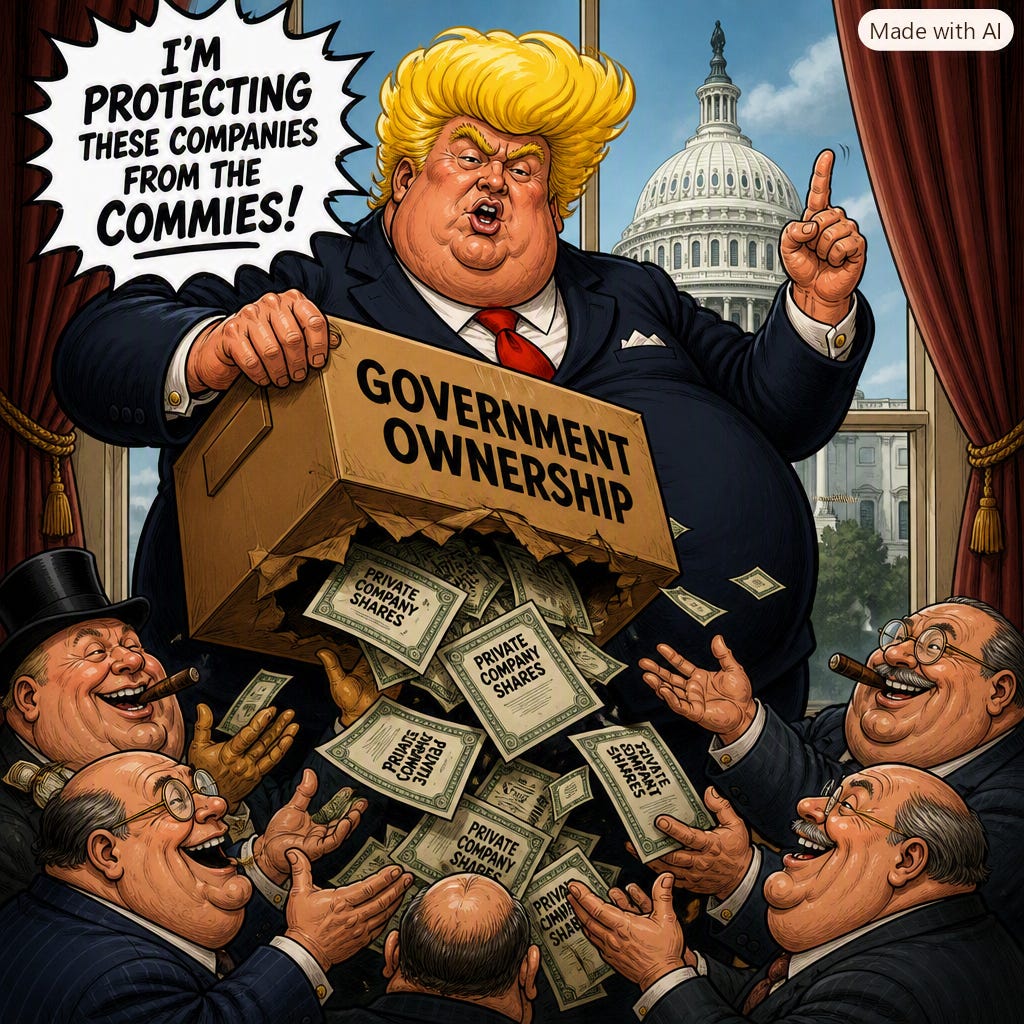
The Trump administration says taxpayers deserve a return on their investments. But when Washington subsidizes companies, regulates them, awards their contracts, and then takes an ownership stake, the government stops being a referee and starts becoming a player. That is not communism. It is something potentially more familiar and more dangerous: state capitalism shaped by political discretion.
The Trump administration’s Commerce Department has quietly crossed another line in American economic policy. In late July, the Department announced letters of intent to provide $874 million in CHIPS and Science Act incentives to seven private semiconductor and advanced-computing companies in exchange for minority, non-controlling equity stakes. The official justification is that taxpayers deserve a return on public investment. That sounds tidy enough, until one asks what it means when the same government that regulates, subsidizes, contracts with, and punishes private firms also becomes one of their shareholders.
This isn’t an isolated incident. The Commerce announcement follows earlier moves by the Trump administration to take or negotiate stakes in companies tied to semiconductors, critical minerals, steel, and other strategic sectors. Reporting and policy analysis have pointed to a 10 percent federal stake in Intel, equity-linked deals involving firms such as MP Materials, and a “golden share” arrangement connected to U.S. Steel. Defenders call it hard-nosed industrial policy. Critics have a simpler description: state capitalism, administered through political discretion rather than market discipline.
This is not the first time that the U.S. government has used public money to stabilize private firms. During crises such as the 2008 financial collapse, the federal government took temporary stakes or warrants in companies as emergency measures, with an expectation that the positions would be unwound. Whatever one thinks of those interventions, they were not presented as a routine governing philosophy.
Trump’s Approach is Different
Trump’s approach is different. It converts subsidies into an expanding portfolio of federal ownership interests and normalizes the notion that favored firms may receive public money if Washington gets a piece of the action.
That arrangement is dangerous because the government is not an ordinary investor. A private shareholder may lobby, vote shares, and hope management performs well. The federal government can also write rules, approve mergers, award contracts, impose tariffs, grant waivers, investigate rivals, and steer future subsidies. Even a “minority” and “non-controlling” stake creates a conflict. If a portfolio company fails, officials may be tempted to protect the government’s investment with more taxpayer money. If a competitor threatens it, regulators may face pressure, subtle or explicit, to tilt the field. The seed bed for corruption is not only cash in envelopes; it is concentrated discretion, opaque valuation, and political favoritism wrapped in the flag and called patriotism.
Communism? Fascism? Markets as Arenas for Political Tribute
The historical echo is not communism in the Soviet sense, with formal state ownership of the commanding heights and central planning of production as it might appear at first sight. A closer analogy is the corporatist model adopted by Benito Mussolini’s Fascist Italy in the 1920s and 1930s. Mussolini did not abolish private property across the board. Instead, he subordinated private enterprise, labor, and industry to the state’s political aims. Fascist corporatism promised to transcend the class conflict of capitalism and the collectivism of communism. In practice, it became a system in which business remained formally private but operated under state direction, labor independence was crushed, and politically connected industrial interests flourished under authoritarian supervision.
The United States is not Fascist Italy, and a non-controlling stake in chip research companies is not the March on Rome. But historical comparisons can be useful when they warn us about habits of power. The danger begins when a leader rejects neutral rules in favor of personal bargaining; when markets are treated not as free institutions but as arenas for political tribute; when public funds become leverage to reward friends, discipline skeptics, and claim credit for “deals.” Trump’s career has always celebrated the deal as a display of dominance. But government is not a casino table, and the Commerce Department is not a private equity shop.
Partisan Hypocrisy
The hypocrisy in this current bout of ‘deal making’ is too thick to miss. Trump and many MAGA loyalists routinely smear Democrats, liberals, and even ordinary regulatory reformers as “communists” or “Marxists” for proposing public investment, consumer protections, labor rights, climate policy, or health-care reforms. Yet here is his own administration saying, in effect: give companies public money, then have the state take ownership stakes. It’s not communism, but it is precisely the kind of state intrusion into private enterprise that conservatives once claimed to abhor.
Real capitalism depends on clear rules, private risk, competitive neutrality, and a government that referees the market rather than secretly joining one team. If national security requires subsidies for semiconductors or critical minerals, Congress should authorize them openly, set transparent conditions, and demand rigorous oversight. But creeping federal ownership, negotiated company by company, invites the worst of both worlds: the inefficiency of politics and the greed of private gain. Trump’s newest equity grab is not socialist planning. It is something more familiar in the history of strongmen: capitalism bent toward personal power, public office turned into leverage, and hypocrisy sold as patriotism.
To paraphrase Austrian-American psychoanalyst Theodor Reik in his 1965 essay, The Unreachables, history might not always repeat itself, but it often rhymes.
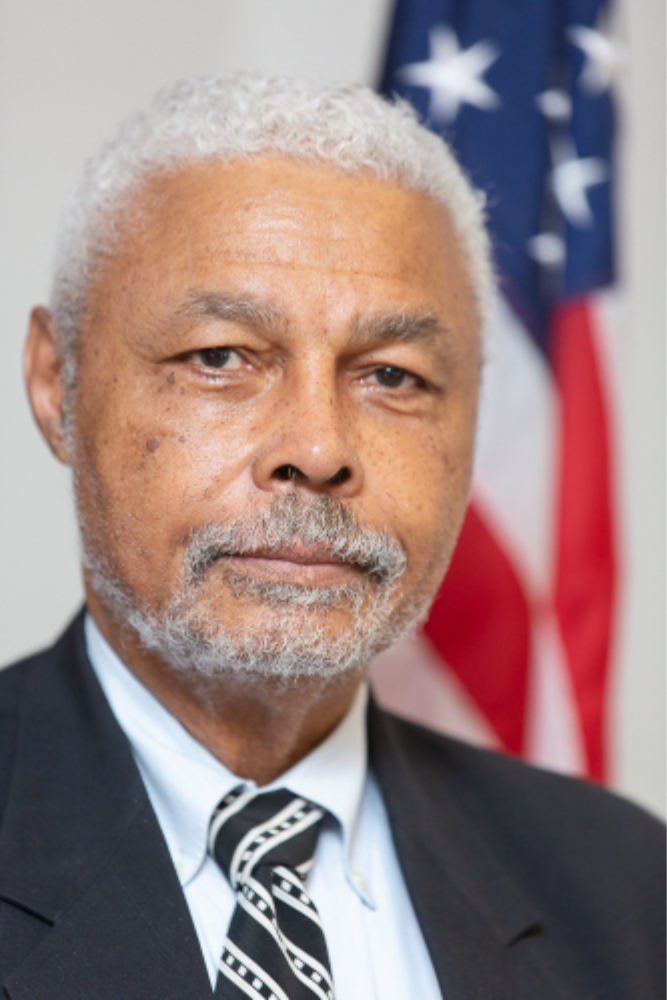
Charles A. Ray served 20 years in the U.S. Army, including two tours in Vietnam. He retired as a senior US diplomat, serving 30 years in the U.S. Foreign Service, with assignments as ambassador to the Kingdom of Cambodia and the Republic of Zimbabwe, and was the first American consul general in Ho Chi Minh City, Vietnam. He also served in senior positions with the Department of Defense and is a member of The Steady State.
Founded in 2016, The Steady State is a nonprofit 501(c)(4) organization of more than 400 former senior national security professionals. Our membership includes former officials from the CIA, FBI, Department of State, Department of Defense, and Department of Homeland Security. Drawing on deep expertise across national security disciplines, including intelligence, diplomacy, military affairs, and law, we advocate for constitutional democracy, the rule of law, and the preservation of America’s national security institutions.
Powered by WPeMatico