
The 51 Were Warning. Trump Calls It a Lie.
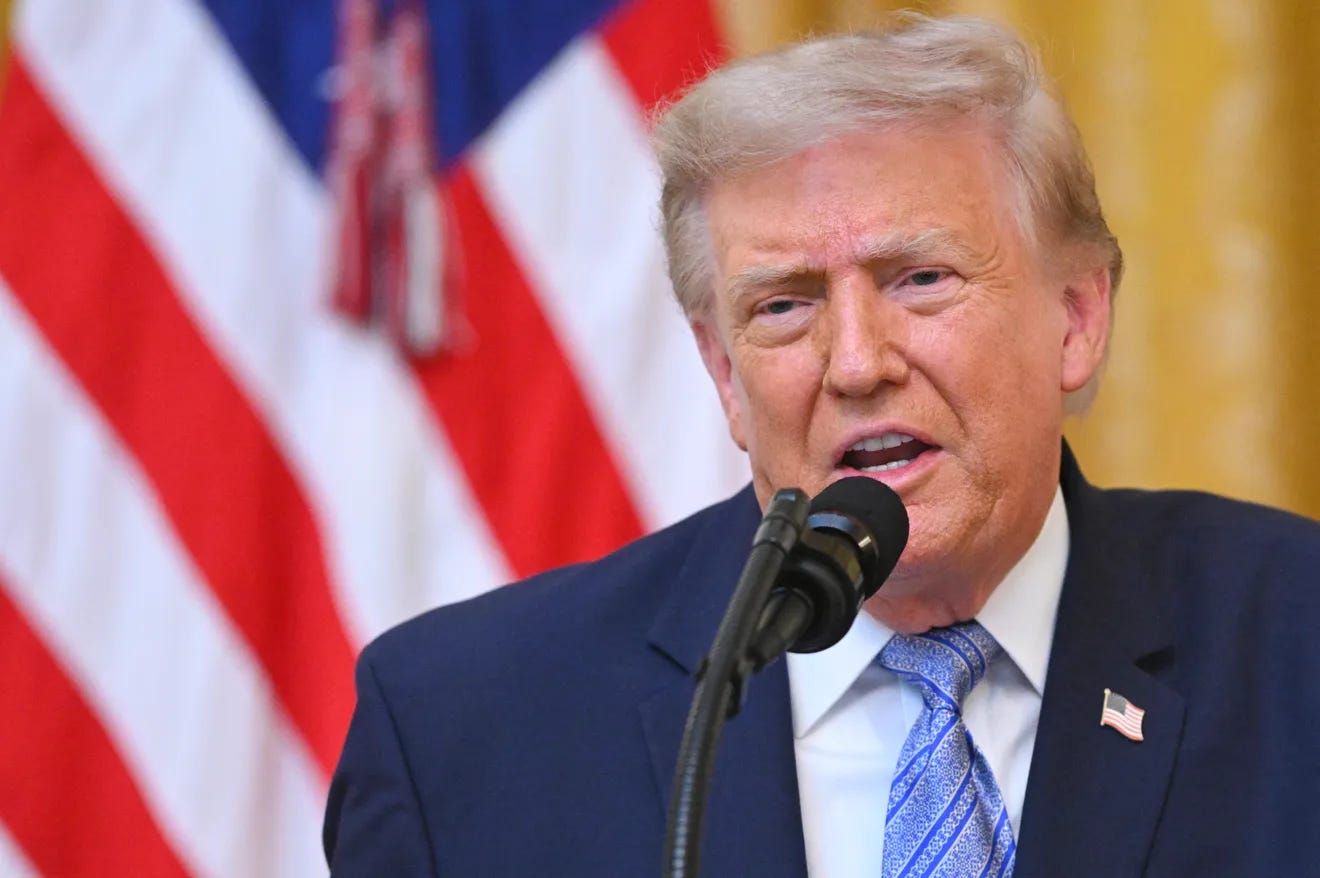
Pool Photo By Saul Loeb, AFP Via Getty Images and USA Today
The “Letter of 51” did not declare the Hunter Biden laptop Russian disinformation. It warned that its emergence bore the “hallmarks” of a Russian information operation. That is an intelligence assessment; not a claim of certainty. The question is whether professionals should be condemned for raising legitimate warning signs.
As President Trump’s address to the nation on July 17, 2026 continues to resonate throughout the country, we note his continuing campaign to investigate the signatories of the “Hunter Biden Laptop” letter. Trump frequently uses that letter to support his false claims of a “deep state” and in his efforts to muddy the intelligence assessments and Congressional findings of Russian meddling in the 2016 election. In his address, the President, without evidence, again accused unnamed “deep state” intelligence officers of concealing intelligence supporting his claims.
In the autumn of 2020, a group of 51 former senior national security officials issued a public letter regarding reporting on the so-called Hunter Biden laptop. The letter has since been invoked, often inaccurately, as evidence of misconduct, bias, or worse. That critique rests, in large part, on misrepresentation of what the letter actually said, what it did not say, and the professional obligations of those who signed it.
What the Letter Said and Did Not Say
The letter did not assert that the laptop was definitively Russian disinformation. It did not claim direct evidence of Russian involvement or reach a forensic conclusion. Instead, it offered a professional judgment: that the emergence and handling of the material had “all the hallmarks” of a Russian information operation.
That distinction is critical: “hallmarks” in the letter refers to patterns, tradecraft indicators, and contextual factors that resemble known methods of adversary activity. It is not a claim of proof. It is an analytic warning.
In this respect, the letter was cautious, not categorical. It reflected uncertainty while identifying risk, precisely what intelligence professionals are trained to do. To recast it as a definitive claim of falsity is to misread it. To characterize it as a statement of fact rather than judgment is to collapse a distinction that is foundational to intelligence tradecraft.
The Obligation to Speak
The signatories were not merely private citizens offering idle commentary. They were individuals with decades of experience in intelligence, counterintelligence, and national security policy. That experience carries not only expertise, but responsibility.
The United States has long recognized that foreign adversaries, most notably Russia, engage in information operations designed to influence public opinion, shape political outcomes, and undermine confidence in democratic institutions. The bipartisan findings of the United States Senate Select Committee on Intelligence leave no doubt on this point. The Committee concluded that Russia conducted an “extensive campaign” to influence the 2016 election, employing cyber operations, disinformation, and the strategic release of compromised materials. This conclusion was recently reinforced by documents declassified and released by President Trump himself, specifically, the National Intelligence Council’s assessment titled Foreign Threats to 2020 US Federal Elections (August 19, 2020):
We assess that Russia is using a range of measures primarily to denigrate former Vice President Biden and what it sees as an anti-Russia establishment. For example, it is directing or encouraging proxies to spread claims about Vice President Biden. Some Kremlin-linked actors are also seeking to boost President Trump’s candidacy on social media. More broadly, Moscow’s efforts seek to amplify social discord in the US and undermine Washington’s global standing.
These Russian operations are not episodic. They are systematic. They are adaptive. And they rely, fundamentally, on the rapid injection of potentially compromising or sensational information into the public sphere, often through intermediaries, at moments of maximum political impact.
Against that backdrop, the sudden appearance of purportedly sensitive material, introduced through opaque channels and amplified in a highly polarized environment, presented precisely the kind of scenario that intelligence professionals are trained to assess with caution.
The signatories had not only the right, but arguably a citizen’s obligation, to say so. Silence in the face of a potential counterintelligence risk, particularly one bearing resemblance to previously documented adversary activity, would have been a dereliction of the very expertise for which they are now criticized.
Hallmarks and Context
The question remains whether the circumstances surrounding the laptop bore characteristics consistent with known Russian information operations. Here again, precision is required.
The Senate Intelligence Committee’s report describes a “multi-faceted” Russian effort that included hacking, the dissemination of acquired materials, and the use of intermediaries to obscure attribution and enhance credibility. It also emphasizes that counterintelligence analysis is not limited to proving criminal conduct, but to assessing vulnerabilities and risks, even where definitive attribution may be unavailable.
Several elements commonly associated with such operations are relevant:
Timing: Information released at politically sensitive moments to maximize impact
Provenance ambiguity: Unclear or unverifiable chains of custody
Amplification patterns: Rapid dissemination through aligned media ecosystems
Narrative alignment: Content that reinforces existing divisions or strategic objectives
The presence of such indicators does not prove foreign involvement. But their convergence raises legitimate analytical concern. To identify those concerns is not to assert certainty. It is to recognize patterns that have been repeatedly documented in prior interference efforts.
A Defense of Judgment
In the end, the “Letter of 51” reflects a professional judgment made under conditions of incomplete information, informed by decades of experience confronting adversary information operations. It was neither definitive nor reckless. It was, in the language of intelligence, an assessment of risk. Reasonable people can disagree with that assessment. They can argue that the indicators were insufficient, or that the judgment was premature. That is a legitimate debate. But to portray the letter as a knowing falsehood, or as an abuse of authority, is to misrepresent both what was said and what was required.
The Steady State exists, in part, to insist on these distinctions. In a domain where language shapes perception and perception shapes policy, precision is not optional. It is essential. And when experienced professionals identify patterns consistent with known threats, their obligation is not to remain silent, but to speak, carefully, clearly, and with the discipline that their profession demands.
Founded in 2016, The Steady State is a nonprofit 501(c)(4) organization of more than 400 former senior national security professionals. Our membership includes former officials from the CIA, FBI, Department of State, Department of Defense, and Department of Homeland Security. Drawing on deep expertise across national security disciplines, including intelligence, diplomacy, military affairs, and law, we advocate for constitutional democracy, the rule of law, and the preservation of America’s national security institutions.
Powered by WPeMatico