
You Live Differently When the Soldiers Arrive
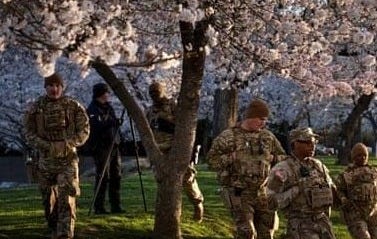
The presence of armed troops changes behavior—even when they do nothing. In Washington, an unnecessary and open-ended deployment is bad on operational grounds, and is making ordinary freedom of movement, speech, and assembly feel less ordinary.
A young friend in Washington, DC, described to me how, on any given Saturday, she and her husband relax after a hard workweek through an enjoyable routine in their neighborhood of grocery shopping, coffee with bagels, and a chat with a street vendor. And she told me that every time, her positive mood and aimless chatting disappear the moment she sees National Guardsmen congregating in front of her Metro stop, hands invariably on their weapons. She and others have told me, and flagged on social media, of the particular menace of groups of armed strangers taking up the sidewalk, wearing bulletproof vests, seemingly ready for violence.
In July, the Department of Defense stated that the Guard would continue its so-called “anti-crime” mission in DC through January 2029. On July 23, the White House announced it had signed a nearly $300 million contract for 2,000 housing units within the Washington, DC area, since the vast majority of guardsmen are not from the region. The costs are estimated variously, but a Congressional Budget Office estimate in January put the costs of deploying 1,000 National Guard at $18-21 million per month in a typical U.S. city. During July 4 celebrations on the National Mall, the deployment numbered 5,000 Guardsmen from over 20 states and territories, at a cost to taxpayers of $3 million a day.
Justification is flimsy. Crime rates are low in Washington DC and had begun dropping before the operation, making this rationale less than credible. And criminologists dispute the efficacy of so-called anti-crime patrolling by people who don’t know the local landscape and are unable to spot anomalies that a policeman might. Similar deployments didn’t last long in states such as California and Illinois, with empowered governors able to push back on behalf of Los Angeles and Chicago. But despite objections by DC city officials, the fact that the District of Columbia is under direct federal control means there is no end in sight.
This extended deployment is a bad idea on simple operational grounds: it is worse than useless to decree that a so-called “emergency” will last for several years. Readiness suffers, and true danger can be missed. When I served as the Deputy Chief of Mission in Kabul in 2018, our Embassy was under a constant stream of potential threats, and every day we considered how to adjust our guard force posture, according to the seriousness of what we thought we were facing. At one point, our senior security officer advised that we needed to stand down, despite ongoing security concerns, because our guards could not physically remain at high alert for weeks at a time and still be effective. Sooner or later, in an endless emergency posture, extraordinary attention starts to fragment, routines become rote, and what is important can be ignored.
But the deployment is also very bad politically for a democracy. I served as a diplomat in war zones and countries with some of the highest murder rates in the world, Afghanistan, El Salvador, Colombia, Mexico, and South Africa, and am highly familiar with the look of well-armed, idle watchers on busy city streets. In some countries these guard forces are themselves the most dangerous elements in a civil conflict, in some they are affiliated with drug kingpins or other criminals, and in others they serve as symbols of a regime or a local strongman. The U.S. has not experienced extended deployments of men with machine guns and rifles in our cities as you might in other parts of the world; it is viscerally intimidating, and I recognize my friend’s disquiet. Peaceful protesting under those circumstances can feel like a life-or-death calculation.
The Washington DC National Guard deployment, counterproductive, expensive, and unnecessary, is an ongoing danger to U.S. democracy as it attempts to normalize the role of the military as everyday agents of law and order. As the National Security Leaders for America stated last year, “Any deployment of the Guard must be justified, time-limited, coordinated with local leadership, and subject to rigorous congressional oversight. Anything less risks turning America’s military into a domestic political weapon.”
Freedom of movement, freedom of speech, and freedom to call your city your own are all being attacked in Washington DC, as residents coexist with the armed reminders that there is a would-be authoritarian in the White House.

A retired U.S. Department of State senior career diplomat with 30 years’ experience in security, human rights, and counter-narcotics policy, Annie Pforzheimer was Deputy Chief of Mission at the US Embassy in Kabul and is currently an adjunct professor of international relations. She is a member of The Steady State.
Founded in 2016, The Steady State is a nonprofit 501(c)(4) organization of more than 400 former senior national security professionals. Our membership includes former officials from the CIA, FBI, Department of State, Department of Defense, and Department of Homeland Security. Drawing on deep expertise across national security disciplines, including intelligence, diplomacy, military affairs, and law, we advocate for constitutional democracy, the rule of law, and the preservation of America’s national security institutions.
Powered by WPeMatico