
25 Years Later: Will Fear Decide Who We Become?
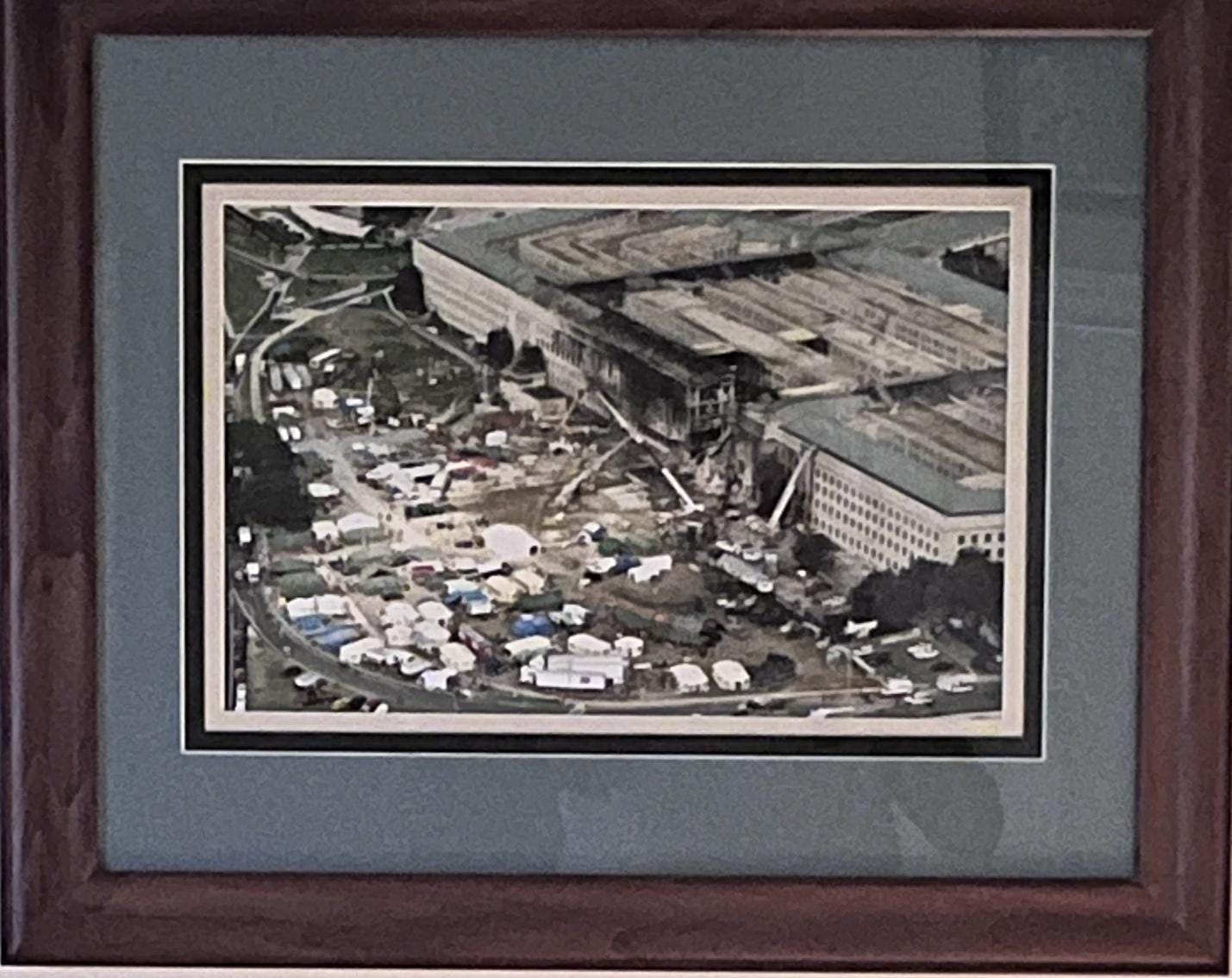
I have this picture in my office and I will never forget their sacrifice.
The attacks showed us what hatred could destroy. The days that followed showed us what solidarity could preserve. Twenty-five years later, the choice between fear and principle remains ours.
On the morning of September 11, 2001, I was working in an off-site intelligence Defense Intelligence Agency (DIA) office.
Like so many Americans, I watched events unfold first as scattered reports, then as something almost incomprehensible. But those of us in the intelligence and national-security communities also understood that those initial attacks might not be over. We did not know how many aircraft were involved, what other targets had been selected, or whether the office in which we were working could be among them. We were trained to evaluate threats, separate facts from assumptions, and remain focused under pressure. But training does not make fear disappear; it gives you something to do while fear is present.
Then came the news that the Pentagon had been struck. For me, that attack was not an image of a distant government building burning on television, as awful as that was. The Pentagon was part of my professional world. I had friends and colleagues in that building. The Pentagon Memorial now honors 184 people killed in the attacks there that morning: 125 inside the building and 59 passengers and crew aboard American Airlines Flight 77. And we commemorate those injured while escaping or helping others.
September 11 was one of the worst days in modern American history. Yet what followed also revealed something important about the country we aspired to be and which much of the world believed us to be.
Our allies stood beside us. That very night, NATO’s North Atlantic Council expressed its solidarity with the United States and invoked Article 5, the principle that an attack against one ally is an attack against all, for the first and only time in the alliance’s history.
People around the world gathered outside American embassies. They lit candles, left flowers, offered prayers, and mourned people they had never met. Our grief crossed borders because, at that moment, the attack was understood not merely as an assault on American territory but as an assault on human beings and on the idea that ordinary people should be able to board an airplane or sit at a desk without becoming targets of political violence. We were wounded, but we were not alone.
Leadership also mattered.
Six days after the attacks, President George W. Bush visited the Islamic Center of Washington. It would have been easy for a president confronting national trauma to speak only to the country’s anger. Instead, he also addressed the danger that fear would be turned against millions of innocent Muslims and Arab Americans. “The face of terror is not the true faith of Islam,” he said. “Islam is peace.” He reminded Americans that women who covered their heads should not be afraid to leave their homes and that Muslims deserved the same dignity and protection as every other citizen.
That appearance did not end prejudice, suspicion, or violence. No presidential speech could. But it established an essential standard: America could defend itself without declaring an entire faith or community to be the enemy. That was not political correctness. It was leadership and it was also strategy. Terrorism seeks more than death and destruction. It seeks overreaction. It tries to convince a society to abandon its own values, turn against its neighbors, and replace judgment with collective blame. When fear causes a democracy to betray its principles, the attacker achieves something no bomb or hijacked aircraft could accomplish alone.
Much has happened in the quarter-century since that morning. The United States went to war. Americans served repeatedly in Afghanistan, Iraq, and other places far from public attention. Military families endured deployments that became measured not in months but in generations. Intelligence officers, diplomats, law-enforcement personnel, aid workers, and allies carried responsibilities that most Americans rarely saw.
Some decisions made after 9/11 protected lives. Others deserve continued scrutiny. Wars launched with broad public support became harder to explain and harder to end. Temporary authorities became enduring institutions. Measures adopted during emergency conditions became normalized.
What became he longest war in American history in Afghanistan eventually ended, but the habits of a forever war did not end with it. We became accustomed to living under permanent threat. We more quickly divided our world into allies and enemies and eventually began treating one another in much the same way. Suspicion became a political language. “Conspiracy theory” took root. Disagreement became disloyalty. Compromise became weakness. Too often, Americans came to see fellow citizens not as people with whom they disagreed, but as dangers to be defeated.
History has always had its dividing points. The Civil War, the struggle over civil rights, Vietnam, Watergate, and September 11 each forced Americans to decide what principles would survive a period of fear and conflict. We are again living through such a moment. The central question is not whether America has enemies. It does. Nor is the question whether the country must be strong. It must. The question is what kind of strength we intend to practice. Is strength to be measured only by the ability to punish? Does patriotism require unquestioning agreement? Or does it require the courage to challenge decisions that may weaken the country we are trying to defend? Can we protect our national security without surrendering civil liberty, religious freedom, factual integrity, and the rule of law?
Who are we, and what do we want to become?
On September 11, 2001, we saw what hatred could destroy. In the days that followed, we also saw what solidarity could preserve. Our allies came to our defense. Strangers helped strangers. First responders ran toward danger. Public servants remained at their posts. A president stood inside an Islamic center and told a frightened nation not to confuse faith with terrorism.
That unity did not last. But it was real. Remembering 9/11 must therefore mean more than recalling where we were when the planes struck. It should mean remembering the colleagues who did not come home. It should mean honoring the families who carried losses the rest of us could never fully understand. It should mean acknowledging the service and sacrifice that continued for decades afterward.
And, remembrance must also carry a warning. A nation can survive an attack and still lose something essential if fear becomes its permanent identity. We honor the dead not by remaining forever at war with foreign enemies, with our neighbors, or with ourselves, but by protecting the principles that violence was intended to break.
Twenty-five years later, the question before us remains the same one that confronted us in those first terrible hours: Will fear decide who we become? Or will we?
Martha Duncan is a retired U.S. Department of Defense senior executive with 37 years of service, including 23 years as an officer in the U.S. Army Reserves, where she also had three operational deployments to Panama, Bosnia and Afghanistan. At Defense Intelligence Agency (DIA), she worked as a Latin American analyst for 11 years. A specialist is human intelligence (HUMINT), she is recognized for her leadership in intelligence operations, coalition-building, and enterprise-level policy development across DIA, the U.S. Army, and the broader Intelligence Community.
Founded in 2016, The Steady State is a nonprofit 501(c)(4) organization of more than 400 former senior national security professionals. Our membership includes former officials from the CIA, FBI, Department of State, Diplomatic Community, Department of Defense and Department of Homeland Security. Drawing on deep expertise across national security disciplines including intelligence, diplomacy, military affairs and law, we advocate for constitutional democracy, the rule of law and the preservation of America’s national security institutions.
Powered by WPeMatico