
Accelerating Authoritarianism: A Warning Assessment Through the 2026 Midterm Elections
1. Key Judgments
We assess that the deterioration of US democratic governance has accelerated since our last assessment in June. The defining change of the summer is one of kind, not degree: the administration has moved from retribution against individuals and institutions to intervention in the machinery of the November 3 midterm elections. The period from election day to the seating of the new Congress on January 3, 2027, is probably the window of greatest risk to constitutional order prior to the 2028 election.
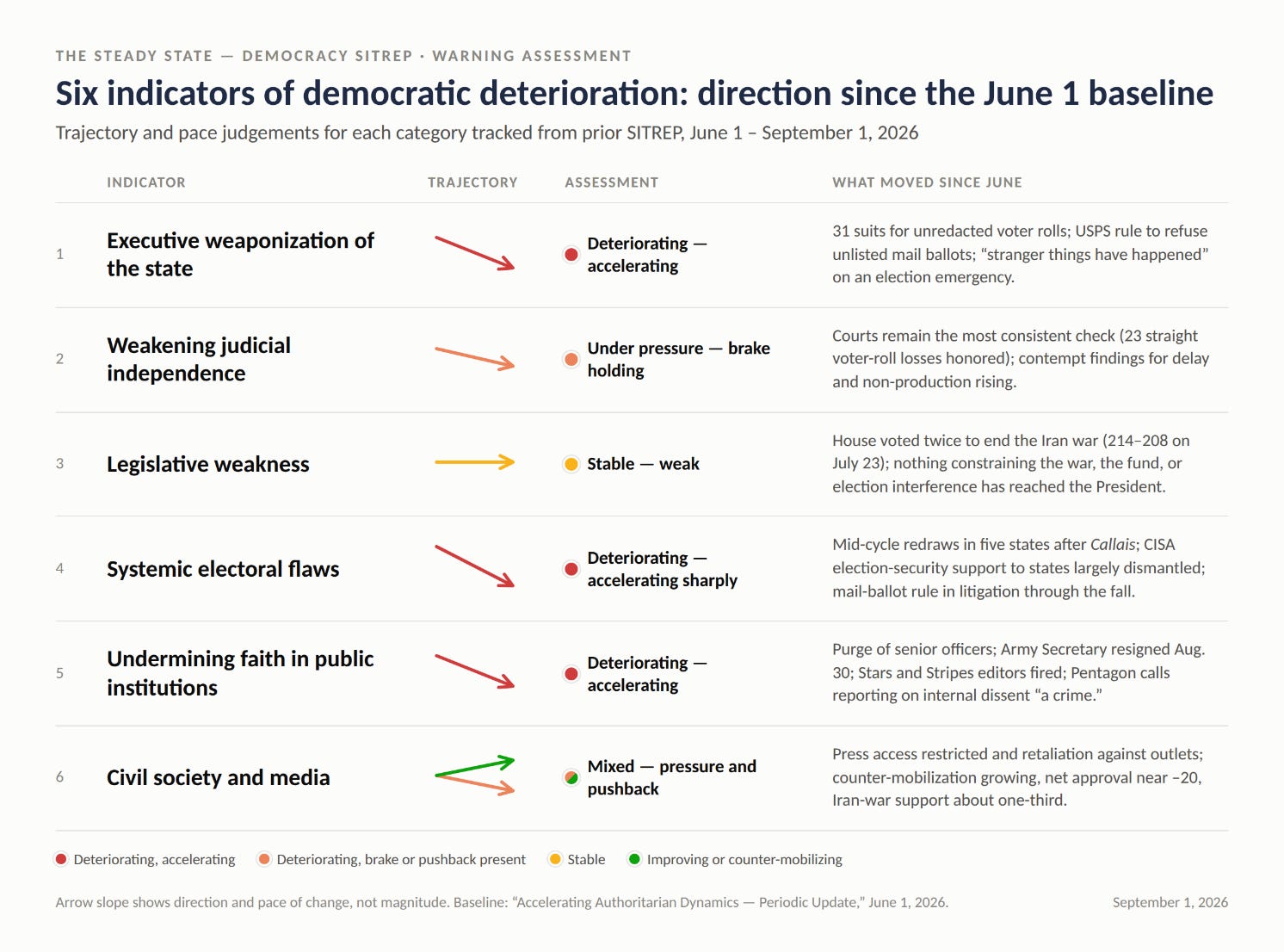
Direction and rate. Deterioration has continued across all six categories we track (see graphic) and has accelerated since June. The driver is unchanged: an executive acting without effective check from Congress. Since June it has sued 30 states for their voter rolls, issued a Postal Service rule to refuse mail ballots not on a federal list, dismantled most federal election-security support, and encouraged mid-cycle redistricting in five states.
Laying the groundwork for interference. The administration is almost certainly laying the legal and political pretext to contest or discredit unfavorable results, whatever the courts decide. It has lost every voter-roll case it has brought but continues to file and appeal. Its mail-ballot restrictions remain in litigation. Whether or not the President intervenes, he has already persuaded many supporters that intervention would be justified.
The courts remain the primary brake. Federal district and state supreme courts remain the most consistent check, and the administration has so far complied with adverse rulings. Congress is an intermittent check: it voted twice to end the Iran war, but passed no measures constraining the war or the $1.776 billion “anti-weaponization” fund. The military has drawn a public line against deploying troops to polling places, though narrowly.
The midterms are an inflection point. If Republicans retain the House, deterioration will likely accelerate under a claimed mandate, leaving the courts and the states as the only brakes. If Democrats win, a real check on spending and oversight returns in January, but so do the odds of confrontation and the administration’s incentive to dispute the result before the new Congress is seated. The more the polls worsen for the President and GOP the greater the likelihood they will resort to extra-constitutional means to retain power.
Most likely pathway. The most likely near-term scenario is extended litigation, pressure on officials who certify results, and federal claims of authority over vote counting. An unprecedented move — seizure of election materials, federal forces at polling or counting sites, or delaying the seating of members — is less likely but possible, and much more likely if razor-thin margins make it decisive for control of Congress.
2. Scope Note and Method
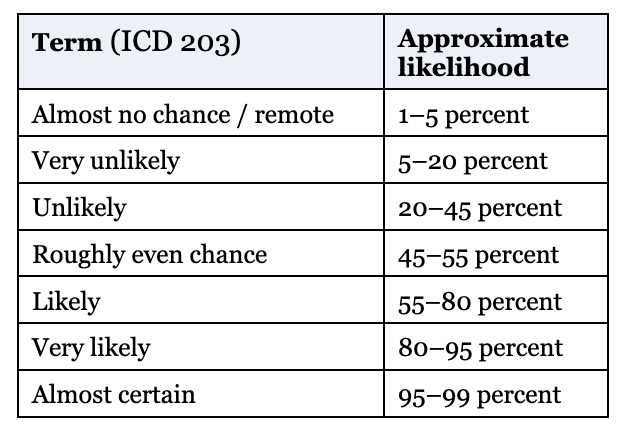
This product is a forecast. Earlier SITREPs asked where American democracy stands; this one asks where the trajectory leads, how fast, and what it implies for the 2026 midterms. Our baseline is the June 1, 2026 SITREP; our horizon runs through the seating of the 120th Congress on January 3, 2027, capturing the pre-election, election-day, certification, and transition windows. The six categories from our previous assessments (see graphic) serve as our indicators, read for direction and pace rather than status. This analysis is open-source, drawing on court filings and rulings, official publications, press reporting, and polling aggregates gathered with AI assistance and analyzed by former intelligence, diplomatic, military, law-enforcement, and homeland-security professionals applying their tradecraft to conditions at home. We follow the Intelligence Community’s analytic standards (ICD 203): we characterize sources and assumptions, identify alternative pathways and indicators of change, and use estimative language to separate judgments from underlying information.
3. Trajectory and Pace of Backsliding Since June
Since June, executive power has been directed at the electoral system, the courts are imposing friction, Congress is absent, and public opinion has turned against the administration. The graphic above summarizes the state of play, and why the window from November 3 to January 3 carries the greatest risk.
Executive weaponization of the state — deteriorating, accelerating. The instruments have not changed since June; the target has. Retaliatory prosecutions continue even as grand juries and courts refuse to go along, and the $1.776 billion “anti-weaponization” fund has been disavowed in testimony but not in writing. What is new is the turn toward the election: the Justice Department suing 30 states and the District of Columbia for their voter rolls in 31 cases, Homeland Security claiming without evidence that voting machines with Chinese components are vulnerable to hacking, and the Postal Service preparing to refuse mail ballots. The Homeland Security claim is the most consequential. Secretary Mullin’s August 24 letter concedes that no vote has been compromised, yet conditions more than $1 billion in grants on hand counts, ballot reconciliation, and citizenship checks against a federal database that cannot reliably match voters by name and birthdate — and threatens to prosecute state officials who refuse. Asked on August 11 whether he would declare a national security emergency to control the election, the President said, “stranger things have happened.” State-level intervention is a parallel risk: several Republican-led states have competitive races this cycle, and we judge it likely that Texas authorities could attempt to intervene, and the state has already reduced the number of polling stations. Georgia, Ohio, Iowa, and purple North Carolina could see similar measures.
Weakening judicial independence — under pressure, brake holding. The courts independence is holding; what has deteriorated is the price of exercising it. District judges, including Trump appointees, have dismissed voter-roll suits 23 times in a row, enjoined the mail-ballot rule twice, halted the weaponization fund, and held the administration in contempt over records on the Los Angeles immigration surge. The administration has so far complied with adverse orders, but judges are bearing the cost: threats against them are at record levels, impeachment resolutions follow unwelcome rulings, and the administration appeals as if every loss were provisional. The courts’ best defense is finality: dismissing cases outright and imposing sanctions leave less room to refile than pausing government action does. The open question is whether the administration’s compliance will hold when a ruling has electoral consequences.
Legislative weakness — stable, weak. Congress has found its voice without finding its power. The House, including four Republicans, voted a second time on July 23 to end the Iran war. A comparable Senate effort stalled, and Republicans blocked an amendment that would have outlawed the weaponization fund. The majority remains unwilling to defend Congress’s powers over war and spending, even when, as with the fund, Congress never appropriated the money. Nothing this summer suggests that will change before a new Congress is seated.
Systemic electoral flaws — deteriorating, accelerating. This category has moved furthest since June, as states acted on the Supreme Court’s ruling in Louisiana v. Callais, which weakened Voting Rights Act protection for minority districts. At least five Southern states redrew maps mid-cycle and challenges are unlikely to resolve before ballots are printed. DHS has launched a “voter fraud surge” in nine states through mid-October, the weeks the campaign is decided. The agency has no election-crimes mandate, and of nearly 16,000 noncitizens DHS claimed to have found on Nevada’s rolls, it confirmed only 185. A new mail-ballot rule would let a federal agency — for the first time — refuse to deliver a ballot. The Supreme Court overruled an initial injunction, and the rule awaits a September 3 hearing and likely litigation into October. While several individual measures have been blocked, together they erode the capacity of the voting system, leaving state constitutions and state courts as the main constraint. High turnout would also blunt these measures, which assume low turnout and thin margins.
Undermining faith in public institutions — deteriorating, accelerating. The politicization documented in our spring assessment has spread to the institution the public trusts most: the military. The Secretary of Defense has removed senior officers judged insufficiently loyal and further restricted press access. The service chiefs warned him in August that Iran operations are unsustainable; when the warning leaked, the department called the reporting “a crime” and fired the leadership of Stars and Stripes, its own newspaper. The Chairman of the Joint Chiefs’ August 31 statement that troops will not be sent to polling places offers some reassurance, though the Secretary has pointedly declined to say the same.
Civil society and media — mixed. Administration pressure on the press and on immigrant-linked organizations has increased, but three counterweights are growing. Public mobilization is larger and more election-focused than at any point since Inauguration Day. The March No Kings protests drew about eight to nine million people, and election-defense networks have shifted to planning — another weekend of action is set for September 18–20. The President’s net approval is near a second-term low and has fallen among Republicans and independents. Only one-third of Americans support the Iran war, and the strain in his coalition, first noted in our May assessment, has widened over the war and the economy. Parts of the financial community have begun to price the risk of a contested election, with analysts warning that a prolonged crisis around the midterms could reprice long-term Treasury yields. We read this as hedging rather than defection: elsewhere, business elites breaking with a consolidating executive has been an early sign of coalition rupture, but pricing a risk is not the same as withdrawing support. This is the only category in which the countertrend matches the trend. The partisan MAGA media ecosystem will almost certainly contest Democratic wins loudly regardless of the evidence.
4. The Midterms: Three Windows of Risk
We assess the midterms in three windows, because the risks, actors, and checks differ in each.
Before election day (now to November 3). The risks are administrative and legal, and already in motion: mid-cycle redistricting, the voter-roll suits, the mail-ballot rule, pressure on state and local election officials, and the withdrawal of federal security support. We judge it very unlikely that any one of these decides control of Congress, but together they could produce disputed districts, delayed counts, and litigation in a post-election challenge. The common mechanism is vulnerability laundering: the executive turns a true but unfixable fact — nearly every US voting machine contains Chinese-made parts — into a threat that can be invoked against any county at will. Specific demands that look reasonable in isolation arrive on impossible timelines, raising the cost of voting and producing rejected ballots and mismatched records later called fraud. Federal presence at the polls is a wild card: Secretary Mullin said on September 1 that ICE would go to polling places only for “specific threats” or active warrants — a loophole wide enough to matter in immigrant-heavy districts. Two near-term concerns stand out: the voter-fraud surge, aimed at naturalized citizens and the county offices that serve them; and the September 3 mail-ballot hearing, including whether the administration complies with the result.
Election day. The greatest risk is intimidation and confusion in precincts where ICE presence has been threatened, or where federal officials have cast doubt on the equipment. The primary impact is likely on turnout and the credibility of close results, which could be decisive because control of the House may turn on a handful of districts. The count itself is likely to produce allegations of fraud: election-day ballots are counted first and mail ballots later, so a Republican lead that narrows overnight is arithmetic, not anomaly — the so-called blue shift. But the hand-count and reconciliation requirements supply official-sounding grounds for calling that ordinary shift suspicious. Explaining the count timeline to the public before election day is the best defense.
After election day (November 4 to January 3). The far-right tactics used to try to steal the 2020 election — mass ballot challenges, certification delays, pressure on county officials — now have a federal partner and, in several states, allies in state government. Machines in targeted counties can be declared “compromised” by press release, and a state that certifies results based on these counts risks its homeland security grants. A local official who declines a federal database check risks federal indictment, and resistance itself can be cast as evidence of the alleged conspiracy. Election meddling could take several forms: certification challenges by local officials, litigation over close counts, federal claims over the tally, or, at the far end, keeping certified winners from being seated when the House organizes on January 3. That last scenario, in which a compliant House Clerk omits lawful winners, has been analyzed publicly, and the safeguards are real: courts could compel the Clerk to perform what is a ministerial duty. But the administration need not succeed to do damage: a contested transition resolved lawfully would still consume the first weeks of the new Congress and set a precedent for 2028. We judge that violence like January 6, 2021 is unlikely at the federal level because this is the mid-terms. However, the likelihood of violence occurring at the state and local level is higher, especially in cases of close elections with contested results. We are uncertain how local and state police would respond.
Two outcomes. If Republicans keep the House — unlikely but possible given the new maps and narrow margins — the administration’s consolidation of power would likely accelerate and increase its incentive to intervene again in 2028, leaving the courts and the states as the only remaining checks. If Democrats win, which is likely, a real check on spending, oversight, and war powers returns in January. Neither outcome stops the decline: in one it steepens, in the other it slows. Slowing it further would require the checks — the courts, the states, and public opinion — to hold through the 2028 elections.
5. Alternative Scenario
The mainline judgments above — continued democratic erosion through litigation and administrative pressure, and a contested or delayed congressional seating — assume the checks hold and the administration does not resort to more blatant extra constitutional measures to sway the outcome. This outlier scenario would most likely begin with a domestic or foreign shock — escalation in the Iran war, a mass-casualty, terrorist, or political-violence event — that becomes the justification for emergency powers, such as the domestic deployment of federal forces, the open defiance of a court order, and the removal of officials who object to federal interference. We judge this scenario unlikely before January 3 but far from remote. The triggering event need not be large: a single protest against ICE that turns violent could serve. An administration that wants the pretext can find one or provoke it.
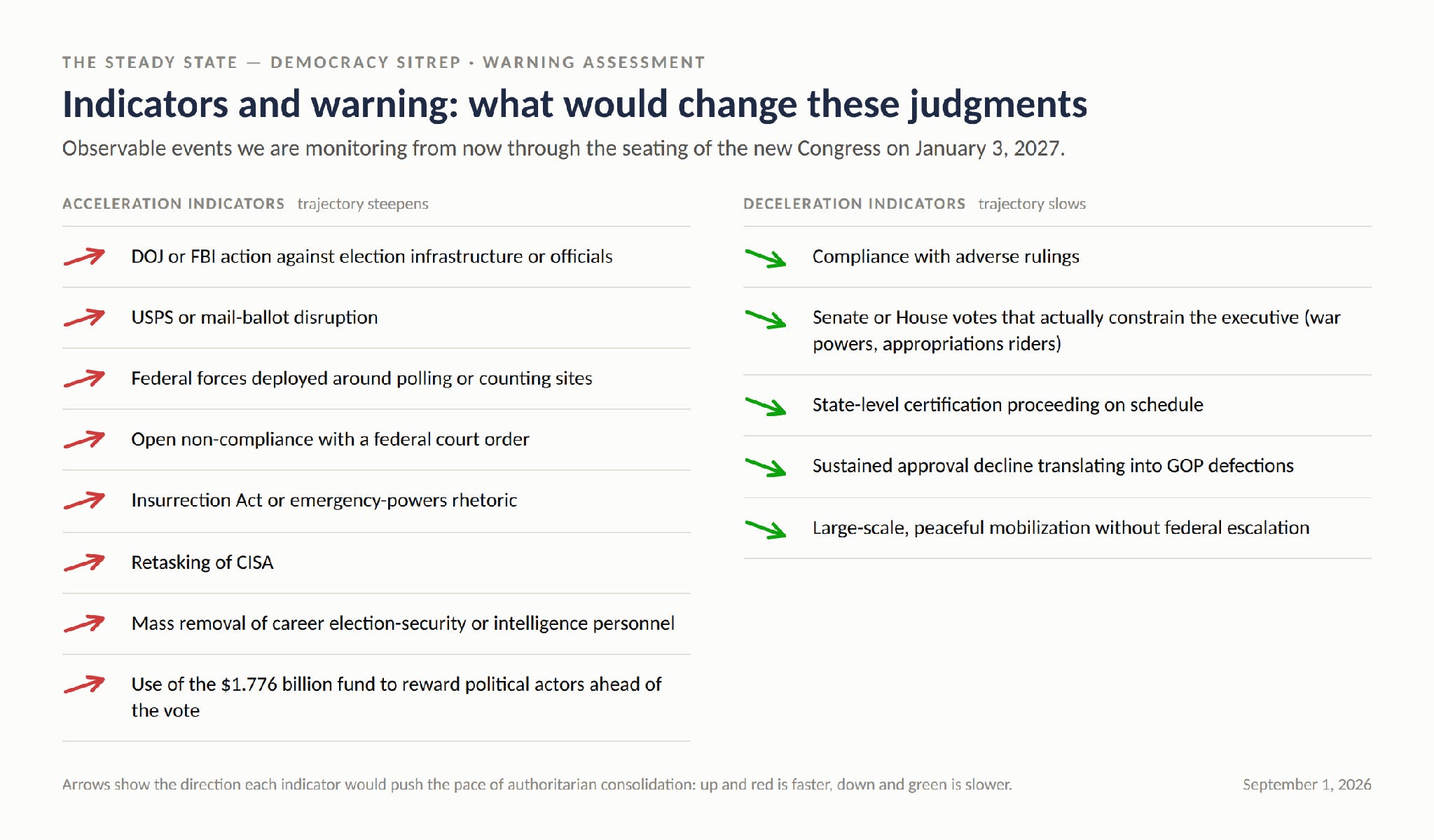
6. Indicators & Warning
Founded in 2016, The Steady State is a nonprofit 501(c)(4) organization of more than 400 former senior national security professionals. Our membership includes former officials from the CIA, FBI, Department of State, Department of Defense, and Department of Homeland Security. Drawing on deep expertise across national security disciplines, including intelligence, diplomacy, military affairs, and law, we advocate for constitutional democracy, the rule of law, and the preservation of America’s national security institutions.
Powered by WPeMatico