

Tag Archive for: National Security

(Photo by Matthew Henry on Unsplash)

Donald Trump’s threats to “destroy” Iran’s energy structure, if carried out, is a potential war crime, implicating not only the president but all who carry out his mission.

In a March 30, 2026, social media post, Donald Trump threatened that if a peace deal is not reached soon and if the Strait of Hormuz is not immediately reopened, the U.S. would broaden its attacks, “completely obliterating power plants, oil wells, Kharg Island, and other civilian infrastructure.” He had made the same threat earlier on March 24, if Iran failed to open the strait, but delayed execution to allow peace talks to go ahead.

While Trump is known to use bluster, misdirection, and over-the-top threats as a negotiating tactic, human rights officials believe that this threat is a potential violation of international humanitarian law. The Geneva Convention prohibits attacks on energy infrastructure if they cause disproportionate harm to civilians. Amnesty International’s Senior Director of Research, Advocacy, Policy, and Campaigns, Erika Guevara-Rosas, said, “Intentionally attacking civilian infrastructure such as power plants is generally prohibited . . . and could amount to a war crime.” Amnesty International has also condemned Iran for threats and attacks on nonmilitary targets.

In 2024, the International Criminal Court (ICC) issued arrest warrants for Russian military officers and officials, charging them with war crimes for attacking Ukrainian electric infrastructure. Kenneth Roth, formerly the executive director of Human Rights Watch, said, “Trump is openly threatening a war crime, and people aren’t saying anything because they’re numb to it.”

As with many of the president’s statements since the war began, it’s impossible to say whether or not this threat is real or just another of his ‘real estate negotiation’ strategy. What we can say, though, is that he has again placed the United States in a position that is more familiar for countries like Iran, Russia, or North Korea. Even if he reverses course, as he has done numerous times in the past, the genie is out of the bottle, and we might not be able to put it back this time, particularly if he goes through with his threat to commit ground forces and his non-war becomes even bloodier for the US side.

Should this action actually take place, and it is determined to be a war crime, it’s not just the leadership, but everyone who participates in it who can be found criminally liable by the ICC. Congress could put a stop to this madness if it chose to reclaim its constitutional authority, but it’s currently on recess (in hiding?) until April 6, which could be too late. Senior military leadership could theoretically refuse to carry out such an order, but the Caribbean ‘drug boat’ attacks demonstrate that this is not likely to happen. Depending on when such an order is given, it would appear to me that the guardrails against a president running amok are down.

Like many an authoritarian, Trump is unilaterally putting those below him, in this case the military, who would be ordered to carry out this mission, at risk of prosecution. But, to him, a lot of this war is ‘just for fun.’

Charles A. Ray served 20 years in the U.S. Army, including two tours in Vietnam. He retired as a senior US diplomat, serving 30 years in the U.S. Foreign Service, with assignments as ambassador to the Kingdom of Cambodia and the Republic of Zimbabwe, and was the first American consul general in Ho Chi Minh City, Vietnam. He also served in senior positions with the Department of Defense and is a member of The Steady State.

Founded in 2016, The Steady State is a nonprofit 501(c)(4) organization of more than 400 former senior national security professionals. Our membership includes former officials from the CIA, FBI, Department of State, Department of Defense, and Department of Homeland Security. Drawing on deep expertise across national security disciplines, including intelligence, diplomacy, military affairs, and law, we advocate for constitutional democracy, the rule of law, and the preservation of America’s national security institutions.

Powered by WPeMatico
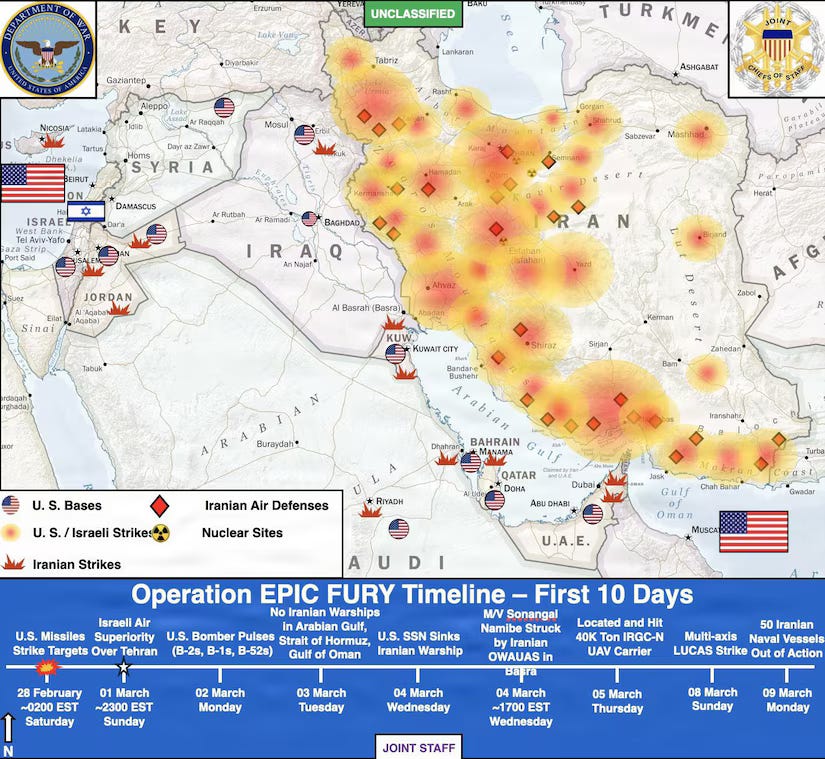
As published below in the Pensacola News Journal Pensacola News Journal (Part of the USA Today Network) March 29 2026

Making sense of the shambolic actions of the Trump administration is a daunting, full-time task for American voters, whether MAGA, Democrat, Republican or Independent.

Deliberate disruption at home metastasized internationally on Feb. 28 with the launch of war against Iran, an undertaking seemingly inadequate in its military and diplomatic planning, political preparation of the nation, and analysis of the second- and third-level consequences of starting a war in the volatile region.

Two questions continue to demand coherent answers: “Why?” and “To whose benefit?”

Instability in world energy supplies, surging gasoline prices and possible terrorist attacks in the U.S., mounting civilian casualties in Iran and the region, deep dismay among allies and partners, and no change in Iran’s nuclear posture are the initial results of the war. The conflict could widen regionally and even globally, as China sees its Iranian oil deliveries threatened, Russia continues to undercut the U.S., and other countries are affected economically or by war-related violence.

How to understand what is happening and why?

One starting point: the Administration’s own National Security Strategy document, released just last November. One would hope that the document answers those questions and confirms how America is being made great again. Rather, it showcases the administration’s muddled thinking, jingoistic public bluster, and lack of serious people with a credible grasp of our dynamic yet unchanging 21st- century world.

The strategy simply defies rationality regarding its purpose and implementation. Its presidential cover letter claims that “America is strong and respected again – and because of that, we are making peace all over the world”, with Iran-Israel included in the list of conflicts resolved. The document’s 29 pages disingenuously assert the need for a radical reorientation of U.S. foreign policy to achieve a more secure America: ”…motivated above all by what works for America—or, in two words—“America First.” President Trump has cemented his legacy as The President of Peace.”

The document’s regional priority is the “Trump Corollary to the Monroe Doctrine, and “a readjustment of our global military presence to address urgent threats in our Hemisphere…”. The administration’s Jan. 3 action to seize Venezuelan leader Maduro and its ongoing pressure on Canada, Mexico and increasingly Cuba demonstrably flow from that.

On Asia, the strategy addresses rebalancing the U.S. economic relationship with China. states the need for a “robust and ongoing focus on deterrence to prevent war in the Indo-Pacific” and recognizes Taiwan’s critical economic and geographic roles.

Europe comes next. The strategy does not mention Russia as a threat to the U.S., but asserts the need to “reestablish strategic stability with Russia” and that NATO allies increase defense spending to meet their security responsibilities in their region. The strategy does recognize that “many Europeans regard Russia as an existential threat” but argues that Europe’s problems also include the twin specters of migration overwhelming countries and political liberty being sapped by (alleged) “censorship and repression”.

Finally, the Middle East (followed by cursory attention to Africa).

The strategy’s text could not be more at odds with the administration’s war on Iran:

“Stopping regional conflicts before they spiral into global wars that drag down whole continents is worthy of the Commander-in-Chief’s attention, and a priority for this administration. A world on fire, where wars come to our shores, is bad for American interests.”

“Conflict remains the Middle East’s most troublesome dynamic, but there is today less to this problem than headlines might lead one to believe. Iran—the region’s chief destabilizing force—has been greatly weakened by Israeli actions since October 7, 2023, and President Trump’s June 2025 Operation Midnight Hammer, which significantly degraded Iran’s nuclear program.”

The days in which the Middle East dominated American foreign policy in both long-term planning and day-to-day execution are thankfully over—not because the Middle East no longer matters, but because it is no longer the constant irritant and potential source of imminent catastrophe, that it once was. It is rather emerging as a place of partnership, friendship, and investment.”

We should encourage and applaud reform when and where it emerges organically, without trying to impose it from without.

National discussion is understandably perplexed by the administration’s preemptive attack on Iran in tandem with Israel. Given the NSS document’s assertion of Operation Midnight Hammer’s significant success, it is difficult to understand what changed since November, other than an urge to exploit the opportunity on Feb. 28 to take out an Iranian leadership foolishly gathering together to consider the results of the Feb. 26 indirect negotiations in Geneva with U.S. representatives.

When you hear leaders on both sides of the aisle question the administration’s Iran war strategy and endgame, know that they are merely reacting to events as they unfold as well as the documented confusion of the National Security Strategy.

It should come as no surprise that Trump 47 is ensuring that America First really means America Alone. This hollowing out of the U.S. role as the leader of the free world has been signaled openly for a decade now; we are simply experiencing the inevitable, despite MAGA’s unrelenting and misleading propaganda otherwise.

Let’s hope that this war ends soon and makes for a safer world and America. Meanwhile, please read the strategy document and continue to ask, “Why?” and “To whose benefit?”

Mike Mozur is a retired Senior Foreign Service Officer with over 33 years of experience in the Soviet Union, former Soviet Union, Eastern Europe, the Balkans and Latin America. Mike also led a global professional association of environmental scientists and writes periodically on current political, economic, and social issues. He is a member of The Steady State.

Founded in 2016, The Steady State is a nonprofit 501(c)(4) organization of more than 400 former senior national security professionals. Our membership includes former officials from the CIA, FBI, Department of State, Department of Defense, and Department of Homeland Security. Drawing on deep expertise across national security disciplines, including intelligence, diplomacy, military affairs, and law, we advocate for constitutional democracy, the rule of law, and the preservation of America’s national security institutions.

Powered by WPeMatico

Here we are, marking yet another “No Kings Day” here in our beloved America, once the world’s beacon of democracy.

This “No King’s Day,” like its predecessors, is driven by growing popular concern of the Trump Administration’s authoritarianism across the range of political, economic, social, and international issues of importance to the nation.

How best to assess and understand Trump’s heavy hand and its iron fist with the MAGA party, once known as the Republican Grand Old Party?

The Declaration of Independence and the Constitution should be our starting points. They convey our values and legal frameworks, and challenge us all to form a “more perfect Union.” Next to these foundational documents, the Administration measures poorly and has prompted the “No Kings” protests.

The American colonists’ Declaration of Independence rebuked the perceived tyranny of the British crown and King George III. Its compelling theme: the excesses of rulers and their misguided measures undermine the welfare and liberties of the people.

Signers declared, “The history of the present King of Great Britain is a history of repeated injuries and usurpations, all having in direct object the establishment of an absolute Tyranny over these States. To prove this, let Facts be submitted to a candid world.”

Like the Founders, let’s look at facts, so little respected in MAGA’s less-than-candid “Post Truth” world. Trump continually drives false narratives via bombast and willful deception. MAGA lost the 2020 election despite the President’s constant lie to the contrary. The 2024 election brought a new administration but did not convey majority support for radical change. The President’s 49.8 percent of the popular vote was no mandate, historic or otherwise. His Electoral College victory hinged on thin margins in a few “battleground” states.

The Founders criticized George III for refusing “his Assent to laws, the most wholesome and necessary for the public good”, forbidding “his Governors to pass Laws of immediate and pressing importance”, “cutting off our Trade with all parts of the world”, and making “Judges dependent on his Will alone, for the tenure of their offices”.

All have echoes in the MAGA agenda today, whether the President’s open disregard for existing law, his blocking of bipartisan legislation on immigration, his incoherent and illegal trade wars, or efforts to bully and control the judiciary, including the Supreme Court whose July 2024 decision on Presidential immunity has enabled Trump’s ongoing threats to the rule of law and separation of powers.

The British Army colonial deployment angered the Founders who wrote that George III “has kept among us, in times of peace, Standing Armies without the Consent of our legislatures.”

Similarly concerning today, the administration’s unwarranted deployment of the National Guard and federal troops in various states and cities was done for naked political purposes over the stated objection of state and local authorities.

The Founders were concerned that George III had “excited domestic insurrections amongst, ” much as the President did after the November 2020 election. His December 19, 2020 tweet (“be there, will be wild”) convoked a mob to Washington on January 6, 2021; he then personally encouraged them to march to the Capitol to “seize their country back” by blocking the electoral vote count chaired by his own Vice President. His pardoning of the convicted was unconscionable.

For many, our President’s words and actions smack of the George III “tyranny” so egregious to the Founders. For his part, the President has answered every legitimate challenge to his many constitutionally or legally questionable executive actions with his signature “smear and vilify” tactic, attacking judges, the media, opponents and fellow “Republicans” while filing strong arm counter suits to intimidate and squeeze opponents for acquiescence and cash.

The President’s 24/7 firehose communications willfully misrepresented the MAGA’s July 2025 budget legislation’s serious threat to the country’s fiscal and financial stability. The President’s communications effort is based on his own personally owned and cynically mislabeled “Truth Social” platform. This should be a red flag for all, an irrefutable sign of his unrelenting manipulation of fact and truth for his own personal and political aims. Meanwhile, the havoc inflicted on the federal government is open for all to see and the American public is suffering from the disruption, dismantlement and denigration of federal government services.

Abroad, the Administration is wandering, and has now launched the country into war in the Middle East at variance to its own National Security Strategy. The President’s incessant public bullying of key partners and allies on tariffs and the Iran war disruptively undercuts global stability. His waffling on Ukraine and support of Russia ensure that allies and opponents do not respect or take the U.S. seriously. No “America Great Again” but “America Alone” for sure.

Closing the Declaration’s litany of grievances against George III, the Founders declared: “In every stage of these Oppressions We have Petitioned for Redress in the most humble terms: Our repeated Petitions have been answered only by repeated injury. A Prince, whose character is thus marked by every act which may define a Tyrant, is unfit to be the ruler of a free people.” Sound familiar today?

Popular concerns about tyrants have long prevailed. But today, we are living the Founders’ fear of excessive power wielded illegitimately. The country is weakened just when we should be working together to ensure greater strength and stability.

How sad, to celebrate the 250th birthday of the great American Democratic experiment and no longer be the envy of the world.

Mike Mozur is a retired Senior Foreign Service Officer with over 33 years of experience in the Soviet Union, former Soviet Union, Eastern Europe, the Balkans and Latin America. He also led a global professional association of environmental scientists and writes periodically on current political, economic, and social issues. He is a member of The Steady State.

Founded in 2016, The Steady State is a nonprofit 501(c)(4) organization of more than 400 former senior national security professionals. Our membership includes former officials from the CIA, FBI, Department of State, Department of Defense, and Department of Homeland Security. Drawing on deep expertise across national security disciplines, including intelligence, diplomacy, military affairs, and law, we advocate for constitutional democracy, the rule of law, and the preservation of America’s national security institutions.

Powered by WPeMatico
In having his name on official currency while in office, Trump can boast that he’s the only living American president in the small but very famous company of autocrats.

You can buy a Julius Caesar Getty Roman Coin online (Getty Museum: $24.00).

Or a Napoleon Emperor Coin Paris Mint, for $2,309. 1812 Gold France 40 Francs.

Perhaps most enticingly, there’s a 1775 King George III – British American Colonial Copper Halfpenny Non Regal coin, for only $10.50)

President Donald Trump has plenty to think about these days, beginning with his bombing of Iran and the continuing Iranian retaliatory missile strikes that have set the Middle East ablaze. Iranian forces have essentially shut down the vital oil-and-gas shipping lanes in the Straits of Hormuz, a body blow to the health of the global economy. The shock waves are hitting (furious) American allies (who have been insulted, not consulted). American servicemen and women have been killed in action, with more to come, the president has said.

Here at home, American consumers are facing skyrocketing prices at their gasoline pumps, wondering what their president was thinking when he launched his newest war of choice. While that remains unclear, one thing is clear: President Trump has been busy thinking of — himself.

He’s been thinking about how to get Congress to change our nation’s voting rules so that his Republicans will win this November’s congressional midterm elections. And further thinking of how to get Washington, D.C.’s Dulles International Airport (and other national landmarks) named after him, like he’s done (sans congressional authorization) with the John F. Kennedy Center and the U.S. Institute for Peace.

There’s much more on the president’s mind: This summer’s cage fighting spectacular on the South Lawn of the White House (perhaps on June 14, coincidentally the day Trump celebrates his 80th birthday). Holding an Indianapolis-style auto race (185 mph along the streets of downtown Washington, D.C.), to highlight this July’s celebrations of America’s 250th anniversary. And he’s surely been congratulating himself for spending the necessary time to persuade his MAGA loyalists at the U.S. Mint to issue a 24-karat gold coin to honor his likeness.

Trump’s latest vanity project has been thoroughly analyzed on late-night television. “Now you can have Trump in your pocket, like Saudi Arabia,” quipped Bill Maher. And this just in: It seems that with Trump, expressing vanity is increasingly open-ended. As the news reports this week, the Treasury Department is now working on the unprecedented step of putting Trump’s signature on dollar bills — all new paper currency, actually.

Criticism aside, managing to get his name on official US coinage is a major accomplishment (of dubious legality for any living president). In his first term, Trump got the White House Gift Shop to offer a “Trump & Putin” medal coin to commemorate the (in)famous 2018 summit in Helsinki. Infamous in leading intelligence and diplomatic circles to this day, because that’s when Trump told the world’s press that he believed his friend Putin’s word that Russia had not covertly tried to help him defeat Hillary Clinton in the 2016 presidential race, and not a deeply researched CIA analysis that had documented Putin’s operation. But now, success in manipulating the official U.S. Mint trumps the gift shop (which also now sells Joe Biden bobbleheads, along with many Trump touristy souvenirs).

It’s possible that any coin comparisons with the British King, who, with his tariffs on American tea, caused a famous party in Boston Harbor, might be of interest to some of the millions of American citizens who will be protesting in cities across the USA, come this Saturday’s March 28 No Kings demonstrations. Perhaps some might dress as King George Coins instead of the Turtles costumes that were prominent in last year’s No Kings’ rallies.

Greg Rushford is a former senior congressional aide (defense & intelligence) and a former Washington-based journalist who specialized in the nexus between national security and global trade politics. He is a member of The Steady State.

Founded in 2016, The Steady State is a nonprofit 501(c)(4) organization of more than 400 former senior national security professionals. Our membership includes former officials from the CIA, FBI, Department of State, Department of Defense, and Department of Homeland Security. Drawing on deep expertise across national security disciplines, including intelligence, diplomacy, military affairs, and law, we advocate for constitutional democracy, the rule of law, and the preservation of America’s national security institutions.

Powered by WPeMatico

For immediate release: March 26, 2026

WASHINGTON, D.C. — The Steady State, an organization of more than 400 former senior national security officials, is excited to announce its participation in the March 28 nationwide “No Kings” movement and call upon Americans in every state to join a local event. Steady State’s participation brings together experts in fighting authoritarianism and a nationwide grassroots coalition to protect American democracy against executive overreach.

This partnership centers on the nationwide “No Kings” mobilization scheduled for Saturday, March 28, 2026. With over 3,200 rallies planned across all 50 states, our participation unites those who have spent their careers defending the Constitution with the millions of Americans now standing to protect it. Steady State speakers will join rallies in key cities across the country, former high-ranking officials and career civil servants, who will provide a unique, nonpartisan perspective on why current executive overreach represents a historical departure from American democratic norms. And many of the rest of us will be marching.

In America, we have no kings. Our oath was, and remains, to the Constitution, not any one individual, party, or would-be strongman. Authoritarians abroad taught us what to watch for, and we are now seeing too many of those tactics at home: politicization of law enforcement, attacks on independent institutions, and treatment of dissent as disloyalty. Americans who might disagree on many issues can and must stand together as one to stress the view that this country rejects kings.

[R]esistance to authoritarianism succeeds when it is inclusive and appeals to the broadest swath of the population,” and it is critical that organizations such as ours join with others, even where we may disagree on policies, in defense of democracy.

The Steady State is encouraging its members, supporters, and concerned citizens nationwide to:

  • Find and join a local No Kings event on March 28 using the nationwide event map.

  • Show up as peaceful, disciplined defenders of the Constitution, modeling nonviolent civic engagement in their communities.

  • Talk with friends and neighbors across party lines about why “no kings” is a shared American value, not a partisan slogan.

On March 28, we invite Americans of every background to stand shoulder to shoulder and say, with one voice, that in this country, there are n

Powered by WPeMatico

PDF VERSION AVAILABLE HERE

We assess that the main driver of increasing authoritarianism in America remains executive overreach, compounded by a renewed presidential focus on securing a legacy through any means, but especially through President Trump’s pursuit of vanity projects—including not only his war in Iran but various events linked to America’s 250th birthday. Trump this month convinced a panel he appointed to approve an initiative to put his name on a commemorative coin, dissembled about his choice of White House drapes during a Medal of Honor ceremony, and is moving forward with plans to host a MMA fight on the White House grounds as part of a massive birthday celebration meant to link his 80th birthday (June 14) to America’s.


Executive Overreach and the Weaponization of the State

President Trump’s belief that the presidency affords him unlimited executive power under Article II of the Constitution and his personal quest for a legacy may be exacerbated by perceptions of his own decline. These competing dynamics probably drove him to join Israel’s war against Iran, resulting in strikes that killed an estimated 1,500 Iranians, from the Ayatollah to dozens of schoolgirls. Trump has variously claimed no one anticipated Iran’s primary responses—closing the Strait of Hormuz and launching attacks on Persian Gulf countries in which the US has a presence—and that they knew it was a possibility but assessed it to be manageable.

Suggesting he understands his adventures have placed him in a politically diminished state, Trump postponed his planned summit with Chinese leader Xi Jinping in China, claiming he needed to be available to “oversee the war” with Iran. His oversight needs have not stopped him from spending copious time on the golf course since the war began. Trump is searching for opportunities to raise his standing, oddly claiming he would have the honor of taking Cuba, and could do whatever he wanted with it. He mused about making Venezuela the 51st state, and, always willing to attempt to raise his standing by denigrating someone else, confusedly spoke of California Governor Gavin Newsom as “president” and, referring to his dyslexia, said “I think a president should not have learning disabilities.”

We assess that Trump likely views his war as a grievous error, but, for reasons related to ego and no concept of how to end this conflict, cannot backtrack, preferring instead to attempt to legitimize this war by, for example, claiming he spoke with a former president who said he wished he had bombed Iran (representatives for all four living former presidents say there is no record of such a conversation), and belittling allies about their lack of participation in helping us secure the Straits of Hormuz.

In positive executive branch developments, National Counterterrorism Center (NCTC) Director Joe Kent resigned to express his opposition to the war with Iran. Kent lacked the qualifications to run the NCTC and was mired in MAGA and various conspiracy theories and espoused anti-Semitism—and his resignation signals deep rifts within MAGA over Trump’s war in Iran. Additionally, Trump fired Homeland Security Secretary Kristi Noem, who lied to Congress about Trump’s knowledge of her expenditure of millions of dollars in an ad campaign ostensibly meant to promote Homeland Security but was widely seen as a vanity campaign positioning herself for a bid for higher office.

Weakening Judicial Independence

Signaling that we will continue to see the Department of Justice (DOJ) adhering to Trump’s whims rather than the rule of law and indicating an awareness that DOJ actions have created difficulties attracting competent prosecutors, Attorney General Pam Bondi has eliminated a requirement that new prosecutors have at least one year of experience practicing law prior to being hired. Highlighting Trump’s interference in DOJ decision-making, after several days of media stories noting the administration had caved after the DOJ dropped its legal argument justifying its decision to boycott certain law firms that had offended Trump, the department reversed its decision and announced it would continue to press its case. Likely expressing sentiments shared by many of his colleagues, US District Judge Zahid Quraishi, frustrated with sloppy prosecutions by the trio of prosecutors replacing (possibly illegally) ousted interim US Attorney Alina Habba in New Jersey, said DOJ has “lost the confidence and the trust of this court”

Legislative Weakness

Congress, and not exclusively Democrats, continues to show indications that members recall the authority the Constitution delegates to it. Congressional Democrats referred Secretary Noem to the DOJ for investigation over allegations she lied in her testimony to both the Senate and House judiciary committees earlier this month when she claimed Trump knew she spent $220 million on an self-aggrandizing ad campaign featuring, among other things, Noem sitting on a horse wearing a cowboy hat. Republicans joined their Democratic colleagues in showing backbone when Senate Majority Leader John Thune said he opposed ending the filibuster to force passage of the SAVE Act—which would establish barriers to voting for many Americans—or a DHS funding bill.

Systemic Electoral Flaws

The Senate is debating Trump’s long-sought SAVE Act, which would place hurdles in front of any American who a) lacks a passport, b) has changed their name, or c) gets booted from their precincts voting rolls. Several Republican states—including Florida, South Dakota, and Utah—are working to pass legislation that requires proof of citizenship, in the event the SAVE Act fails in the Senate. As of this date, it does not appear this legislation will pass. Trump will likely renew his effort to accomplish the goals of SAVE through executive orders and pressure on Republican governors and state legislatures.

Undermining Faith in Public Institutions

Raising questions about America’s commitment to the rule of law, particularly treaties requiring that civilians not be targeted in conflict and that prisoners are treated humanely, Secretary of Defense Pete Hegseth launched a review of the legal offices across the Pentagon, suggesting a new purge of attorneys and legal advisers is coming. Hegseth claims this will move the Pentagon from “tepid legality” to “maximum lethality,” and, oddly, indicates this will help reduce “moral ambiguity”—as though that were an admirable goal. In one frightening speech, Hegseth warned that the US would give “no quarter” to “our enemies” in the war with Iran. Suggesting Hegseth, a Christian nationalist who holds apocalyptic “end times” views, is prepared to follow through on his “maximum lethality” pledge, military commanders have reportedly been telling troops not to fear a war with Iran, which is necessary to bring about ‘Armegeddon’—prompting more than 200 complaints from members of the military.

Raising questions about the independence of America’s intelligence community, during her Annual Threat Assessment testimony on March 18, DNI Tulsi Gabbard refused to say whether Iran posted an “imminent threat” to the United States, claiming only President Trump can decide that. It should be noted that the job of the intelligence community is to provide warning of threats to American security and national interests.

Civil Society/Media

The Trump Administration continues to put pressure on media outlets, trying to intimidate them into only providing coverage favorable to its agenda. FCC Chairman Brendan Carr demanded that the media tell Trump’s version of how the war in Iran is going, and said stations that share “fake news” may lose their licenses, while Trump said media spreading “fake news” depicting carriers on fire (no US media shared these stories, published on Iranian and Russian media outlets) were guilty of treason.

Founded in 2016, The Steady State is a nonprofit 501(c)(4) organization of more than 400 former senior national security professionals. Our membership includes former officials from the CIA, FBI, Department of State, Department of Defense, and Department of Homeland Security. Drawing on deep expertise across national security disciplines, including intelligence, diplomacy, military affairs, and law, we advocate for constitutional democracy, the rule of law, and the preservation of America’s national security institutions.

Powered by WPeMatico

This is the last in the series of four articles that examines the way in which the Immigration and Customs Enforcement Department (ICE) under Trump has created a vertically integrated structure that relies on a massive multi-year appropriation from Congress, its newly recruited paramilitary detention force, Roberts Court Shadow Docket decisions, and the ability to operate without fear of serious legal consequences to apprehend, detain, and remove thousands of undocumented individuals currently residing in the United States

The cavalier manner in which ICE conducts its deportation/rendition flights to remove individuals from the United States, many of whom are in the process of having their refugee status adjudicated.

From the earliest day of 2025, the Trump administration demonstrated how aggressive its removal operations would be, sending a large group of Venezuelan immigrants to the notorious CECOT prison camp in El Salvador. DHS claimed without evidence that these men were all members of the Venezuelan prison gang Tren de Aragua (TdA). Four of the five removal flights to CECOT were in defiance of court orders. The removals were justified through presidential invocation of the Alien Enemies Act (AEA) that made the absurd claim that the United States was being invaded by TdA. By invoking the AEA, the administration hoped it could remove thousands of Venezuelans without due process, even when Federal courts had ordered a stop to these removal flights. When countries refused to grant landing permits to planes loaded with detainees, the administration immediately threatened retaliatory action, to include imposing prohibitive tariffs. In a twist of particular cruelty, ICE has rapidly expanded third-country deportations this year, sending hundreds of detainees to countries with which they had no contact, and with no due process. When a Federal District Court ordered a fifteen-day pause in third-country deportations, the Roberts Majority once again came to the rescue via the Shadow Docket, authorizing such flights while litigation continued. Detainees are given as little as six hours’ notice before removal, effectively denying individuals any form of meaningful due process.

In February of this year, District Court Judge Brian Murphy issued an 81-page order again halting the flights, finding they represented a gross violation of due process rights of individuals who are living in the United States. As practiced by ICE, third-country removals deprive individuals of adequate notice, require no factual basis, and make any substantive challenge impossible. The order was paused for fifteen days to allow ICE to appeal. Among other things, the order noted the utter cruelty of using South Sudan as a third-country landing zone. The Roberts Court, having allowed this program to continue once, will now have the chance to decide the case on the merits.

Rapid removal is the final and essential component of the vertically integrated ICE program. There have been limited occasions where courts have required the Government to return individuals who have been removed from the country in violation of an existing court order. The most visible example was Kilmar Abrego Garcia, a Maryland resident who had protected status against forced return to El Salvador but was subjected to a warrantless arrest, immediate removal to his native El Salvador, and confinement in CECOT, none of which had any discernible legal basis. This was a rare Supreme Court intervention on behalf of a detainee. Since he was returned to the United States, he has been subjected to non-stop efforts to detain, prosecute, and remove him.

The Government continues to remove detained individuals, even where there is an active request for refugee status or where the individuals have legal status. DHS has removed over 80 individuals protected by DACA, apparently without any due process, and notwithstanding their legal status. By definition, these adults were brought here as children, have lived their entire lives in the United States, and have no ties to their country of birth. DHS recently has attempted to send back to Iran an ethnic Iranian woman who was adopted at the age of two, brought to the United States by her adoptive parents, raised believing that she was a US citizen, but whose adoptive parents failed to complete the paperwork for her naturalization. It is not clear if DHS will wait until the current American and Israeli bombing campaign ends before attempting to return her to Iran.

In another sadistic twist, undocumented individuals who have received court protection against removal to their home country are targeted for third-country removal. In theory, removal may only occur once DHS receives credible assurances that the detainees will be treated humanely and that their human rights will be respected. A recent case involved removal of a Moroccan woman to Cameroon, who was seeking refugee status and who was protected from being sent to Morocco. Homosexuality is also illegal in Cameroon; in effect, Cameroon was used as a way station to avoid directly violating the judicial order. When the outcome is the same, she is reportedly living in hiding in Morocco, the Government’s contempt for the law is obvious. Cruelty is a convenient method of dehumanizing undocumented individuals. DHS recently dropped off a blind man with refugee status outside a closed restaurant in the middle of winter in upstate New York, misrepresented what it had done, and has expressed no regret that the refugee’s body was discovered several days later.

Much has been written about the US Government’s rendition program. The ICE removal program is much broader and more insidious. It relies on financial rewards to small countries that agree to allow ICE removal flights to land and offload people who have no connection to where they have been kicked off the plane. The problem is solved in terms of US official policy in that there are now fewer undocumented people in the United States, regardless of whether they would qualify for refugee status or asylum under US law. Having achieved another tactical success, the vertically integrated system then restarts the process that will only end when millions of people are redistributed all over the globe.

James Petrila spent over thirty years as a lawyer in the Intelligence Community, working at the National Security Agency and, for most of his career, at the Central Intelligence Agency. He has taught courses on counterterrorism law and legal issues at the CIA at the George Washington University School of Law. He is currently a senior advisor to the Institute for the Study of States of Exception and is a member of The Steady State.

All statements of fact, opinion, or analysis expressed are those of the author and do not reflect the official positions or views of the US Government. Nothing in the contents should be construed as asserting or implying US Government authentication of information or endorsement of the author’s views.

Founded in 2016, The Steady State is a nonprofit 501(c)(4) organization of more than 400 former senior national security professionals. Our membership includes former officials from the CIA, FBI, Department of State, Department of Defense, and Department of Homeland Security. Drawing on deep expertise across national security disciplines, including intelligence, diplomacy, military affairs, and law, we advocate for constitutional democracy, the rule of law, and the preservation of America’s national security institutions.

Powered by WPeMatico

With Thanks to Wikipedia

March 20, 2026, a true servant leader, Robert S. Mueller III, died. To many people, Mueller was one of his titles: FBI Director, Federal Prosecutor, Special Counsel, but to thousands of us in the FBI, he was our boss. And some of us had the privilege of working closely with him during our careers.

Mr. Mueller’s leadership reflected personal discipline and a deep alignment with the principles that underpin a democratic system: independence, accountability, adherence to the rule of law, and respect for dissent. He was demanding and had a remarkable recall of investigative details. He was also a deeply decent human being.

I vividly recall my first interaction with him. I was in professional limbo because of a difficult U.S. Ambassador. Rather than rely on the views of others, Director Mueller asked to meet me. I’m certain he recognized that I was apprehensive. He asked very direct questions. Then he acted, and what had been a stalled and uncertain situation was resolved. Just like that.

Later, while I was serving as the FBI’s Legal Attache in Paris, Director Mueller was scheduled to travel to France for his first in-person meetings with his counterparts. His trip was abruptly cancelled. I learned later that it was because his wife, Ann, was dealing with a medical situation. He continued to work his usual long days, but he was at his wife’s side every day during her treatment.

Director Mueller was consistent in his expectations of us, and he was always thinking ahead. He routinely shared his view on the importance of our liaison relationships. He often said, “You don’t want to be shaking hands for the first time in the middle of a crisis.”

The Illusion of Cooperation – Tunisia

Late at night in Tunis, in 2003, after a long trip through the Middle East, Director Mueller arrived to assess whether the FBI should establish a presence in North Africa, in the aftermath of the Casablanca terror attacks. At the time, I was covering the North Africa region from Paris.

On the drive from the airport, Director Mueller raised a question that I thought had already been decided. FBIHQ wanted to open an office in Tunisia. He wanted to know what I thought. I hesitated. He looked at me and said, “They told you not to talk to me about it.” “Yes, sir,” I said. He smiled lightly, then asked me again. So I told him the truth.

Tunisia, at the time, was not a place where meaningful cooperation happened; we called it the place “where leads went to die.” Everything was tightly controlled in the authoritarian regime of President Zine El Abidine Ben Ali, and they were exceedingly difficult to work with.

“If we’re going to be in North Africa,” I told him, “we should be in Rabat, Morocco .” He listened.

The next day, in a meeting with Tunisian officials, they began discussing a potential terrorist plot. He leaned toward me and quietly asked, “Did they share this with you?” “No,” I said. “I’m trying to read it from their notes.”

He stopped the meeting and asked them directly if they had provided me with this information. They said they were planning to share it. Their classic response; deflection and delay. He let it play out for a moment longer, just long enough to confirm what he was seeing.

Then he closed his notebook and said, “We’re done here.” He stood up. No speech. No posturing. His clear message was that cooperation is imperative when lives are at stake.

What followed was almost surreal. The usual diplomatic gestures of gifts proceeded at a rapid pace. We then had unexpected free time before we flew onward to Morocco, so our group went on a walk through Sidi Bou Said in blistering midday heat, on hilly cobblestone streets in business attire.

The episode was characteristic on so many levels, including that he would not accept the appearance of partnership if there was no substance.

Real Cooperation in Morocco

Morocco was a stark contrast to Tunis, and made clear the reasons I had recommended Morocco as a location for our Legat office was quickly apparent. At the last minute, the King changed the location of our meeting from the capital, Rabat, to Agadir, which caused great concern for the Director’s security detail. I felt confident in assuring both the security detail and the Director that they could trust the Moroccans.

A police-escorted motorcade awaited us, and the Ambassador met us at our staging area, a hotel. As the Director exited the vehicle, the path from the car to the hotel entrance was covered with rose petals. He turned and gave me a glance with one eyebrow partially raised. And I said, “This is Morocco.” The meeting with the King was cordial and focused on mutual cooperation and the importance the king placed on our relationship, stressing the imperative for cooperation and collaboration. The King expressly said he would welcome an FBI office in Morocco, something the Ambassador and I had talked about before the Director’s arrival.

A few hours later, during a Moroccan-hosted meal, the Ambassador told me we needed to move on the establishment of the office. She reiterated that as we stood side by side on the tarmac, watching the Director mount the steps to the aircraft.

In a previous conversation, I had raised concerns about the size of the territory that our office covered. At the time, Director Mueller dismissed it. As he said at the time, this was a common Legat complaint. But the conversation in Tunis opened the door. He had asked that I sit with him during our flight to Morocco, where we were scheduled to meet with King Mohammed VI. When the opportunity arose, I talked with him about it. He listened. He asked for the plan directly—and then told me, with characteristic clarity, to send it to him as Director, knowing full well it disrupted the chain of command that would not appreciate being bypassed.

Director Mueller was open to learning more and not simply accepting what FBI headquarters managers were telling him. He wanted to understand the ground realities and make the best decision for the FBI and for the security of our country. Even in tightly controlled environments, like Morocco, he looked for and responded to genuine cooperation when it was there. In all the years I knew him, he recognized good partnerships – and he knew they were vital – wherever they were. He didn’t hesitate to walk away—or to move forward. He was willing to challenge internal assumptions and invite input from many levels—something that depends on an environment where information can flow upward, not just down, and be heard.

Leadership depends on something larger than any one person. It depends on institutions that encourage independence and insist on accountability, and respect for the rule of law.

Robert S. Mueller III embodied that standard.

It is a standard we should demand from all our leaders.

Lauren C. Anderson is a former FBI executive with more than 40 years of experience in national security, serving in operational and leadership roles in the United States and overseas, as well as in advisory capacities across the government. A member of the Council on Foreign Relations, she co-hosts The Steady State Sentinel podcast and writes What We Choose to Defend, focused on national security, the rule of law, and institutional trust.

Founded in 2016, The Steady State is a nonprofit 501(c)(4) organization of more than 400 former senior national security professionals. Our membership includes former officials from the CIA, FBI, Department of State, Department of Defense, and Department of Homeland Security. Drawing on deep expertise across national security disciplines, including intelligence, diplomacy, military affairs, and law, we advocate for constitutional democracy, the rule of law, and the preservation of America’s national security institutions.

Powered by WPeMatico
This is is the third in the series of four articles that examines the way in which the Immigration and Customs Enforcement Department (ICE) under Trump has created a vertically integrated structure that relies on a massive multi-year appropriation from Congress, its newly recruited paramilitary detention force, Roberts Court Shadow Docket decisions, and the ability to operate without fear of serious legal consequences to apprehend, detain, and remove thousands of undocumented individuals currently residing in the United States

How ICE’s creative legal opinions have eliminated detainees’ right to post a bond while challenging their detention, resulting in open-ended detention and the flood of habeas cases that are testing the patience of District Court judges, as the Government ignores court orders on a regular basis.

As ICE uses creative legal interpretations to increase the circle of those eligible for apprehension, ICE lawyers, together with DOJ, have taken steps to ensure that, once ensnared in the Gulag, the only way out is through deportation or rendition to a third country. Critical to the vertically integrated effort is a vast expansion of capability through purchases of warehouses throughout the country. This planned expansion is occurring even as current detention facilities come under criticism for wretched living conditions, lack of space and health care for detainees, particularly children, prisoner abuse by contractors, and a complete lack of oversight, even as numbers of detainees skyrocketed. The Supreme Court recently allowed ICE’s primary detention contractor to be sued for forced labor at one of its facilities in Colorado, where it has forced detainees to work for as little as one dollar per hour.

A primary reason for overcrowded facilities and the need to convert warehouses into holding pens is that ICE has overturned decades of practice and now refuses to allow temporary release of detainees on bond. Undocumented individuals no longer have the opportunity to demonstrate their right to remain (e.g., as an asylum or refugee seeker). ICE Director Lyons’ determination that bond hearings are no longer available for any undocumented person detained by ICE relies on a 1996 amendment to the Immigration and Naturalization Act (INA) to conclude that the Government is compelled to detain anyone apprehended until they are removed from the country. Not surprisingly, this interpretation of the statute was affirmed in September by the Department of Justice-controlled Board of Immigration Appeals (BIA), which has been purged of all Biden-era appointees and packed with loyalists who rule for the Government in nearly every case. In fact, the BIA announced in February that it would no longer hear appeals as a means of speeding up mass deportations.

ICE’s decision to proceed with aggressive efforts to purchase warehouses across the country is a critical piece of the puzzle. Aggressive apprehension of anyone found to be undocumented, coupled with a determination to hold them until removed, only works if there is an archipelago of camps in which to stash them until they can be removed. Aggressive apprehension is the first step; denial of bond hearings is the second step; and the requirement for thousands of spaces in warehouses logically follows.

The decision to deny bond hearings to all detainees has been challenged in courts across the country. Recently, a federal judge in California, in a class action suit called Maldonado Bautista v. DHS, issued a nationwide injunction intended to force ICE to resume bond hearings. This decision will be appealed by the Government, and most certainly will end up at the Supreme Court. Because of the consequences of this issue, how the Roberts Court decides the issue will be of generational significance. The nationwide injunction does not apply to detainees in Texas, Mississippi, and Louisiana, which are part of the Fifth Circuit. In a similar case challenging ICE’s denial of bond hearings, a divided Fifth Circuit panel concluded that the 1996 amendment to the INA prohibited the release of any and all undocumented individuals and thus required the Government to detain every such individual that comes into custody until removed from the country.

It remains to be seen whether ICE will ignore the class action order and continue its hasty efforts to remove as many individuals as possible before the courts can catch up. Since habeas is now the only possible remedy for an apprehended individual to challenge his detention and removal, thousands are flooding federal District Courts across the country. Minneapolis has become ground zero for habeas cases, and for ICE ignoring hundreds of court orders regarding individual detainees. The chaos in Minnesota has received national attention, though similar situations exist elsewhere. Constant violation of court orders by DHS officials calls into question whether the United States Government continues to believe that the law applies to it.

The ICE playbook also calls for the rapid movement of detainees out of their home state in the hope that the detainee can be moved before a lawyer can file a habeas claim. By removing the individuals from the jurisdiction in which they are apprehended, often in direct defiance of court orders not to remove detainees, habeas claims may then only be filed in the new Gulag location. Rapid movement through the system also makes it difficult for family members, many of them US citizens, to know where their loved ones are, let alone communicate with them or work to provide legal assistance.

ICE’s aggressive efforts to purchase and convert warehouses into human holding tanks generally take place under the radar to the extent possible. Once communities are aware that as many as ten thousand undocumented individuals might show up in warehouses near their communities, the pushback has been significant. As ICE’s credibility sinks under the disinformation and outright lies that have led to numerous criminal cases being dropped, it is understandable that local communities want nothing to do with converted warehouses that will overwhelm local infrastructure and question ICE’s assurances that it will address such issues as water, power, and sewage, as well as staffing for populations that are bigger than the communities in which they are located.

Reports of deplorable conditions from existing facilities, such as Alligator Alley in the Everglades and the Dilley Immigration Processing Center in San Antonio, where guards have confiscated drawings by children, are all too common. Communities understandably lack enthusiasm for facilities that have been linked to detainee deaths, inadequate medical care, and inhumane treatment, to include depriving detained children of crayons, paper, and pencils. Such are the predictable consequences of opaque facilities that are devoid of oversight and where there are no consequences for detainee mistreatment.

Next: Emptying the Gulag – Removal

James Petrila spent over thirty years as a lawyer in the Intelligence Community, working at the National Security Agency and, for most of his career, at the Central Intelligence Agency. He has taught courses on counterterrorism law and legal issues at the CIA at the George Washington University School of Law. He is currently a senior advisor to the Institute for the Study of States of Exception and is a member of The Steady State.

Founded in 2016, The Steady State is a nonprofit 501(c)(4) organization of more than 400 former senior national security professionals. Our membership includes former officials from the CIA, FBI, Department of State, Department of Defense, and Department of Homeland Security. Drawing on deep expertise across national security disciplines, including intelligence, diplomacy, military affairs, and law, we advocate for constitutional democracy, the rule of law, and the preservation of America’s national security institutions.

Powered by WPeMatico

This is the second in the series of four articles that examines the way in which ICE has created a vertically integrated structure that relies on a massive multi-year appropriation from Congress, its newly recruited paramilitary detention force, Roberts Court Shadow Docket decisions, and the ability to operate without fear of serious legal consequences to apprehend, detain, and remove thousands of undocumented individuals currently residing in the United States.

Part II: The new legal paradigm that allows mass apprehension of non-citizens, many of whom have lived in the United States for decades, have deep roots in their communities, and have no criminal records.

It is widely reported that Deputy National Security Advisor Stephen Miller set detention quotas for ICE of 3,000 people per day or over a million people per year. To meet the goal, has taken several steps to expand the target pool of individuals that its paramilitary detention force, in cooperation with Customs and Border Patrol (CBP), can apprehend. Apprehension is the first step in the vertical integration that also includes open-ended detention and removal to a third country.

During ICE’s initial mass detention mission in Los Angeles in early 2025, numerous US citizens and those in the country legally were rounded up by the ICE paramilitary detention force and CBP. This pattern has repeated itself in Chicago and Minneapolis. A number of US citizens, after being arrested, zip-tied, beaten, and detained during the ICE roundups, filed suit and obtained a temporary injunction preventing ICE from continuing its indiscriminate apprehensions and detentions that targeted brown people who were at bus stops, car washes, or doing lawn and garden work. The unsigned Supreme Court Shadow Docket decision (Noem v. Vasquez Perdomo) overturned the injunction. Unusually, Justice Kavanaugh took the opportunity to explain that ICE detentions based on racial or ethnic identity were not a problem if combined with other factors such as working at a low-paying job or speaking accented or no English. In Kavanaugh’s Shadow Docket world, US citizens would only be briefly detained until they could prove their status, and all would be treated humanely. In the real world, which is described in detail in a forceful dissent by Justice Sotomayor, ICE has made aggressive use of such “Kavanaugh Stops” whenever and wherever deployed in the United States, which has resulted in apprehension of both undocumented persons and US citizens. Evidence of aggressive ICE behavior in support of its aggressive apprehension operations, including killing two American citizens, abounds.

Of greater concern is ICE’s assertion of authority to use forcible warrantless entries into private residences to apprehend undocumented individuals. In May 2025, Acting ICE Director Todd Lyons informed a limited number of DHS officers that a new ICE legal determination now authorized forcible warrantless entry into the homes of aliens who are subject to a final administrative order of deportation issued by an immigration judge. This secret legal opinion is the subject of a whistleblower complaint, but its implementation in Minneapolis has resulted in countless videos of masked and heavily armed unidentified agents smashing doors and entering residences with weapons drawn. Such warrantless break-ins are being challenged in federal courts and have not yet been authorized by the Roberts Court.

When paired with its increasing use of AI and big tech fueled data bases that provide real time locational information, together with increased use of facial recognition technology directed at apprehension targets as well as US citizens exercising their First Amendment rights, ICE now has the ability and the purported legal authority to enter any residence in the United States and apprehend anyone that it believes to be an undocumented individual.

DHS has taken additional steps to increase the pool of individuals subject to apprehension: a ban on refugee applications; a ban on the processing of asylum requests for everyone except White South Africans; a review of all requests for asylum for individuals who entered the country after January 20, 2021; and a drastic reduction in the number of countries covered by Temporary Protective Status, though the TPS actions are being challenged in federal court. The intent certainly appears to be the removal of as many Brown and Black people as possible from the United States. The push to end birthright citizenship strikes at the right of children of undocumented individuals to be considered citizens of the United States.

As the number of ICE’s paramilitary detention force increases, and ICE continues its aggressive use of AI to locate undocumented individuals, millions of noncitizens in every corner of the United States are at risk of apprehension and indeterminate detention. While Los Angeles, Chicago, and Minneapolis have borne the brunt of ICE’s paramilitary deployments, no region of the country has been immune. A massive ICE raid on a small town in Idaho that resulted in the detention of several hundred US citizens is now the subject of a lawsuit.

While DHS continues to insist that it is only arresting the “worst of the worst”, otherwise law-abiding individuals continue to be apprehended, to include the spouse of a US citizen who is a vocal MAGA adherent. Apprehensions now regularly occur during interviews for green cards; failure to attend an interview can also be a basis for apprehension. ICE now regularly apprehends students and parents at schools and outside of churches. ICE actions directed at European tourists, to include grandmothers, have been widely publicized. While DHS continues to insist that its actions are directed at “the worst of the worst”, an unfortunate echo of the Bush administration’s statements regarding the initial detainees at Guantanamo, the fear of apprehension has led a number of European countries to issue travel warnings for travel to the United States ahead of the World Cup.

As the pool of apprehension targets and ICE’s aggressiveness in apprehending as many undocumented individuals as possible continue to increase, ICE and DOJ have moved to restrict the ability of these individuals, the vast majority of whom do not have criminal records, to obtain temporary release.

Next: Unbounded Detention

James Petrila spent over thirty years as a lawyer in the Intelligence Community, working at the National Security Agency and, for most of his career, at the Central Intelligence Agency. He has taught courses on counterterrorism law and legal issues at the CIA at the George Washington University School of Law. He is currently a senior advisor to the Institute for the Study of States of Exception and is a member of The Steady State.

Founded in 2016, The Steady State is a nonprofit 501(c)(4) organization of more than 400 former senior national security professionals. Our membership includes former officials from the CIA, FBI, Department of State, Department of Defense, and Department of Homeland Security. Drawing on deep expertise across national security disciplines, including intelligence, diplomacy, military affairs, and law, we advocate for constitutional democracy, the rule of law, and the preservation of America’s national security institutions.

Powered by WPeMatico