
Tag Archive for: National Security

Driven by a desire to retain power and avoid political consequences such as impeachment, Donald Trump is pursuing three measures that could influence the upcoming midterm elections.

Late last month, the No Kings Movement conducted over three thousand large protests in all fifty states. As many as eight million concerned citizens made their voices heard, the largest protest in US history, and everyone was watching. This president and the complicit now sense their end and are rightfully frightened. The much-anticipated November mid-term elections risk sweeping a host of Trump supporters from office and Democrats becoming the majority in the House and Senate. Which risks a presidential impeachment process to follow. A third impeachment of a president has no historical precedent. Then again, there has never been a White House resident like this one.

Trump is actively taking at least three measures to influence these midterm elections in order to avoid this outcome.

(1) The Save America Act.

The most immediate impediment is the ill-named Save America Act, which if made into law will serve as one of the greatest voter suppression actions in the history of our republic. Based on the bill’s current wording, every woman who took her husband’s name at the altar could be denied the vote because the name on her birth certificate is different from the name on her passport or driver’s license. Also, many Americans neither drive nor have ever had a passport. Additionally, the Bipartisan Policy Center says that “…instances of noncitizen voting are rare.” More to the point, citizenship is usually verified at the time of voter registration. So, what is the actual point of the act? Demanding that any person born in America, or a naturalized citizen, provides proof of this sort is a poll tax in all but name. Poll taxes were used extensively in the American south during the wicked days of Jim Crow to suppress the Black vote. Is this where we are headed now?

(2) Suppression of Mail-In Ballots

Although this president recently mailed in his voter’s ballot, he wishes to deny this option to average Americans. He declared on his “Truth Social” site that “ELECTIONS CAN NEVER BE HONEST WITH MAIL IN BALLOTS…”. He provides no evidence that this is in fact the case. His claim that there is considerable fraud in the current voting system cannot withstand even casual scrutiny. The federal Cybersecurity and Infrastructure Security Agency (CISA) found that the 2024 elections were “the most secure in American history.” The most politically conservative organization in America, the Heritage Foundation, could find no evidence of voter fraud to support this Oval Office’s lies. To quote an old franchise burger TV commercial, “Where’s the beef? If Trump were to be successful in eliminating vote by mail, millions of senior citizens and the disabled could be denied their right to vote.

(3) An “Emergency” to declare Martial Law

This Oval Office declares a trumped-up emergency (pun intended) prior to the mid-terms, and then exercising emergency powers, refuses to hold the elections. Think of the nonexistent ANTIFA red herring. This president decided that the leaderless, amorphous and ill-defined movement warranted the title of a “domestic terrorist organization.” Reuters recently reported that this administration is organizing an international “…summit focused on countering the left-wing movement.” Reuters also reported in the same piece that “Counterterrorism experts argue that it does not exist as an organized entity.” The experts would be correct. The fact is that ANTIFA poses little if any threat to the nation. But don’t be surprised if at some point between now and this coming Autumn this White House claims otherwise.

This president possesses clear authoritarian tendencies. This president is a convicted felon. This president engaged the American military in a war with Iran without Congressional consultation. This president appears to be the most corrupt and self-serving in the history of our nation. This president demonstrated a propensity for the incitement of violence on the 6th of January Insurrection in 2021. This president has stated clearly that he knows that impeachment hearings will follow any mid-term Democratic Party landslide by a likely plurality of the nation.

Nobody can summon the future. Nobody knows what will happen next. Only one thing is certain. Trump is desperate to cling to power. Based on his history, and if the mid-term elections turn into a Republican rout, expect a violent response from him that makes “January 6” look like a tea party.

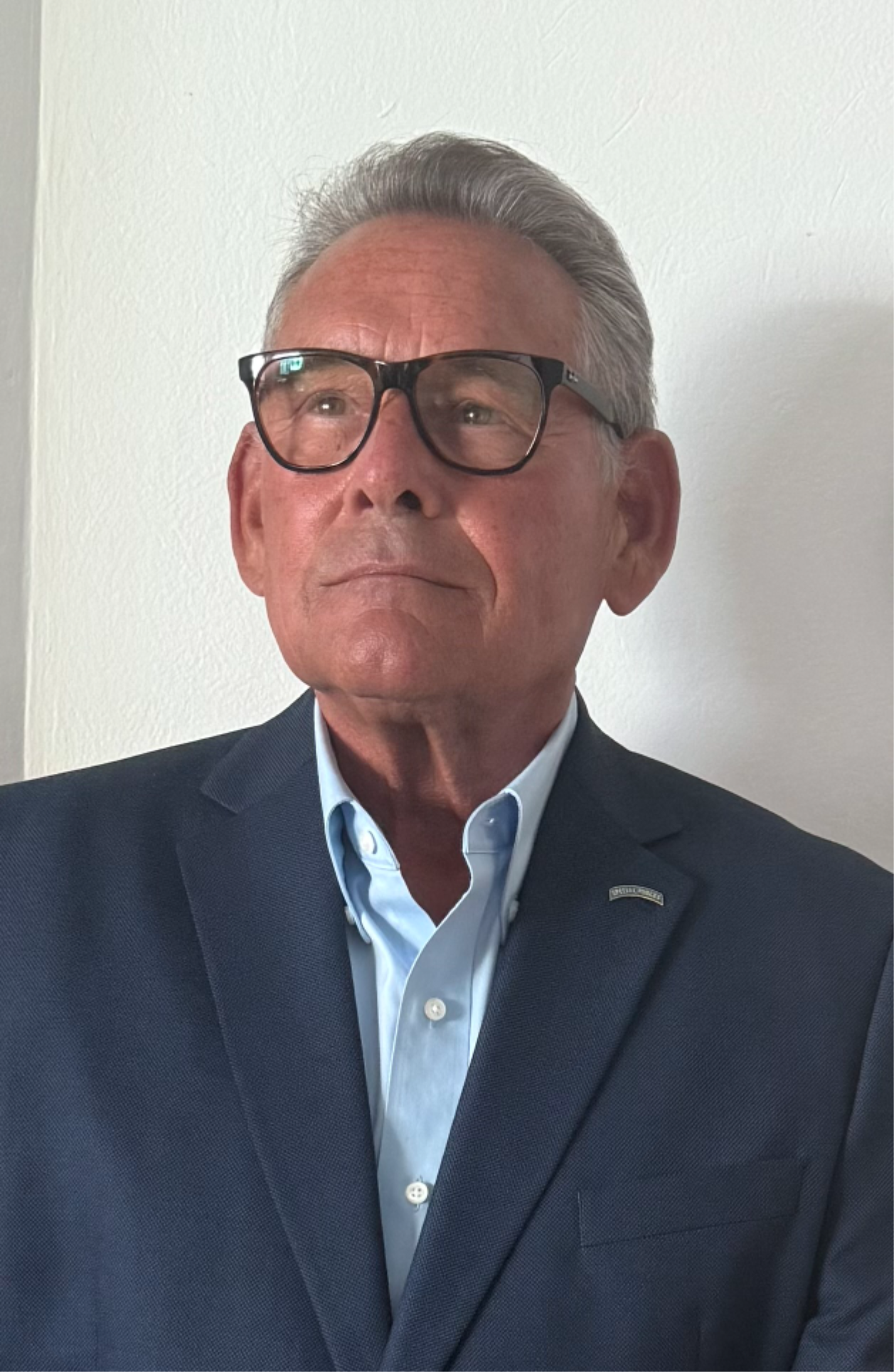
Robert Bruce Adolph, an author and qualified Military Strategist, is a retired senior US Army Special Forces soldier. He holds graduate degrees in both National Security Studies & International Affairs and was formally trained as a counterintelligence special agent. Robert also taught university level courses in American Government, US History, and World Politics. Following his retirement from the active military, he joined the UN, subsequently seeing service in Sierra Leone, Yemen, Iraq, Egypt, Israel/Palestine, Indonesia and more, culminating in the role of Chief of the Middle East and North Africa at UN Headquarters in New York. He is a member of The Steady State.
Founded in 2016, The Steady State is a nonprofit 501(c)(4) organization of more than 400 former senior national security professionals. Our membership includes former officials from the CIA, FBI, Department of State, Department of Defense, and Department of Homeland Security. Drawing on deep expertise across national security disciplines, including intelligence, diplomacy, military affairs, and law, we advocate for constitutional democracy, the rFounded ule of law, and the preservation of America’s national security institutions.

Powered by WPeMatico
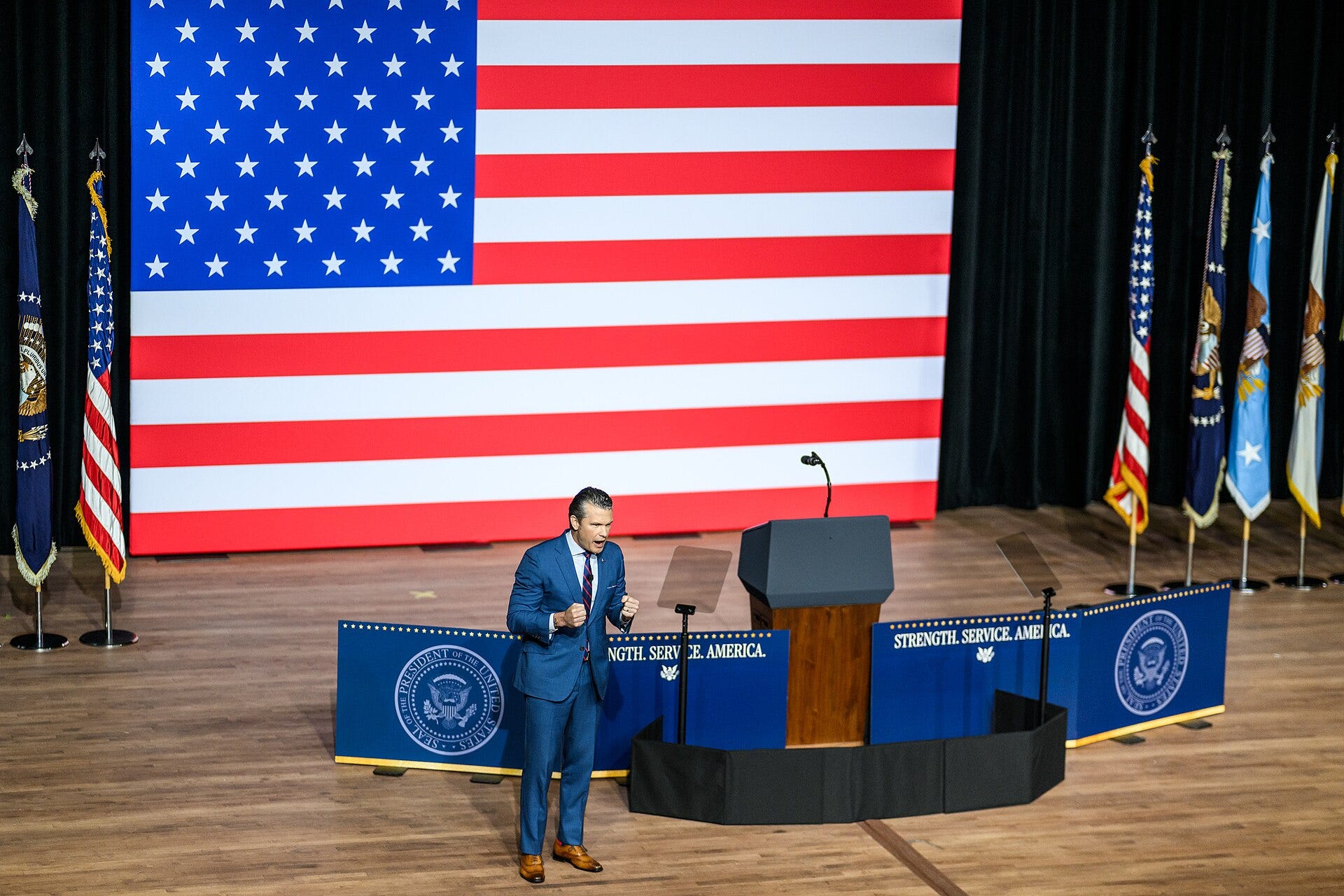
Pete Hegseth, Quantico, Va., Addressing Flag Officers

The US military has long been respected by American citizens for its professionalism, its independence from politics, and its commitment to include every American who wants to serve. These traditions are under assault. Once gone they will be hard to restore.

Secretary of Defense Hegseth came on board champing at the bit to remake the culture of the US military. He saw it as in the grip of the latest vogues in diversity and gender inclusion, to the detriment of traditional warrior virtues. The military needed to purge itself of these foreign viruses and get back to its roots: macho celebrations of strength, manliness, fitness, violence and tactical excellence. Armies are designed to kill people and blow things up, and we have gotten away from this core understanding.

Unfortunately this approach will exacerbate, not correct, the American military’s underlying problems. Recently the Council on Foreign Relations conducted a survey of historians to rank the top 10 greatest foreign policy successes and failures in our 250 year history. At the top of the failure list were #1, the Iraq War and #2, the Vietnam War. Certainly the war in Afghanistan also belongs on this list. The consistent cause of these failures has been the same: over-confidence in our strengths in technology, weaponry, and logistics; under-estimation of the commitment and resilience of our enemies.

History has not been kind to the commanders responsible for these campaigns. William Westmoreland in Vietnam, and Tommy Franks in Iraq, vie for the title of America’s most incompetent general. Westmoreland was convinced that the US could win by attrition and prioritized body counts as a way to judge progress; Franks focused on defeating Saddam’s military and failed to plan for the follow-on. Both thought American superiority in firepower was all that mattered. Behind each of them looms a Defense Secretary—Robert McNamara for Vietnam, Donald Rumsfeld for Iraq—in the grip of the same blindspots.

Today the United States is replicating these same mistakes in Iran. Great tactical skills and awesome capabilities are being squandered by leaders who failed to either define clear goals or understand the enemy. Despite all the historic evidence to the contrary, an air campaign is, by itself, expected to be decisive in achieving ambitious strategic aims.

The American military’s failures in Vietnam, Iraq and Afghanistan were not caused by the cultural shifts that Hegseth and Trump detest. Integrating African-Americans, women, gays and transgender soldiers into the force has been long and difficult, but there is no evidence that any of this has reduced readiness, lethality, or esprit de corps. Hegseth’s focus on undoing these shifts and the progress they represent is all about ensuring loyalty and pandering to the MAGA base—and perhaps to Hegseth’s reactionary religious convictions—not improving the military.

Hegseth is in fact reinforcing our strategic weaknesses by doubling down on stereotypes of what an effective military looks like. In and out of the military there are many who blame our defeats on weak-kneed civilians imposing restrictive rules of engagement. The story that ‘we were stabbed in the back’ has followed many military failures.

The Hegseth warrior image gains its strength from this myth. If only the military took the gloves off, stopped worrying about civilian casualties and winning hearts and minds and just went out and kicked butt, we would win. This is the thinking we now see at work in the Iran war.

The Hegseth warrior is all testosterone and no brains or morals. Hegseth has intervened in the military education system to prevent officers from attending the country’s top universities. He has prohibited them from going to professional conferences, like the prestigious Aspen Security Conference, claiming it “promotes the evil of globalism, disdain for our great country and hatred for the President of the United States.” He just fired the head of the Army’s chaplain service. His rhetoric is a never-ending bombast about inflicting maximum pain, bombing enemies back to the stone age, and asking for Jesus’s blessing to see all our bullets find their mark.

The American military has been tactically proficient but strategically and morally deficient. The United States badly needs more senior leaders equipped to think deeply about the country’s long-term goals and how to use our enormous wealth and power to achieve them in accordance with internationally-accepted norms. Unfortunately the President and his Secretary of Defense are in the process of getting rid of any soldier who thinks of war as something other than a video game. They are revamping military training and education to teach the same lessons. Several more years of this will result in lasting damage to the entire defense establishment.

The campaign against ‘wokeness’ has another purpose, to ensure loyalty. Women and minorities are automatically suspected of not being on the Trump train; witness Hegseth’s recent insistence on refusing promotion to four officers, two women and two African-Americans—the only officers that Hegseth singled out.

Hegseth is trying to destroy the idea that there might be honest disagreement or that military service might require questioning the judgment or legality of a course of action. When Senator Mark Kelly, retired fighter pilot and Space Shuttle commander, joined with other members of Congress in reminding soldiers that they have a duty not to obey illegal orders, the Pentagon tried to punish him by docking his pension—a petty action dismissed in court, but designed to send a warning to others. We will reward and punish you based on your loyalty to Donald Trump, not to the Constitution or the nation.

This paves the way for sycophancy. Soldiers who think independently are not welcome here. Such soldiers will see no chance for advancement and will leave, replaced by those willing to bend the knee.

It also paves the way for a military less willing to resist pressure to act improperly, both overseas and at home. The longer this continues, the easier it will be to carry out Donald Trump’s impulsive and incoherent wishes. Invade Greenland? Yes, sir! And the easier it will be to invoke the Insurrection Act and deploy active duty forces against the President’s internal enemies.

Adam Wasserman is a retired CIA analyst with experience on failing democracies in the former Soviet Union, the Middle East, and Southeast Asia. He served on the State Department Policy Planning Staff, the CIA Red Cell, and the National Security Council staff. He is a member of The Steady State.

Founded in 2016, The Steady State is a nonprofit 501(c)(4) organization of more than 400 former senior national security professionals. Our membership includes former officials from the CIA, FBI, Department of State, Department of Defense, and Department of Homeland Security. Drawing on deep expertise across national security disciplines, including intelligence, diplomacy, military affairs, and law, we advocate for constitutional democracy, the rule of law, and the preservation of America’s national security institutions.

Powered by WPeMatico
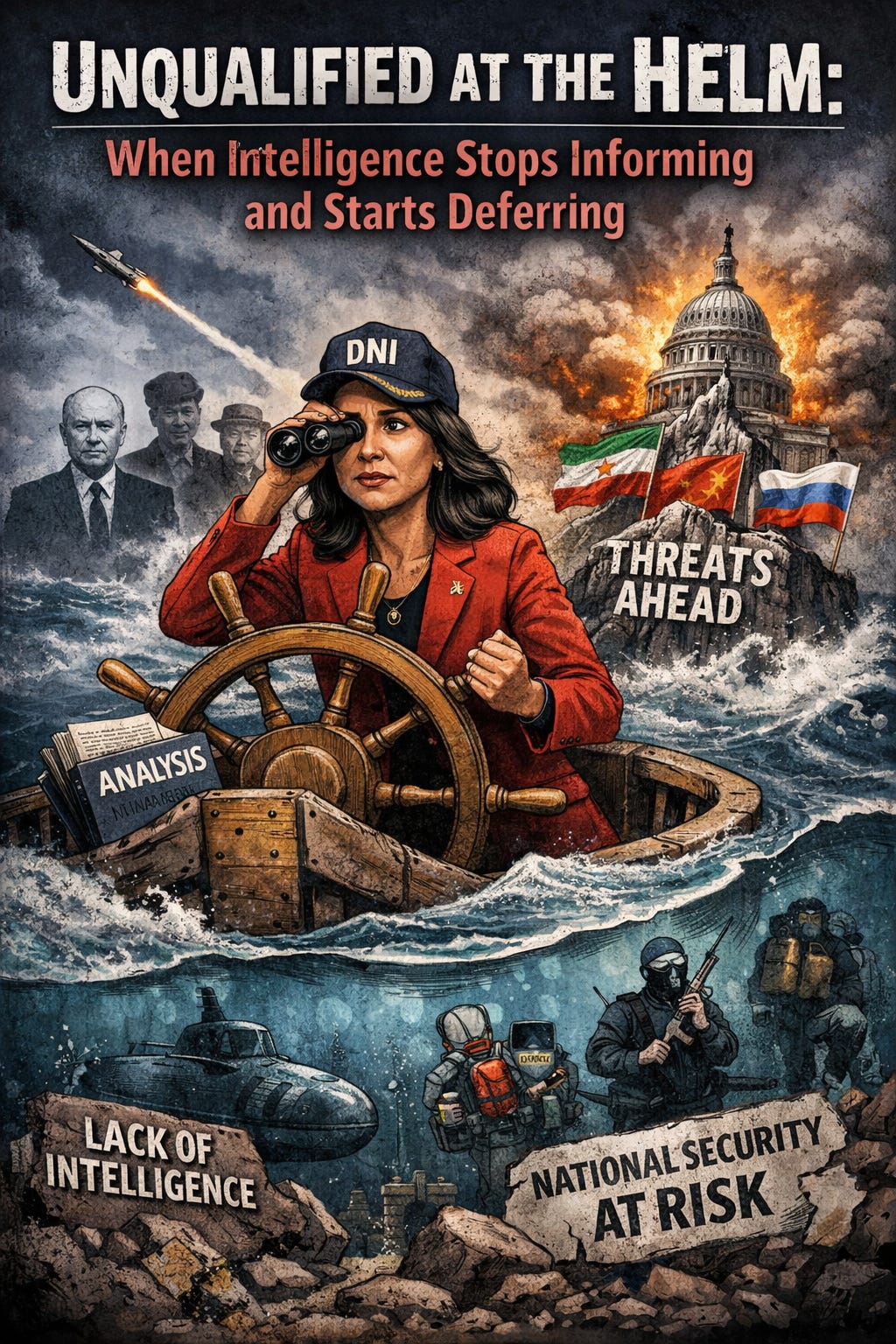
When intelligence stops informing power and starts deferring to it, it ceases to be intelligence at all—and becomes a liability that risks strategic blindness, policy failure, and war.

In a functioning democracy, intelligence exists to illuminate reality, not to mirror power. That principle is not aspirational; it is structural. The Office of the Director of National Intelligence (DNI) was created to ensure that objective, apolitical analysis reaches policymakers with clarity, independence, and integrity. When that function falters, the consequences are not theoretical; they are operational, tactical, and strategic—often immediate, and sometimes tragic.

Recent testimony by Tulsi Gabbard raises a fundamental concern: whether the DNI is fulfilling that mission at all. By declining to assess whether Iran poses an “imminent threat” and asserting that only Donald Trump can make that determination, the DNI did more than sidestep a question—she relinquished the core analytic responsibility of her office. This is not how the system is designed to work.

The DNI is not an extension of presidential judgment. The role exists precisely to inform that judgment—grounding it in evidence, context, and independent analysis. “Imminence” is not a political label. It is an analytic conclusion derived from intelligence collection, pattern recognition, and expert assessment. When that responsibility is deferred upward, intelligence ceases to function as a check on power and becomes an instrument of it. That shift is especially dangerous given the complexity of today’s global threat environment.

Professor Jiang Xueqin, a Chinese-Canadian educator, and others have noted that the strategic alignment among Iran, China, and Russia is not incidental—it is structural. Eurasian integration, energy control, and geographic chokepoints like the Strait of Hormuz form the backbone of a long-term competition that cannot be understood through isolated or reactive analysis. Iran is not just a regional actor; it is a connective node in a broader geopolitical architecture that links energy flows, financial systems, and military positioning.

We have already seen Iranian forces bolstered by Russian and Chinese technology.

Professor Xueqin posited that the war with Iran is also impacted by economic flow that comes from UAE, Saudi Arabia, and Qatar. If the supply chain from this Middle East sector is impacted, then the American economy is impacted. Understanding those inter-connecting systems requires exactly what the DNI appears to be abandoning: deep, integrative analysis.

The Steady State former intelligence professionals have raised alarms about the recent Annual Threat Assessment—pointing to its reliance on commercially available information, its lack of analytic depth, and its omission of critical threat domains ranging from domestic extremism to climate instability and global migration. These are not minor gaps. They are indicators of a diminished analytic enterprise.

The Steady State has gone further, warning that the document reads less like an intelligence product and more like a political one—shaped as much by omission as by inclusion. When key threats are excluded, and convenient narratives are emphasized, the result is not just incomplete, it is misleading.

This erosion of analytic rigor is compounded by a broader cultural shift. Discussions in recent forums by some of our retired members of the National Security Community have highlighted the growing influence of ideological framing. When strategic analysis is replaced by worldview-driven narratives, the risk is not just bias; it is blindness.

Blindness, in intelligence, is how wars begin. History offers a clear warning. From Vietnam to Iraq to Afghanistan, the United States has repeatedly entered conflicts where initial assumptions hardened into political commitments—commitments that then demanded validation, escalation, and, ultimately, prolonged entanglement.

In such an environment, the role of intelligence is not to justify decisions; it is to challenge them. That requires independence. It requires the willingness to assess threats, even when those assessments complicate political narratives. It requires the ability to connect disparate signals into a coherent picture of long-term risk. And above all, it requires leadership capable of exercising that responsibility.

Right now, that capability is in question.

When the DNI defers analytic judgment to the President, relies on shallow or incomplete data, and presides over a threat assessment that omits critical realities, the issue is not just performance—it is qualification. The position demands more than alignment with executive authority. It demands expertise, rigor, and the courage to speak with analytic clarity.

The stakes could not be higher. The partnership among Iran, China, and Russia, the fragility of global energy systems, the persistence of domestic and transnational threats are not problems that yield to simplified narratives or politically convenient omissions. They require a fully functioning Intelligence Community led by someone prepared to do the job as it was intended.

Intelligence must inform power—not defer to it. If that principle is lost, so too is one of the most critical safeguards of American national security.

Martha Duncan is a retired U.S. Department of Defense senior executive with 37 years of service, including 23 years as an officer in the U.S. Army Reserves, where she also served as Reserve Attache. She had three operational deployments to Panama, Bosnia, and Afghanistan. At DIA, she worked as a Latin American analyst for 11 years. A specialist in human intelligence (HUMINT), she is recognized for her leadership in intelligence operations, coalition-building, and enterprise-level policy development across the Defense Intelligence Agency (DIA), the U.S. Army, and the broader Intelligence Community. She grew up in Panama during the rise of Manuel Noriega and was instrumental in his capture.

Founded in 2016, The Steady State is a nonprofit 501(c)(4) organization of more than 400 former senior national security professionals. Our membership includes former officials from the CIA, FBI, Department of State, Department of Defense, and Department of Homeland Security. Drawing on deep expertise across national security disciplines, including intelligence, diplomacy, military affairs, and law, we advocate for constitutional democracy, the rule of law, and the preservation of America’s national security institutions.

Powered by WPeMatico
ICYMI: The United States is walking away from the alliance‑based, globally‑engaged foreign policy that defined the post‑WWII era. Ambassador Tom Shannon calls it a “counterrevolution” and it’s not an accident.

In the latest episode of The Steady State Sentinel, Lauren Anderson sits down with Ambassador Tom Shannon, one of the most senior diplomats of his generation, for a far‑reaching conversation about how U.S. foreign policy is being fundamentally rewritten, and what that might mean for our security, our values, and the next generation.

Shannon served as Under Secretary of State for Political Affairs, led the State Department during the Obama‑Trump transition, and spent 35 years as a Foreign Service Officer. He is now teaching at Princeton, where he watches Gen Z wrestle with the same questions that keep national security professionals up at night.

What follows is not a partisan take but a sober, inside account of a deliberate shift away from global engagement, and a warning about what gets left behind.

The Counterrevolution Is Real, and It’s Been Building for Decades

Shannon argues that the “revolution” in U.S. foreign policy happened after World War II, when America chose alliances, global governance, and engagement over isolation. That system lasted for nearly 70 years.

But Iraq, Afghanistan, the 2008 financial crisis, and COVID eroded public faith in foreign policy elites. What we are seeing now, from trade wars to ambassadorial vacancies to the gutting of USAID – is a counterrevolution: a return to the pre‑WWII model of “America first, America alone.”

“President Trump has been one of the most effective articulators of this kind of foreign policy,” Shannon says. “But the task before the American people today is to determine whether or not this is a correct path.”

Burning the Ships On Purpose

Shannon offers a great analogy: Hernán Cortés, upon landing in Mexico, burned his ships so his men could not turn back.

He believes the current administration is doing the same thing, systematically dismantling the structures and personnel that allowed the U.S. to be a global power, so that no future administration can easily reverse course.

“It’s not happenstance. It’s purposeful…they are determined that we’re going to burn our ships, that we are going to end the structures and the personnel who filled those structures that have allowed us to be global over time.”

Empty ambassadorships, defunded exchange programs, and the departure of regional experts are not bugs but features.

Power Without Purpose Is an Empty Vessel

Shannon is no pacifist. He understands the necessity of hard power. But he warns that lethality without values is a trap.

The magic of the United States, he says, has never been just its military. It has been its soft power: the Peace Corps, the International Visitor Leadership Program, scientific exchanges, and the quiet work of showing up in other people’s communities.

“Power without purpose, power without values or principle is an empty vessel… like quicksand once you step into it, it’s very hard to get out of.”

When the U.S. pulls back from that work, it convinces other nations that we are not reliable partners, only transactional actors.

What Gen Z Understands (That Elites Don’t)

Shannon has been teaching at Princeton for seven years. His students were all born after 9/11. They do not remember the attacks. They grew up watching Iraq, Afghanistan, the financial crisis, and COVID.

When they hear establishment figures talk about American purpose, Shannon says, it sounds like the adults in a Charlie Brown cartoon: wah, wah, wah, wah.

But here is what gives him hope: they are not fearful. They want a peaceful, connected world because they know conflict will find them anyway. And they understand they will inherit the world left to them.

“This rising generation is going to play a role in shaping the world they live in…it’s going to be a world of their making. That was not true for us.”

Expertise Cannot Be Backfilled Overnight

Anderson and Shannon both warn that stripping the State Department, FBI, and intelligence community of language and regional expertise leaves the United States dangerously vulnerable.

Shannon points to the empty ambassadorial posts in the Middle East, during an active war, as “pitiful.” Anderson notes that the FBI removed its Iranian expertise squad just before the U.S. struck Iran with Israel.

Shannon states: rebuilding what has been lost will take a half‑generation, if it is possible at all.

What Can Be Done and Why You Should Be Excited

Shannon ends on a surprising note of optimism.

He tells his students that there is no place to hide in this world. You can live in a cave with a goat, and the world will still find you. So you might as well understand it and help shape it.

He urges the next generation and anyone listening to be excited, not afraid. The current debate about America’s role in the world is not settled. And that means there is room to act.

“What a wonderful opportunity. What an incredible challenge. Knowing that what you do is going to have an influence that carries through the rest of this century.”

Listen and watch the full conversation below:

Powered by WPeMatico

There is good reason to think that, before the Iran war, Russia was close to the breaking point. Sanctions and low global oil prices were squeezing Russian revenues. Russian forces were making at best incremental gains on the Ukraine battlefield, at tremendous cost: well over 1000 casualties a day in 2025, according to the Center for Strategic and International Studies. The loss of Russian access to Starlink in February helped shift the initiative to Ukraine, which began to recapture territory.

According to Russian journalist Mikhail Zygar, Putin was planning a shake-up inside the Kremlin, to include dismissing his chief Ukraine negotiator. A new team would be needed if Putin wanted to change course on Ukraine.

But the Iran war has handed Putin a lifeline. Oil prices are way up, with oil routinely selling at over $100/barrel. To keep prices down the US has waived sanctions on Russian exports. Air defense missiles that could have gone to Ukraine are being used up to defend against Iranian attacks. The cost of the war—the Pentagon has reportedly proposed a defense supplemental of $200 billion—will make the US even more reluctant to support NATO.

Relations between the US and its allies, already strained, have been shredded by a war undertaken with no American consultation with key partners in Europe and Asia. These regions are being badly hurt by oil and gas shortages. These same allies are being publicly attacked by President Trump for refusing to help; Trump and Secretary of State Rubio are now openly talking about leaving NATO altogether.

Russia is ecstatic at seeing the US once again drawn into a Middle East adventure that squanders American resources and distracts it from countering Russia. America’s lengthy wars in Iraq and Afghanistan helped Putin immensely as he consolidated power and re-built Russia’s repressive systems in the first decades of the 21st century.

Putin’s long-game strategy in Ukraine has always been to count on the West’s internal divisions. He has calculated that the US and NATO will struggle to sustain a common front, and that the US will be paralyzed by disagreements between America-firsters and those wanting to counter Russia. Russia has done all it could to widen these fissures, from massive social media campaigns to hosting Tucker Carlson in Moscow. It has manipulated Victor Orban’s Hungary into being a constant obstacle to European support for Ukraine; Hungary is now blocking a $100 million loan to Ukraine on the pretext that Ukraine is not allowing Russian oil to flow through the Druzhba pipeline. Russia is reportedly providing Iran with targeting information to use against the US.

Curious things are happening inside Russia. Major cities, including Moscow and Petersburg, have recently been experiencing prolonged interruptions in basic internet services as the state tries to force users onto MAX, a single centralized service. Russia’s complacent middle class, which up to now has been carefully insulated from the impact of the war in Ukraine, is now feeling some discomfort. Muscovites are complaining they can’t get Uber rides or order take-out. Putin seems to judge that now is a critical moment to tighten his control and further restrict access to outside information.

Is this, as Zygar suggests, in preparation for changing course and abandoning Russia’s maximalist demands? In this case Putin may fear a backlash from the militant nationalists he has whipped into a frenzy over the past four years. Recently one of his fervent supporters, Ilya Remeslo, issued a public attack on Putin that went out to his 90,000 Telegram followers, one of the services now being disrupted: “Vladimir Putin is not a legitimate president. Vladimir Putin must resign and be ​brought to trial as a war criminal and a thief!” Two days later Remeslo found himself in Petersburg’s Psychiatric Hospital #3.

Or, could Putin, seeing NATO divided and distracted, instead be preparing for escalation? This would require a level of mobilization that Putin has so far tried to avoid: higher taxes, rationing, conscription—sacrifices that would not spare the urban middle class. Russia and the US have been negotiating fruitlessly about Ukraine for months. Russian commentators are now warning that negotiating with America is a dangerous waste of time, pointing to how the US used its negotiations with Iran to disguise its attack.

Putin has been preparing Russia for something like this. The movie “Mr. Nobody Against Putin,” which recently won an Oscar for best documentary, shows how since the beginning of the ‘special military operation’ in 2022, Russian school-children have been bombarded with ultra-nationalist propaganda. Mandatory programs teach Russians to fear the West and hate Ukrainians. They incessantly put before young people the example of World War II, the Great Patriotic War, a time of sacrifice to the Motherland. They prepare them for military service with practice marching, weapons training, and exposure to Ukraine veterans.

Putin is consumed by visions of his historical importance that depend on winning the Ukraine war and permanently returning Ukraine to its ‘rightful place’ in the Russian empire. Thanks to Donald Trump he may now see this as within reach.

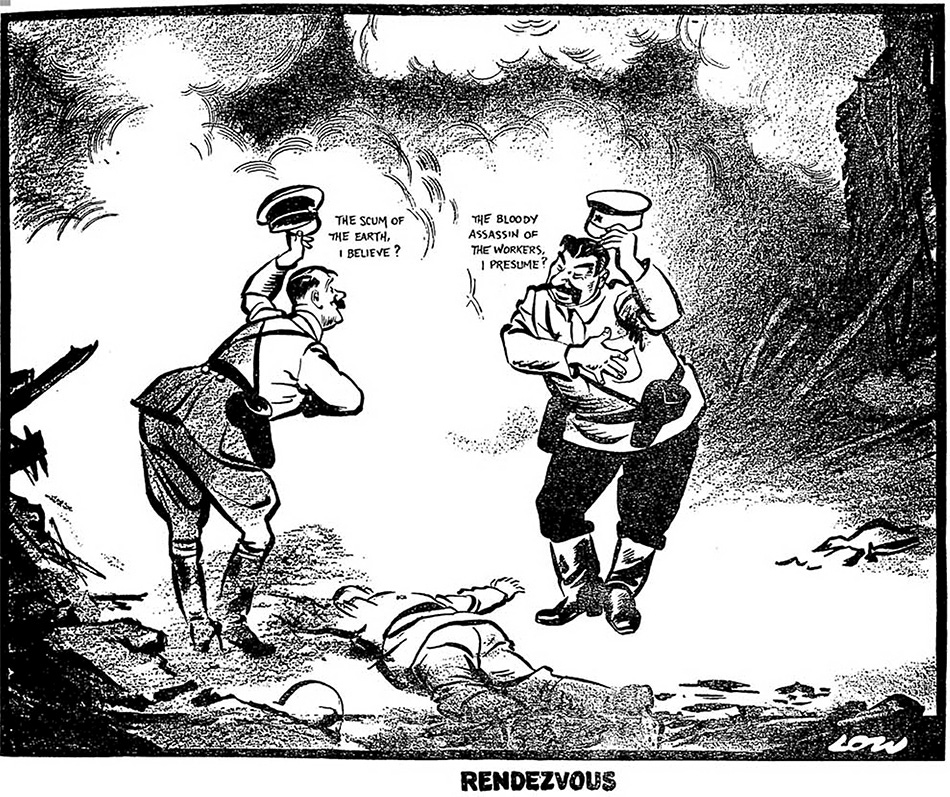
Trump and his close supporters, who have long despised Ukraine and looked up to Putin, may not be unhappy with this turn of events. Military adventurism, propaganda in schools, clamping down on dissent, and intimidating online critics are all in the Trump playbook. Putin is intent on controlling the outcome of parliamentary elections this fall, just as Trump is hoping to shape the midterms. The meeting of minds between two old enemies may not be as jarring as the infamous Hitler-Stalin rapprochement in 1939 that led to the Second World War. But it is equally shortsighted and morally bankrupt.

Adam Wasserman is a retired CIA analyst with experience on failing democracies in the former Soviet Union, the Middle East, and Southeast Asia. He served on the State Department Policy Planning Staff, the CIA Red Cell, and the National Security Council staff. He is a member of The Steady State.

Founded in 2016, The Steady State is a nonprofit 501(c)(4) organization of more than 400 former senior national security professionals. Our membership includes former officials from the CIA, FBI, Department of State, Department of Defense, and Department of Homeland Security. Drawing on deep expertise across national security disciplines, including intelligence, diplomacy, military affairs, and law, we advocate for constitutional democracy, the rule of law, and the preservation of America’s national security institutions.

Powered by WPeMatico

Washington, D.C. — The Steady State today filed a formal public comment strongly opposing the U.S. Department of Justice’s proposed rule, “Review of State Bar Complaints and Allegations Against Department of Justice Attorneys,” warning that the rule would undermine the rule of law, violate federal statute, and erode a core system of independent oversight. The filing can be found here.

The proposed rule would permit the Attorney General or his/her designee to intervene in, delay, and potentially override state bar disciplinary proceedings involving Department of Justice attorneys. In its filing, The Steady State concludes that the rule is contrary to longstanding federal law, exceeds the Department’s authority, and raises serious constitutional and federalism concerns.

“The integrity of our legal system depends on the principle that no one is above the law, including government attorneys,” said Steven Cash, Executive Director of The Steady State, and an attorney. “This proposed rule would create a mechanism for shielding Department of Justice attorneys from independent professional accountability. It is inconsistent with federal statute, and it is inconsistent with the basic expectations of a constitutional democracy.”

The Steady State’s comment emphasizes that Congress has already resolved this issue through 28 U.S.C. § 530B, which requires federal attorneys to comply with the same ethical rules and to be subject to the same disciplinary processes as all other attorneys. The proposed rule would depart from that requirement by allowing the Department to delay or interfere with state bar investigations, effectively creating a special regime for federal lawyers unavailable to any other member of the profession.

The filing further warns that the rule would intrude upon the authority of state courts, which have long held primary responsibility for regulating the legal profession. By seeking to influence or suspend state disciplinary proceedings, the Department risks disrupting a system that is both judicial in nature and essential to maintaining public trust in the administration of justice.

“Independent bar discipline is one of the last remaining safeguards ensuring that government lawyers adhere to their ethical obligations,” added Mary Kate Whalen, a Steady State member and former Transportation Security Agency (TSA) Senior Attorney. “Weakening that safeguard is not an administrative adjustment. It is a structural change that would diminish accountability at precisely the moment it is most needed.”

The Steady State also notes that the proposed rule comes amid broader efforts to weaken both internal and external oversight mechanisms within the Department of Justice. The filing cautions that, taken together, these developments risk creating an environment in which attorneys are discouraged from upholding their professional obligations or raising concerns about unlawful or unconstitutional conduct.

The Steady State urges the Department of Justice to withdraw the proposed rule in its entirety.

The Steady State is an organization of more than 400 former senior national security, intelligence, military, diplomatic, and law enforcement professionals committed to defending the Constitution, the rule of law, and democratic institutions.

Media Contact: [email protected]

Powered by WPeMatico

In this edition of the Sentinel podcast, host Lauren Anderson, former senior FBI executive, sits down with Ambassador Tom Shannon, one of the most experienced diplomats of his generation. They discuss what Shannon describes as a “counterrevolution” in U.S. foreign policy – a shift away from the post-WWII alliance-based system toward a more unilateral “America First” approach. Shannon warns that the erosion of institutional expertise at agencies like the State Department and FBI, and across the national security enterprise, will have long-term consequences for U.S. effectiveness abroad. He also emphasizes the enduring importance of soft power, including programs like the International Visitor Leadership Program (IVLP), in shaping global relations. The conversation closes with a look at how Gen Z students, including those Shannon teaches at Princeton, view America’s role in a chaotic world.

Thomas A Shannon Jr. is one of the United States’ most experienced career diplomats, with more than 35 years in the Foreign Service. He served as Under Secretary of State for Political Affairs, the State Department’s top career diplomat, and held senior roles across multiple administrations, including as U.S. Ambassador to Brazil and Assistant Secretary of State for Western Hemisphere Affairs. He also led the department through the transition between the Obama and Trump administrations. Now teaching at Princeton University, Shannon brings deep expertise in diplomacy, U.S. foreign policy, and America’s role in a rapidly changing world.

View the episode transcript here and watch for the full write-up on Thursday.

Powered by WPeMatico

Applying the “broken windows theory” to international relations seems appropriate in this moment of riotous disorder – at least to explain why the weakening of the legal and customary architecture of the system in the hands of autocrats has so profoundly impacted individuals caught up in violence that they never wanted .

The broken windows theory states that visible signs of disorder and misbehavior in an environment encourage further disorder and misbehavior, leading to serious crimes. The principle was developed to explain the decay of neighborhoods, but it is often applied to work and educational environments.

When I tell my students that the international order is anarchic, with no supreme entity that has enforcement capability, they are skeptical of the utility of treaties, norms, and other kinds of moral codes. When those tools are withdrawn, however, we see that they have more psychological power than we had imagined. That is why they are under attack by autocrats around the world.

A high point of post-World War II international cooperation and rules-based order might be marked by the “Responsibility to Protect” (R2P) doctrine, enshrined in the 2005 UN World Summit agreement. The nightmares of the 1990s – Rwanda and the Balkans – had given birth to the idea that an international obligation existed that was even more compelling than the absolute sovereignty of nation states to do whatever they wanted. R2P exhorts national leaders to never carry out atrocities against their own population; to protect parts of their population from other parts seeking to harm them; and if national governments fail then other governments should help populations in grave risk.

Within a decade, as the Syrian war metastasized and Russia regretted supporting international intervention in Libya, the R2P doctrine took a knee and has not recovered. Now, two decades later, aggressive war and attendant harm to civilian populations is happening in Ukraine, Gaza, Iran, Sudan, Lebanon, the Democratic Republic of the Congo, Afghanistan, and elsewhere. Patients dying in hospitals; homes reduced to rubble.

In this moment of extremis, governments in the United States, Russia, Israel and Pakistan, to name only a few, are not only ignoring the “R2P” doctrine, but going even further and degrading longer-established international humanitarian law. International humanitarian law exhortations to belligerent nations convey what they should not do: targeting medical and other civilian facilities, cutting off clean water and energy to entire populations, and harming prisoners of war. Now, all are now looking like checklists.

The Geneva Convention and Protocols date to 1949. While there has never been an enforcement mechanism, they were observed more carefully in the past. What has changed is the concept of obedience to norms which grew out of the horror of World Wars I and II. Those in power in the U.S. are joining what we used to call pariah states in arguing that these rules are against the national interest, in the process affording the citizens of other nations as much attention as players give to tiny plastic pieces in the game of “Risk.”

Maybe it’s my years of living overseas as a diplomat, in war zones and countries emerging from conflict, but I am aghast every single day that a war of choice is waged in my name. Unanswerable autocrats consistently make poor choices with which the rest of us must live. War impoverishes this and future generations worldwide. It is not an effective counter-terrorism tool, but instead generates new adherents for extremist indoctrination. It degrades the environment and kills those most vulnerable to ruptures of electricity, food supplies, and clean water.

The broken windows theory posits that when someone is seen breaking the rules, the rules suffer and more destruction follows. Indeed, the people living amongst shattered glass also suffer, beyond the capacity of many of us to understand. Beset by negative reports, we are supposed to lose focus and care less. Those of us living in peace need to push back against the normalization of unchecked and illegal aggression by autocrats, and argue for the rules. Incredibly, those treaties, norms, and codes had the power to keep people alive.

Annie Pforzheimer is a retired senior Foreign Service Officer who served in the State Department for thirty years, including in Afghanistan, Colombia, South Africa, and El Salvador. She is an adjunct professor of international relations at the City University of New York and a member of The Steady State.

Founded in 2016, The Steady State is a nonprofit 501(c)(4) organization of more than 400 former senior national security professionals. Our membership includes former officials from the CIA, FBI, Department of State, Department of Defense, and Department of Homeland Security. Drawing on deep expertise across national security disciplines, including intelligence, diplomacy, military affairs, and law, we advocate for constitutional democracy, the rule of law, and the preservation of America’s national security institutions.

Powered by WPeMatico

Since the Trump administration launched Operation Epic Fury on February 28, 2026, the public has been subjected to a torrent of misinformation, disinformation, and conflicting accounts regarding everything about the action, from its motives to who is responsible for what. A good term for the way information has been managed in Epic Fury is “gaslighting.”

Gaslighting, a form of psychological manipulation where the perpetrator attempts to make the victim doubt their memory, perception, or sanity, has emerged as a significant term in contemporary discourse and seems to be a tool of choice in Trump’s authoritarian playbook as he increasingly employs the technique to sway public opinion, manipulate narratives, and consolidate power. The term comes from the 1938 play ‘Gas Light,” and its film adaptations, in which a husband manipulates a wife into believing that she is losing her mind by subtly altering elements of their environment and then denying the changes when confronted. In politics, gaslighting involves deliberately distorting facts, denying reality, and creating false narratives to disorient the public. In both of his terms, we’ve seen Trump use these tactics to create confusion and manipulate reality. Gaslighting has been in full-speed-ahead mode since the US launched in Epic Fury.

During Trump’s first term in office, he frequently teased pulling out of NATO, and since his second inauguration, relations with our European allies have been strained by his erratic tariff policies and his threat to ‘take’ Greenland from Denmark. Then, there was his failure to notify NATO allies in advance of the launch of Epic Fury. The attack came as no surprise, given the buildup of US naval forces in the Gulf prior to the attack, but there was no official notice of the start of hostilities to enable our allies to protect their installations and embassies.

Once the fighting started, and the Iranians closed the Strait of Hormuz, Trump then demanded the allies come to our support, and expressed anger when, one by one, they rebuffed him. Ignored during his outburst of anger, which included a threat to pull the US out of NATO, was were his remarks in January, dismissing the sacrifices of NATO and other allies in their support of the US in Operation Enduring Freedom (OEF) in Afghanistan, which began on October 7, 2001, and lasted for two decades. In public remarks about NATO in January of this year, Trump said that the US had never needed its NATO allies and that allied troops had stayed “a little off the front lines” in Afghanistan. Statistics available from official US sources on OEF show the remarks to be misinformation at best, and outright lies at worst.

According to a White House web page dated October 7, 2002, one year after the start of OEF, 27 coalition countries had forces in Afghanistan, totaling 5,000. The US had 9,000 troops on the ground. During that first year, coalition nations deployed more than 14,000 troops in support of OEF, and while no numbers were given, it was reported that coalition forces also suffered deaths and injuries in support of OEF. Coalition partners provided a wide range of combat, logistics, and training support to OEF, including special operations force deployments.

NATO allies participated in combat operations from the start of OEF and also provided logistical and intelligence support.

The illustration below shows the organization of coalition forces during OEF.

unknown.jpg

Organization of OEF Forces (Courtesy of CENTCOM)

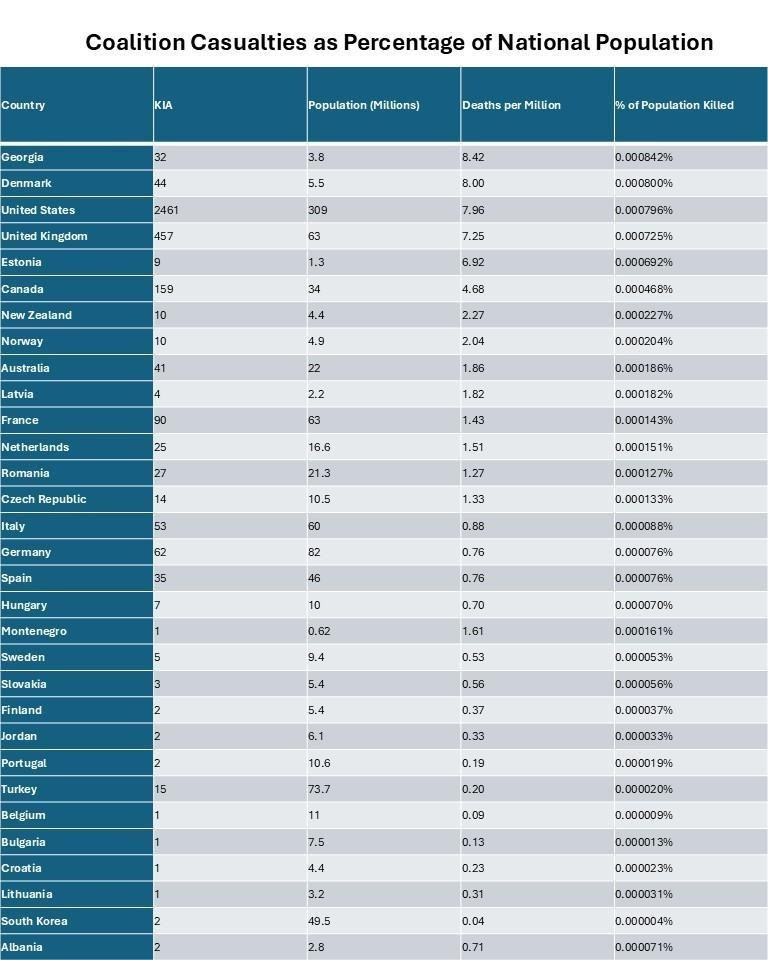
The following chart presents coalition military fatalities in the Afghanistan War (Operation Enduring Freedom/ISAF) relative to each contributing nation’s population. Values include total Killed in Action, national population (in millions), deaths per million population, and the equivalent percentage of national population. Nations with smaller populations and substantial combat deployments—such as Georgia, Denmark, Estonia, the United States, and the United Kingdom—show the highest per-capita fatality rates. Countries with limited combat roles or larger populations show correspondingly lower per-capita rates.

unknown.jpg

What these charts show is the gaslighting tactic of outright denial of verifiable facts, creating an environment where truth becomes subjective, and we are left questioning the validity of established information. The deliberate distortion of facts and denial of reality threatens the very concept of objective truth. When political leaders manipulate information to suit their agenda, the line between truth and lies blurs, undermining our ability to make informed decisions. It also weakens the foundations of democratic governance.

That this situation has security implications for all of us is undeniable. One has but to look at the current cost of a gallon of regular gasoline. Gaslighting is not the only fault to be found with the way the administration has handled Epic Fury, but as the refusal of our NATO allies to be pulled into the quagmire illustrates, it certainly imposes its own costs.

Much of the damage done will be hard to undo. Some of it is permanent. Our relationship with our NATO allies, for example, which has endured for over 75 years, will probably never be the same again, as they form new partnerships to compensate for America’s vacillating resolve from election to election. The question, though, is how will we survive? Or will we, like the boy who cried ‘wolf’ too many times, be eaten by that wolf?

Charles A. Ray served 20 years in the U.S. Army, including two tours in Vietnam. He retired as a senior US diplomat, serving 30 years in the U.S. Foreign Service, with assignments as ambassador to the Kingdom of Cambodia and the Republic of Zimbabwe, and was the first American consul general in Ho Chi Minh City, Vietnam. He also served in senior positions with the Department of Defense and is a member of The Steady State.

Founded in 2016, The Steady State is a nonprofit 501(c)(4) organization of more than 400 former senior national security professionals. Our membership includes former officials from the CIA, FBI, Department of State, Department of Defense, and Department of Homeland Security. Drawing on deep expertise across national security disciplines, including intelligence, diplomacy, military affairs, and law, we advocate for constitutional democracy, the rule of law, and the preservation of America’s national security institutions.

Powered by WPeMatico
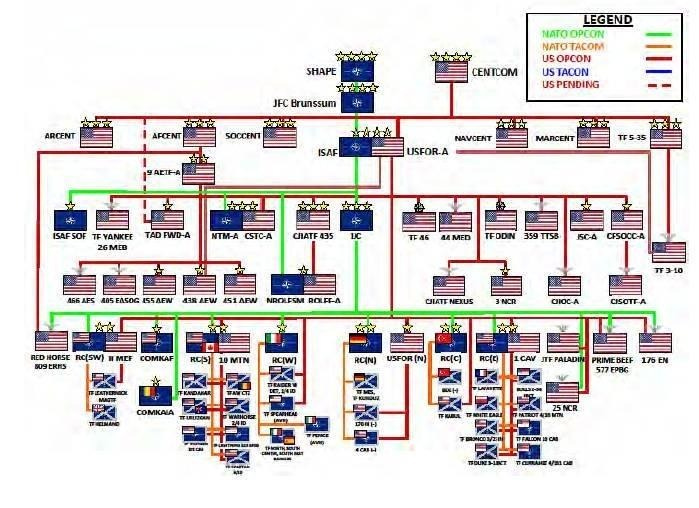
Photo by Engin_Akyurt

Welcome to The Steady State’s Weekly Digest, a compilation of the week’s Steady State publications. Catch up on what you missed or dive deeper into the issues shaping our moment.

Threatening War Crimes: Has Trump Finally Crossed the Line? by| Charles A. Ray

Donald Trump’s threats to “destroy” Iran’s energy structure, if carried out, is a potential war crime, implicating not only the president but all who carry out his mission.

Reckless Power: Steering America Toward a Deeper Middle East Quagmire by Bill Piekney

“Ours are the unequalled machines of war, a military superiority that in the hands of an unbalanced president and a hormonal defense secretary are just begging to be used.”

The Ice Gulag-Power, Surveillance, and Fear Undermine Our Democracy: Push Back by James Petrila

“Because the structure of the “Ice Gulag” is currently supported by all three branches of the Government, opposition must target all three aspects: apprehension, detention, and removal.”

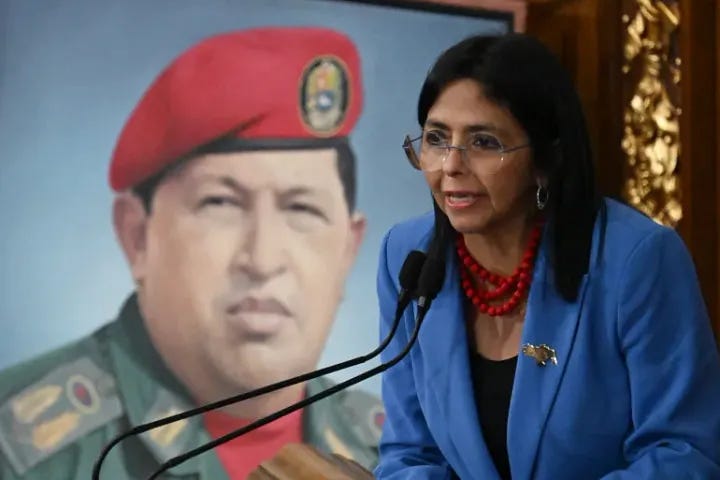
From Caracas to Tehran: The Same Failed Playbook by Brian R. Naranjo

Autocrats start wars for no better reason than consolidating their power at home, making follow-up incoherent. Donald Trump is no exception.

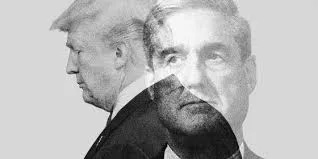
Robert Mueller: A Hero Remembered, A Presidency Revealed by Mike Mozur

These many strands, taken together, leave numerous unanswered questions that linger from the facts uncovered by Mueller’s team’s investigation and 2019 report. As for obstruction of justice, Trump 47 offers new examples with each passing week, even today.

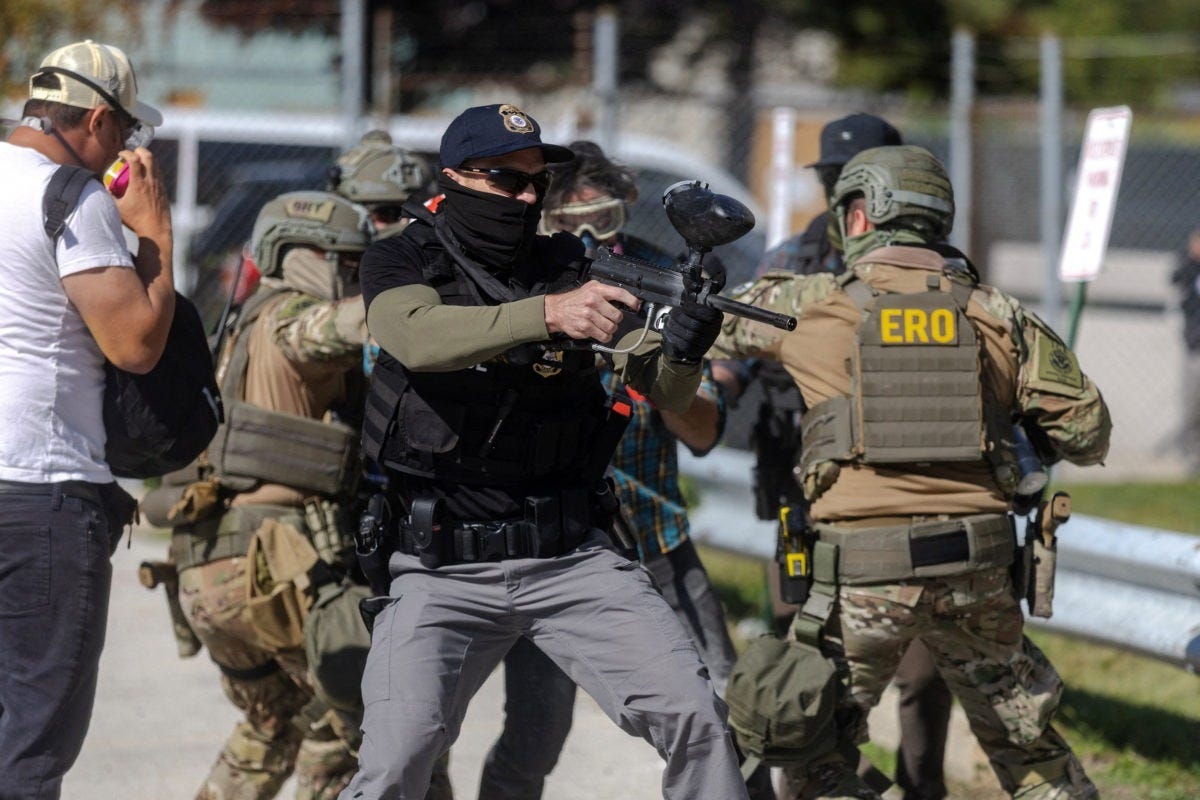
DHS- ICE: The Making of a Paramilitary Force Plain Sight by Ken Syring

If you wanted to design a hiring and training system that would produce the most psychologically volatile, constitutionally illiterate federal law enforcement officers possible, it would look almost exactly like what the Department of Homeland Security is building today.

Rule of Law vs. Rule of One by Martha Duncan

This was a moment in recent American life that should give us pause, not only because it was crass personal and political rhetoric, but because it revealed a collision between two fundamentally different visions of power.

Why a Superpower Finds Itself Alone by Amb. (ret.) Bonnie D. Jenkin

If we fail to rebuild international respect, credibility, and partnership, we will be treated as a rogue national and inconstant ally, which will only benefit America’s adversaries.

Founded in 2016, The Steady State is a nonprofit 501(c)(4) organization of more than 400 former senior national security professionals. Our membership includes former officials from the CIA, FBI, Department of State, Department of Defense, and Department of Homeland Security. Drawing on deep expertise across national security disciplines, including intelligence, diplomacy, military affairs, and law, we advocate for constitutional democracy, the rule of law, and the preservation of America’s national security institutions.

Powered by WPeMatico