
ICYMI: “Let’s Kill All the Lawyers” – Mark Zaid on Whistleblowers, Clearance Wars, and the Rule of Law Under Fire
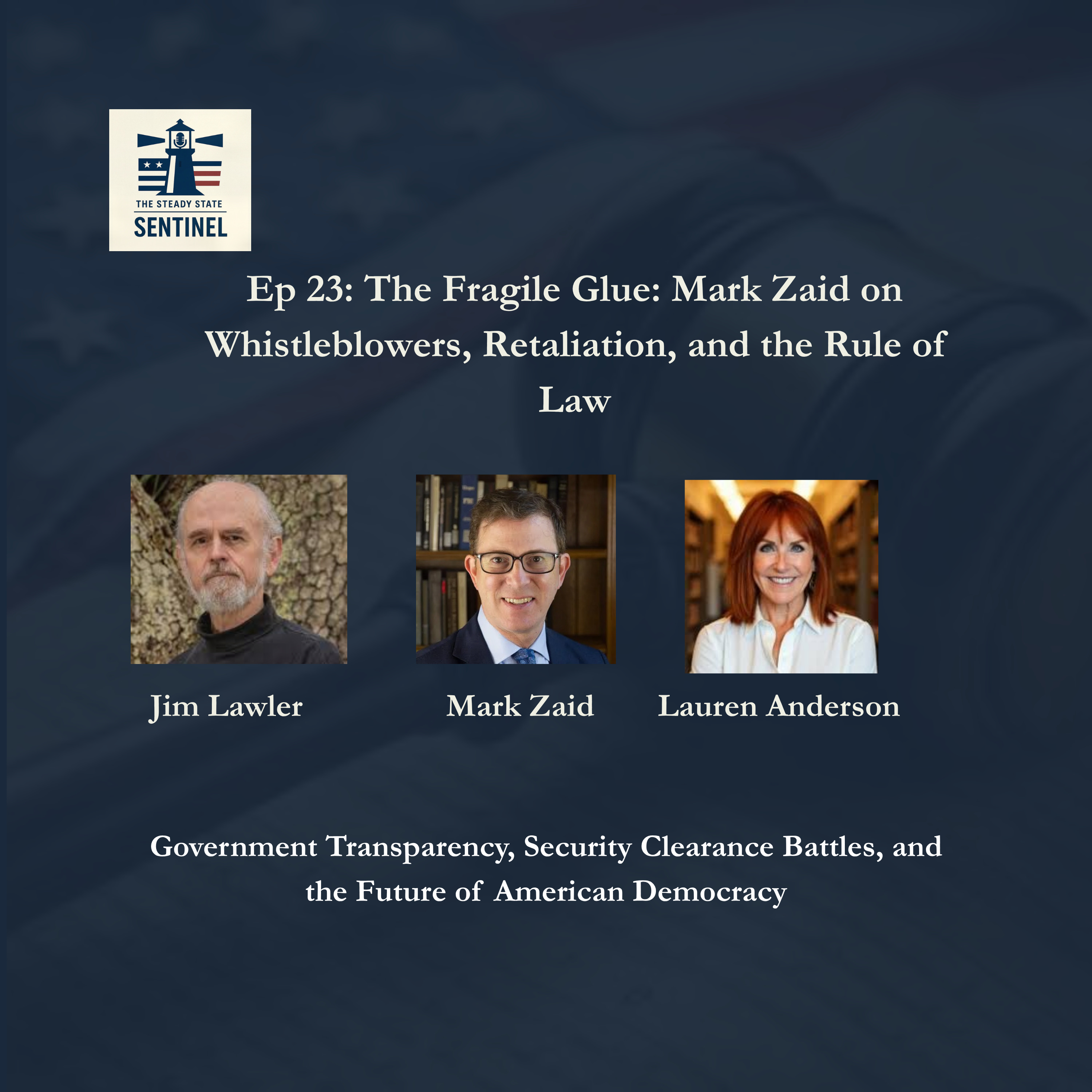
What happens when the executive branch starts stripping security clearances from private attorneys who represent whistleblowers? Mark Zaid knows firsthand, because Donald Trump put him on a list with Kamala Harris, Liz Cheney, and Joe Biden (among others). In this episode, two former intelligence officers sit down with one of Washington’s most fearless national security lawyers to talk about government secrecy, the difference between a whistleblower and a leaker, and why the judiciary is now the last line of defense.
In this edition of The Steady State Sentinel, co‑hosts Jim Lawler (former CIA officer) and Lauren Anderson (former FBI special agent) welcome Mark S. Zaid, a Washington, D.C. attorney who has spent three decades representing federal employees, intelligence officers, and whistleblowers in some of the country’s most sensitive national security cases.
Zaid founded the James Madison Project in 1998 to reduce government secrecy and promote the Freedom of Information Act. He co‑founded Whistleblower Aid in 2017 to give government employees a lawful path to report wrongdoing without leaking classified information. He was a member of the legal team for the whistleblower whose complaint triggered Donald Trump’s first impeachment. He sued Libya on behalf of Pan Am Flight 103 victims (winning a $2.7 billion settlement) and represented victims of anomalous health incidents, better known as Havana syndrome.
Here is what you need to know from a conversation about trust, retaliation, and the fragility of American democracy;
FOIA Then and Now: More Information, But Slower Than Ever
Zaid has been filing FOIA requests since before the internet. He says technology has been a double‑edged sword.
On one hand, emails and text messages can now be searched and preserved. On the other hand, the sheer volume of electronic records has overwhelmed agencies. Government officials using personal devices for work, whether Hillary Clinton’s email server or Trump aides using private phones, has created a nightmare for transparency.
“The biggest problem is lack of resources,” Zaid says. “There’s not enough money put into an agency’s FOIA program to hire proper staff or purchase proper equipment. The time frame for accessing information has lengthened significantly. I used to tell people we’d resolve a FOIA lawsuit within a year. Now it could be years and years and years.”
Whistleblower vs. Leaker: The Line That Matters
Zaid draws a sharp distinction that the public often blurs.
A leaker, in Washington shorthand, is someone who discloses classified information , what the Espionage Act calls “national defense information.” A whistleblower follows lawful procedures to report wrongdoing to appropriate oversight authorities without breaking the law.
“Ed Snowden to many would be viewed as a whistleblower. But by revealing classified information, under law he’s not a whistleblower. He has no protection whatsoever.”
Zaid helped create Whistleblower Aid to prevent another Snowden. If a government employee comes to him with concerns, he navigates the system to bring those concerns to the right authorities, up to the line, but never across it.
“We don’t want a 29‑year‑old who has barely worked in the federal government to use his own ideological view to just decide, ‘This is what I’m going to do.’”
Snowden took millions of documents, far more than he could have read. He leaked lawful programs, including surveillance of Angela Merkel, which damaged national security and relationships with allies. That, Zaid says, is not whistleblowing.
“I Found Out from the New York Post That the President Was Revoking My Clearance”
In February 2025, Zaid learned from a newspaper that Donald Trump was revoking his security clearance. It took weeks for the government to figure out how to do it. He sued in May. A judge ruled in his favor in December 2025, and he got his clearance back in January 2026. The government has appealed; oral arguments are scheduled for May.
For nine months, Zaid could not represent clients on any classified matter, including two to three dozen victims of Havana syndrome, most of whom are CIA personnel.
“I was being punished like everyone else.” But the public knows who Kamala Harris is, who Joe Biden is, who Liz Cheney is. They get to my name and say, ‘Who the hell is Zaid?’”
The administration’s executive order had stripped clearances from the 51 signatories of the Hunter Biden letter – many of whom had already retired and didn’t even have clearances anymore. Zaid was added weeks later. Why? He was the lawyer for the first impeachment whistleblower.
“Shakespeare wrote ‘let’s kill all the lawyers’, that’s actually a compliment. The lawyers needed to die because they stood in the way of the opponent who wanted to overthrow the king. They need to get rid of us because we uphold the rule of law.”
The Erosion of Norms – and the Fragility of Trust
Zaid distinguishes the second Trump administration from the first. In the first, career professionals like James Mattis would “put the kibosh” on extreme measures. In the second, those guardrails are gone.
“We have really seen how fragile our democracy is. The glue that holds the rule of law together is a water‑erasable marker. It is easy to erase.”
Congress has largely disappeared as a check. The executive branch has made retaliation personal. But the judiciary, including Trump‑appointed judges, has consistently ruled against the administration on due process issues.
That is where Zaid places his hope.
Is It Dangerous to Represent Clients Who Challenge the Executive Branch?
During the first Trump impeachment, Zaid received death threats. The FBI, which he sues all the time, investigated and prosecuted a man who threatened his life. Rush Limbaugh mentioning his name would spike the threats.
In the second administration, the volume of threats has dropped. Zaid thinks it’s because the administration feels it has won and doesn’t need to rally the base against him anymore.
But he is more concerned about his clients.
“I’ve had cases where we kept my involvement hidden because we were worried the client would be retaliated against just because I was the lawyer. I’ve actually told prospective clients: maybe you don’t want to hire me.”
He represents FBI agents who have been fired, and also current employees still working inside the government, watching and documenting, waiting for their line to be crossed.
What He Tells His Students
Zaid teaches at Johns Hopkins University. His students are entering a profession where political retaliation is now a real risk.
“This is a great time to be in law school, to watch how the Constitution actually works or doesn’t work. You can strengthen the system later.”
He advises government employees to decide where their line is – the legal line and the ethical line. Some choose to stay inside to be a voice of reason. Others are documenting everything, waiting for a Democratic Congress in 2027 that might have the power to act.
“I have quite a number of whistleblower clients inside the administration that no one knows about. They haven’t gotten to their line yet.”
What Gives Him Hope
Lauren Anderson asks the episode question: what gives you hope?
Zaid’s answer is immediate and clear.
“The judiciary. The Supreme Court has upheld the rule of law, especially on due process issues. To see judges appointed by President Trump rule against him, that gives me hope. The rule of law still holds.”
Without that, he says, he would be powerless.
“What else am I going to do if I couldn’t count on that? When I see the executive branch do things wrong, illegal, or unethical, I can go to the courts. That is really hopeful.”
Listen and Watch the full Podcast Here:
Founded in 2016, The Steady State is a nonprofit 501(c)(4) organization of more than 400 former senior national security professionals. Our membership includes former officials from the CIA, FBI, Department of State, Department of Defense, and Department of Homeland Security. Drawing on deep expertise across national security disciplines, including intelligence, diplomacy, military affairs, and law, we advocate for constitutional democracy, the rule of law, and the preservation of America’s national security institutions.
Powered by WPeMatico