
The Missing Institution in America’s Democratic Crisis
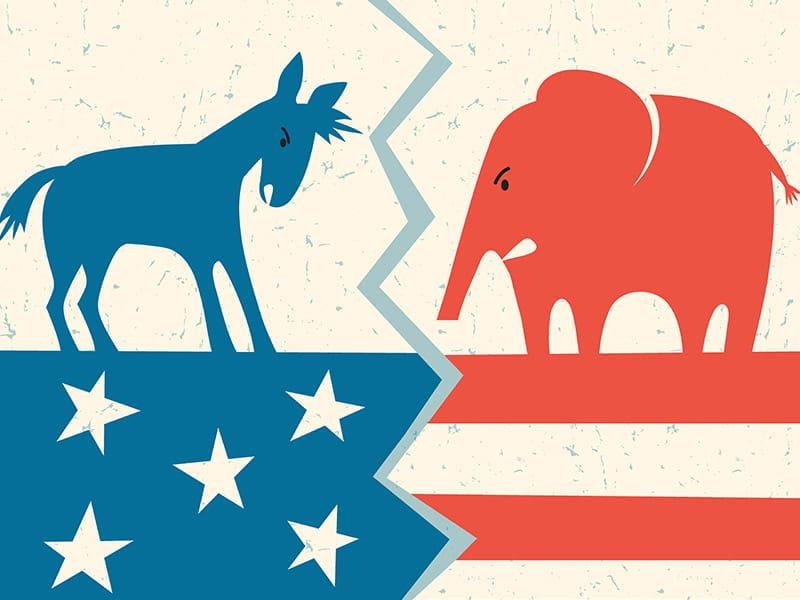
Rebuilding democracy requires rebuilding the parties that make democratic competition possible.
America’s democratic crisis is not only about polarization or personalities. It is also about the slow deterioration of its political parties. Unlimited money, technological disruption, populism, and declining public trust have hollowed out the institutions that translate citizens’ voices into effective governance.
GOP and Democratic Party Problems
Most observers would agree that America’s two main political parties have serious problems. This link between the American public and its government is weak, undermining democracy, rule of law, and basic governance. The GOP is on the cusp of being little more than a Trumpian cult of personality that would be at home in North Korea. Moreover, much of the GOP appears to have abandoned the key tenets of democracy — the willingness to relinquish power after an election loss and accepting the legitimacy of opposing parties. In contrast, the Democratic Party often exists as only a label for a loose coalition of divergent groups and philosophies. Unifying only against a declining 80-year-old lame duck is not a prescription for furthering or strengthening our democracy. It seems to be a party afraid of its own shadow, as evidenced by the inability to conduct a coherent after-action review of the 2024 election.
Pol-Sci 101 – Democracy Needs Parties
Most of the readers here probably took Political Science 101 years or decades ago. That course would have taught that political parties are fundamental to democratic governance. They organize people of similar political interests and views, serve as a crucial bridge between citizens and their government, and translate democratic will into actionable policy. The link between ordinary citizens and the machinery of government rarely happens by accident — parties are that link. Beyond elections and campaigns, parties also develop sets of policies that are supposed to translate democratic will into actionable policy to be carried out by government agencies. While the founding fathers initially opposed parties or organized factions, they quickly adopted them when the time came to develop and execute the actual “meat and potatoes” of governance. Every other democracy has them, as they have become an essential part of political mobilization and governance since the beginning of the 19th century. Even authoritarian and totalitarian countries have them, albeit typically limited to one.
The Steady State is a non-partisan organization committed to democracy and the rule of law and avoids commenting on the Republican (GOP) and Democratic policies. Yet the health of political parties is inextricably linked to the health of democracy itself. Parties are deeply embedded in the political system, but their weaknesses are too often dismissed as a mere reflection of larger societal ailments. Strengthening political parties is a necessary component of reconstituting a functioning democracy in the US.
Unrestricted and Unaccountable Campaign Finance
A fundamental problem is that as a society we have not found a way to preserve a democracy that is drowning in massive, largely unaccountable, private funding. Power is now concentrated in the hands of a narrow group of individuals pursuing narrow interests. While well-intentioned, the limitations on large donations to parties enacted in the 2002 McCain-Feingold bill, combined with the 2010 Supreme Court “Citizens United” ruling (along with several campaign finance rulings), accelerated a major shift away from how political campaigns are funded and how power is gained, with parties on the losing end of both trends.
Falling Behind the Technological Revolution
Modern political parties were largely conceived and shaped in the 20th century, well before the internet and social media. Neither party has found a sustained way to cope with the ongoing technological revolution and its associated social change. Both parties have enjoyed temporary adaptation for a cycle or two, but this is inadequate for sustained party development. More fundamentally, neither party has grappled seriously with technology’s impact on how citizens receive information, form opinions, and organize themselves.
Emergence of Diverse and Divergent Issues and Views
Beginning in the 1960s, issues beyond straightforward economics or war and peace emerged as increasingly salient: civil rights, women’s rights, environmentalism, the role of religion, abortion, immigration, accelerating cultural and technological change, etc. These topics cut across the traditional GOP-Democratic divide, straining both parties. For example, the wholesale switch of segregationist “Dixiecrats” to the GOP and that party’s increasing exploitation of race is illustrative.
The different party response points to some of the dilemmas today. The Democratic Party largely embraced a change-oriented and inclusive approach, which has rendered the party seemingly listless, with too many factions pursuing separate agendas without a focused collective program. In contrast, the GOP decided to exploit the divisions over these issues, purposely stoking antagonisms across society, focusing on various identity themes and since 2016 embracing an openly nostalgic and reactionary “Make America Great Again” approach, harkening back to a pre-1960’s era. Over the past 30 years, this has led to a party that increasingly views its opponents as enemies.
The Rise of Populism Undermines Political Parties
Neither party has fully reckoned with the consequences of the 2008-2009 global financial crisis or the unsatisfying outcomes of the post 9/11 wars. The policy response of both parties to the financial crisis prioritized preserving the existing financial system and avoiding punishment for business leaders. Whether a more thorough economic overhaul was wise or specific laws were broken is less important; the average citizen feels otherwise. Many feel they “got the shaft,” while CEOs just got off. This perception has been a major driver of populism, the belief that the system is rigged to benefit the unaccountable rich and powerful. At the same time, the American public began to sour on various post 9/11 wars, which dragged on without resolution. The wave of unity and patriotism after 9/11 has dissipated into general distrust of leadership and frustration with the world not bending to our will.
Rebuilding Democracy Requires Stronger Parties
Political parties occupy an institutional grey zone, yet they are vital to democratic health. Addressing what has weakened them must be on America’s agenda. This is not a partisan concern. A healthy democracy requires at least two competitive parties that mutually accept each other’s legitimacy and respect their supporters. Without that foundation, the machinery of democratic self-governance cannot function. The question of how to rebuild stronger parties is not a question for partisans alone; it is a question for anyone who believes democracy is worth preserving
Harry Hannah retired after four decades of experience in the Intelligence Community. He retired from the CIA in 2018. About half that time was focused on analyzing the capability of multiple foreign militaries in direct support of US military planning and operations and national level decision making. He is a member of The Steady State.
Founded in 2016, The Steady State is a nonprofit 501(c)(4) organization of more than 400 former senior national security professionals. Our membership includes former officials from the CIA, FBI, Department of State, Department of Defense, and Department of Homeland Security. Drawing on deep expertise across national security disciplines, including intelligence, diplomacy, military affairs, and law, we advocate for constitutional democracy, the rule of law, and the preservation of America’s national security institutions.
Powered by WPeMatico