
The Iran War: A Thumb-Nail Strategy Analysis
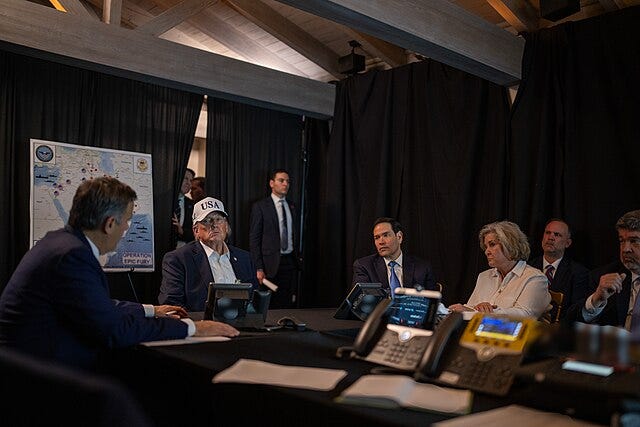
President Donald J. Trump oversees Operation Epic Fury at Mar-a-Lago, Palm Beach, FL
_(55121599389).jpg)
National-level warfighting strategies are defined by the objectives established by the commander-in-chief, in this case, Donald Trump. The end state desired, assuming the chief executive of the nation did not misspeak, appears to number three: (1) to ensure that Iran can never construct an atomic device, (2) “raze” Iran’s ability to build missiles, while destroying its navy; and (3) regime change. The ends, ways, and means of a strategy to accomplish these goals are all subject to examination under three analytical criteria. These are suitability, feasibility, and acceptability.
The Iranian Atomic Bomb
At the outset, I will remove the first objective from later discussion. This president recently told Americans on live TV that the Iranian capability to build an atomic bomb had been “obliterated.” The word obliterated cannot be easily misunderstood. One other related matter, the Obama Administration previously solved this problem successfully, securing an inspectable agreement with European Union assistance. Mr. Trump blew up that agreement in his first term. Nobody seems to know why. By some estimates, he created the problem that he now seeks to solve using America’s sons and daughters as cannon fodder. Bottom line, the Iranian regime, no doubt deserving of the label heinous after killing thousands of their own, is also no existential threat to the American people. That leaves only two objectives for further examination.
Raze Missiles and Destroy Navy
Assuming good intelligence, and the Israelis are very good at this sort of thing concerning Iran, it is within the realm of the possible that missile production facilities and a navy can indeed be destroyed from the air using a combination of missiles, drones, and manned aircraft. It is therefore feasible. However, as the US Army saying goes, “The enemy always gets a vote.” The Iranian military had plenty of time to move or camouflage some of their most effective offensive combat systems that, to date, have been challenging to locate. There are historical antecedents. It was no easy task to find, fix, and destroy SCUD rockets during the first Gulf War. US and NATO pilots destroyed hundreds of dummy mock-ups of Serbian tanks following the breakup of the former Yugoslavia. Also, air wars consume ammunition rapidly. It has been suggested that current expenditure rates are unsustainable. Finally, acceptability is a critical yet thorny political issue, which involves not only the US but all those who are impacted, including thousands of American citizens, now stranded, who were not evacuated during the weeks leading up to this decision.
Regime Change
In my student readings on Military History, a required course at the US Army’s Command and General Staff College, I cannot recall even one instance where a country compelled regime change in another utilizing only air power. If accurate, then it would be the wildest stroke of luck if the Iranian people rose up and threw off the shackles of the ayatollahs. We might all hope for a better future for the people of that sad country, but as one of my generals once told me, “Hope is not a course of action.” It is critically important to know that Mr. Trump’s uniformed military advisors would have informed him well before attacking Iran again that the chances of sparking a regime change in Tehran had no historical precedent, utilizing the ways and means chosen (air power). However, it was previously reported in credible media that the advice of the president’s son-in-law, Jared Kushner, and Middle East envoy, Steve Witkoff, would be given great weight in Oval Office decision-making. Both are billionaire property developers. What could possibly go wrong?
Acceptability
Acceptability is an extraordinarily important consideration in the strategy development process, especially for America. Presidents are not royalty. They do not rule by divine right. Congress is the direct representative of the people in our republic and must be consulted. Moreover, only Congress may fund a war. The Framers of our Constitution knew better than to leave such a profound decision as risking our citizens in uniform in war to one person. It is not acceptable that this president took America into sustained armed conflict by choice. Other stakeholders are our traditional NATO allies, who are not universally supportive. More naysayers might include those nations that are now cut off from their usual oil shipments that formerly passed through the Strait of Hormuz, now shut. Those nations that have suffered missile and drone attacks, including Kuwait, UAE, Qatar, Bahrain, Saudi Arabia, Jordan, and Iraq, may also have serious doubts regarding the acceptability of Mr. Trump’s decisions. An expanded conflict in the Middle East, which is in nobody’s interest apart from the Netanyahu government in Jerusalem, is where we are now.
Possibilities and Conclusions
The possible permutations are multiple. Nobody knows what comes next. This White House occupant has opened Pandora’s box. All sorts of potential maladies are now loose. Iran’s proxies in Lebanon, Syria, Iraq, and Yemen might attack those who are associated with the Trump Administration’s actions. Israel has already struck Hezbollah targets in Lebanon. Iran can easily mount assaults on oil and gas infrastructure. Saudi Arabia, UAE, Qatar, and Kuwait are all equally vulnerable. Unattributable asymmetrical acts of terror are once again a very real prospect. The Strait of Hormuz will remain closed for the foreseeable future. The list goes on.
Unsurprisingly, all these events were perfectly predictable prior to the first US missile being launched. The US Secretary of State stated that America had to preemptively strike Iran because Israel was planning to do so. Has our national warfighting decision-making been outsourced? Based on this thumbnail analysis, I am compelled to call Mr. Trump’s Iranian strategy patently absurd and uncorrectable by even the world’s most powerful military.
Clearly, there is also a major domestic issue at hand that can be found in the question: will the US Congress bring this Oval Office to heel? Thus far, Republicans in the Senate and House of Representatives have repeatedly demonstrated cowardice in the face of this president. It is well beyond time to find their courage and act in the interests of the nation by complying with the intent of the Framers and their oaths of office to “support and defend” our Constitution. Their failure to do so to date is in large measure responsible for the ongoing death and destruction currently unleashed across the Middle East.
Founded in 2016, The Steady State is a nonprofit 501(c)(4) organization of more than 390 former senior national security professionals. Our membership includes former officials from the CIA, FBI, Department of State, Department of Defense, and Department of Homeland Security. Drawing on deep expertise across national security disciplines, including intelligence, diplomacy, military affairs, and law, we advocate for constitutional democracy, the rule of law, and the preservation of America’s national security institutions.
Robert Bruce Adolph , a qualified Military Strategist, is a retired senior US Army Special Forces soldier. He holds graduate degrees in both National Security Studies & International Affairs and was formally trained as a counterintelligence special agent. Robert also taught university level courses in American Government, US History, and World Politics. Following his retirement from the active military, he joined the UN, subsequently seeing service in Sierra Leone, Yemen, Iraq, Egypt, Israel/Palestine, Indonesia and more, culminating in the role of Chief of the Middle East and North Africa at UN Headquarters in New York. He is a member of The Steady State.
Powered by WPeMatico