
The signal you send is the policy you make
For decades, U.S.-South Korean exercises have communicated readiness, resolve, and mutual commitment. Abruptly weakening them—without clear strategy or allied consultation—risks telling North Korea, South Korea, and China something Washington may not intend: that American reliability is conditional.
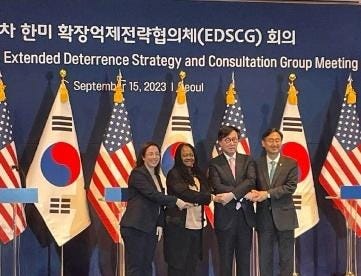
The United States has provided South Korea with extended deterrence for decades, since the two countries signed the U.S.-Republic of Korea Mutual Defense Treaty in October 1953. Since then, the U.S. has taken numerous actions to strengthen that relationship. During my time as Under Secretary of State for Arms Control and International Security, I hosted many bilateral meetings as well as the large Extended Deterrence discussions with my DoD counterpart and our South Korean counterparts
All of these efforts were not only ways to strengthen our collaboration, but were also a signal to the world, particularly to North Korea and others in the Northeast Asian region, that South Korea is within the U.S. nuclear umbrella and has U.S. protection. It was also a signal to the South Korean domestic audience that they did not have to develop their own nuclear weapons to deter North Korea, which would be more of a destabilizing force in the region.
Deterrence can be understood as a living arrangement, which is why the relationship was regularly reinforced. On the Korean Peninsula, one of those relationship builders has been combined military exercises. While in the Naval Reserves years ago, I had the opportunity to take part in one of these exercises, which were impressive in their reach and engagement of the U.S. and South Korean military. So after decades of these and other bilateral engagements, including summits between our Presidents, President Trump’s statement that the United States should substantially scale back those joint drills came out of left field, likely without consultation with South Korea, if past actions with allies are any indication.
The problem is not only the loss of the operational value of exercises, though that matters a great deal, but the symbolism that accompanies them. Exercises rehearse the integration of capabilities and deterrence and reinforce U.S. commitment. When American and South Korean forces integrate command-and-control, maneuver side by side, and iterate complex scenarios, they demonstrate two things at once: readiness to fight if necessary and political resolve to do so together. For a long time, North Korea has treated these drills as bargaining chips it wants ended precisely because the exercises have been threatening to them.
Unilateral downgrades also retard alliance dynamics. Extended deterrence works because the ally under threat believes the guarantor is both capable and willing to be transparent to them about intent and decisions. Their security is impacted when relevant decisions are made. The minute that willingness appears conditional, subject to a leader’s personal grievances or transactional demands unrelated to the shared threat, the psychological architecture of deterrence starts to erode. In South Korea, where public debates about indigenous nuclear options often surface whenever U.S. commitment seems uncertain and when North Korea takes aggressive actions, mixed signals from Washington can push domestic discourse in an unfavorable direction for nuclear nonproliferation. Relations have already been strained during this administration as a result of tariff issues and the treatment of South Korean workers in Georgia, not to mention the withdrawal of U.S. interceptors and radar components in support of the U.S. war in Iran.
The consequences of muddled signaling are not theoretical. They manifest in unpredictable ways. For example, North Korea’s response, publicly dismissing the notion that scaled-back drills reduce the “provocative” nature of U.S.-ROK activities and then launching short-range ballistic missiles, was probably not on the President’s radar. Trump indicated a future meeting with President Kim Jong Un; however, North Korea instead took note of what appears to be a lack of strategy and took advantage of the situation by embarrassing the President, saying the country has no plans to meet with Trump. Meanwhile, South Korean officials met with Chinese officials, and in those discussions, Beijing pressed South Korea to pursue “strategic autonomy” and avoid taking sides.
Praising Kim Jong Un and calling him “respectful” while criticizing allies and long-time engagements invites confusion that undermines deterrence. Reliability matters, and we must act and speak in ways that project consistency. That is what the U.S. has done for decades regarding our relationship with South Korea. Also, it is important to keep in mind that our deterrence must be credible not only to North Korea, but also to the South Korean public, many of whom continue to question why South Korea does not develop a nuclear weapon of its own.
Ambassador (ret.) Bonnie Jenkins is currently the Shapiro Visiting Professor of International Affairs at the Elliot School of International Affairs at George Washington University. She is also Founder and Executive Director of Women of Color Advancing Peace and Security (WCAPS). Jenkins served as the Under Secretary of State for Arms Control and International Security. From 2009 – 2017, Jenkins served as Special Envoy and Coordinator for Threat Reduction Programs in the Bureau of International Security and Nonproliferation with the rank of Ambassador. She is a member of The Steady State.
Founded in 2016, The Steady State is a nonprofit 501(c)(4) organization of more than 400 former senior national security professionals. Our membership includes former officials from the CIA, FBI, Department of State, Department of Defense, and Department of Homeland Security. Drawing on deep expertise across national security disciplines, including intelligence, diplomacy, military affairs, and law, we advocate for constitutional democracy, the rule of law, and the preservation of America’s national security institutions.
Powered by WPeMatico